The Solow model gave us a powerful result: saving can build capital and make an economy richer. But it left one crucial engine outside the model. Technology grew at a rate we simply assumed. Where did the better machines, new medicines, improved software, and more efficient ways of organizing work come from?
Endogenous-growth theory asks us to bring that engine inside. It studies how investment decisions, education, research, and the production of ideas can generate productivity growth. The word endogenous means the source of growth is explained within the model, rather than entered as an unexplained trend. No single model captures every channel; we will start with a deliberately spare equation and then see what it leaves out.
The AK model: a different return to capital
In the basic Solow model, adding more physical capital to a fixed amount of effective labor eventually yields smaller and smaller gains. That diminishing return pulls the economy toward a steady state. To see how a model can instead sustain growth, begin with a stripped-down AK model:
where is reproducible capital and is a constant productivity parameter. For now, think of capital broadly: it may include physical equipment and, in richer models, human capital or knowledge that helps make other capital more productive. With labor , output per worker is and capital per worker is , so
There is no diminishing return to aggregate reproducible capital in this equation. Doubling capital doubles output, even when the economy is already rich. That assumption is strong; it is the mechanism that makes persistent growth possible without an externally growing technology term.
Let a constant fraction of output be invested, let capital depreciate at rate , and let labor grow at rate . In continuous time,
Since , its change per worker is
Substitute :
Divide by to get the growth rate:
Because with constant , output per worker grows at the same rate. If investment is large enough to cover depreciation and the dilution from a growing workforce, , capital and output per worker grow continuously. A higher saving rate can permanently raise that growth rate in this model—unlike in the basic Solow model, where diminishing returns eventually make the effect fade.
That contrast is the point, not a claim that the AK equation is a complete description of any particular country. If every additional machine really produced the same lasting increase in output, the model would predict explosive paths unless something else changed. We need an account of why returns might remain high, and why firms and workers would keep creating valuable new capital.
Ideas are not ordinary goods
A steel beam is rival: if one builder uses it, another cannot use that same beam at the same time. A formula, design, or production technique is often nonrival: many people can use the same idea simultaneously. Knowledge can also spill over. One firm’s research may help suppliers, competitors, workers who change jobs, and future researchers.
But ideas are not always freely available. A patent, trade secret, copyright, or lead-time advantage can make knowledge partly excludable. This creates a tension. If inventors cannot earn any return, firms may invest too little in costly and uncertain research. If protection is too strong or lasts too long, society may face high prices, limited access, or barriers to follow-on innovation.
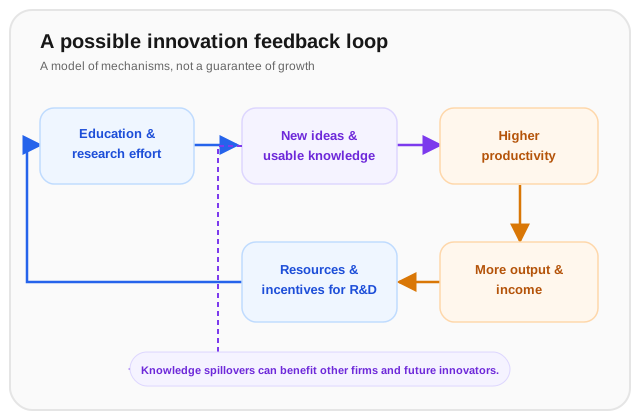
The private return to an invention is the benefit its owner can capture. The social return includes benefits to everyone who can use or build on the knowledge. When social returns exceed private returns, a market may fund less research than would maximize total welfare. This is one reason governments support basic research, universities, grants, prizes, or carefully designed intellectual-property systems. It is not proof that every subsidy or patent is well designed: public agencies face information problems too, and researchers can pursue projects with low social value.
From research effort to idea growth
One way to represent the idea-production process is
where is the stock of usable knowledge, is the labor devoted to research, and measures how productive that research effort is. This simplified equation says that new ideas depend both on people doing research and on the ideas already available to help them work. Its implied growth rate is
This is a useful picture of a feedback: existing knowledge makes research more productive; successful research adds to the knowledge base. It is not a universal law. Some models assume that discovering the next idea becomes harder, so may appear with an exponent below one. Others emphasize education, learning by doing, competition, or the movement of skilled workers across firms.
Research also uses scarce resources. A scientist working on a new battery is not simultaneously designing a medical treatment. Firms compare expected returns, costs, and risks; workers choose education and occupations; governments shape the environment through funding, regulation, procurement, and intellectual-property rules. An endogenous-growth model tries to explain these choices and their consequences, not simply rename the technology trend.
Human capital and knowledge spillovers
Skills are another channel. Education and training can raise a worker’s own productivity, but the benefit may extend beyond that worker: coworkers learn, firms reorganize production, and new ideas become easier to understand and improve. If these wider effects are substantial, the return to education for society can exceed the wage increase captured by one student.
This connects growth theory to familiar economic choices. A person weighs tuition, time, and foregone earnings against expected benefits. A firm weighs training costs against the chance that a trained worker leaves. A society asks whether private decisions add up to enough education and research given spillovers and unequal access. Each question involves evidence and institutions; the model does not make the answers automatic.
What these models explain—and what they do not
Endogenous-growth models show how a sustained rise in output per worker can emerge from investment, knowledge creation, or human-capital accumulation rather than from a technology-growth rate inserted from outside. In the simple AK model, the mechanism is constant returns to broad capital. In idea-based models, it is the creation and reuse of knowledge, shaped by research incentives and spillovers.
The mechanisms have different implications. A higher saving rate in the AK model can raise the growth rate indefinitely; in the basic Solow model it mainly raises the steady-state level. Research models can connect innovation to the number and productivity of researchers, but some early formulations implied that larger populations would always grow faster. That strong scale effect is not a universal empirical law, and later models modify the idea-production process to avoid it.
Nor does endogenous growth mean growth is limitless or guaranteed. Natural resources, environmental costs, market power, education quality, political institutions, financial constraints, and the direction of innovation all matter. More research spending does not ensure socially useful discoveries; a patent can encourage invention and restrict access at the same time. The models help us make those trade-offs explicit and ask what evidence could distinguish competing explanations.
Worked example
In a simple AK economy, output per worker is , with per year. The saving rate is , depreciation is per year, and labor grows at per year. Find the long-run growth rate of output per worker. If the saving rate rises to 0.30, what does this model predict—and what important assumption makes the result different from Solow?
Step 1 — write the AK growth equation.
Step 2 — substitute the first saving rate.
Output per worker grows at 5% per year in this simplified model.
Step 3 — raise saving to 0.30.
The model predicts a permanently higher 7% growth rate, as long as the parameters remain constant. The key assumption is that broad reproducible capital has a constant return: additional capital does not face diminishing returns at the aggregate level. In the basic Solow model, diminishing returns make a higher saving rate raise the long-run level rather than the long-run growth rate.
Where this leads
We have now replaced Solow’s unexplained technology trend with candidate mechanisms: reproducible capital, research, ideas, and skills. The next step is to make households’ saving and consumption choices explicit over time, then study how those choices interact with firms’ investment and research. That leads toward dynamic optimization and the research-level models of growth and innovation.