Imagine two economies with similar workers, institutions, and technology. One saves a larger share of its output and builds more factories, tools, and infrastructure. It may become richer per person. But does saving more make it grow faster forever—or does the advantage eventually fade? To answer that, we need a model where capital accumulates, wears out, and is spread across a changing workforce.
The Solow growth model is a compact way to study that problem. It shows how saving can raise the level of output per person, why diminishing returns create a steady state, and why sustained growth in output per worker requires technological progress in the model. It is a framework, not a complete account of why technology advances or why countries differ.
Put capital and technology on comparable terms
Let be the economy’s stock of physical capital, such as machines and structures; let be labor; and let represent the efficiency of labor, which stands for technology and knowledge embodied in production. Output is produced according to
The term is effective labor: the number of workers adjusted for how productive each worker is. Assume the production function has constant returns to scale, so doubling both capital and effective labor doubles output. We can then express output per effective worker as a function of capital per effective worker:
For a concrete example, a Cobb–Douglas production function is
which becomes . The condition gives diminishing marginal returns to capital: adding a machine helps, but with effective labor fixed, each additional machine adds less output than the previous one.
How capital changes over time
Suppose a constant fraction of output is saved and invested, and capital depreciates at rate . In continuous time, aggregate capital evolves as
Investment adds to the capital stock; depreciation wears part of it out. But can change even if does not, because the workforce and its productivity may grow. Let labor grow at rate and technology at rate :
Differentiate . Its growth rate is the growth rate of capital minus the growth rate of effective labor, so
Substituting the capital-accumulation equation and dividing by gives the central Solow equation:
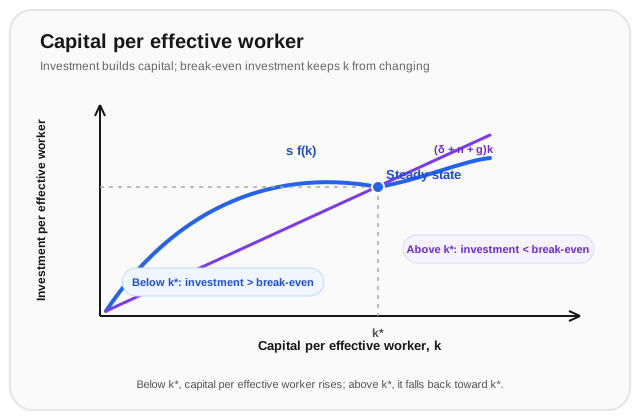
The first term, , is investment per effective worker. The second term is break-even investment: the amount needed to replace depreciated capital and equip the growing number of effective workers. If investment is larger, rises. If it is smaller, falls.
The steady state
A steady state for capital per effective worker occurs when :
The left side is investment; the right side is break-even investment. If the economy starts below , investment exceeds break-even investment and capital per effective worker increases. If it starts above , depreciation and the growth of effective labor dominate, so declines. With a concave production function, these forces tend to move the economy toward the intersection.
This steady state does not mean that the economy stops producing or that total capital is frozen. It means capital and output per effective worker are constant. If technology and labor continue to grow, the economy can keep accumulating total capital and producing more total output while maintaining the same and .
What a higher saving rate does—and does not do
Raise and, at every given level of , more output is invested. The curve moves upward, so the new steady state has more capital and output per effective worker. During the transition, output per worker can grow faster as the economy builds toward that higher level.
But diminishing returns matter. As capital per effective worker rises, the extra output from another unit of capital gets smaller. The economy approaches the new steady state, and the temporary growth acceleration fades. In the basic model, a higher saving rate changes the level of long-run output per worker; it does not permanently raise its growth rate.
To see where sustained growth comes from, return to the units. At the steady state, output per effective worker is constant. Output per ordinary worker is
If technology grows at , output per worker therefore grows at along the balanced-growth path. With labor growing at , total output grows at . If , the basic Solow model predicts that growth in output per worker eventually stops, even though total output may rise as the population grows. The model takes technological progress as given; it does not explain where new ideas come from.
Saving, consumption, and the Golden Rule
More capital is not automatically better for living standards. Saving means consuming less now in exchange for more productive capacity later. At a steady state, consumption per effective worker is output minus the investment needed to maintain :
The Golden Rule capital stock maximizes this steady-state consumption. At an interior maximum, differentiate with respect to :
The marginal product of capital must equal the amount of investment needed to keep that capital in place as it depreciates and effective labor grows. If an economy has less capital than the Golden Rule level, more saving can raise both future output and steady-state consumption. If it has more, the extra output from additional capital is smaller than the resources needed to maintain it; reducing saving can increase sustainable consumption. The Golden Rule is a model benchmark, not a claim that a government can identify a perfect saving rate without uncertainty or distributional trade-offs.
Convergence is conditional
The model gives a precise version of a tempting idea: poorer economies should grow faster because they have less capital and therefore higher marginal returns to new capital. That prediction applies conditional on economies sharing the relevant fundamentals—such as saving behavior, population growth, depreciation, institutions, and access to technology. Two countries with different fundamentals need not converge to the same income per person.
Even with similar fundamentals, the model predicts a transition toward a common steady state, not an automatic catch-up clock. Shocks, conflict, policy, education, health, institutions, and access to ideas can alter the path. The model helps us state what would have to be similar before comparing growth rates; it does not let us infer the cause of a country’s growth from income data alone.
Worked example
Suppose output per effective worker follows , the saving rate is , and break-even investment is . Find the steady-state capital and output per effective worker. Then raise the saving rate to 0.30 and calculate the new steady state. Does the higher saving rate permanently raise the growth rate of output per worker if technology growth remains zero?
Step 1 — set investment equal to break-even investment. With , the steady-state condition is
For a positive steady state, divide by :
Step 2 — calculate the first steady state. With ,
Step 3 — calculate the new steady state. With ,
The higher saving rate leads to a higher steady-state level of capital and output per effective worker. Under the second steady state, consumption per effective worker is ; the saving rate does not simply translate one-for-one into consumption.
Step 4 — separate level from growth. If technology growth is zero, then output per worker is constant once either steady state is reached. The higher saving rate can create a period of faster growth while the economy transitions from toward , but it does not permanently raise the long-run growth rate in this model.
Where this leads
The Solow model turns the saving–investment relationship into a theory of capital accumulation, steady states, and conditional convergence. It also draws a boundary: sustained growth in output per worker depends on technological progress, which the basic model treats as external. The next layer of growth theory asks how ideas, research, skills, and incentives can make productivity grow endogenously rather than arriving from outside the model.