Here's a question that sounds too simple to be worth asking: how fast is a falling ball going?
You might say: measure how far it falls in one second, and that's your answer. Fair enough. But now ask a harder version of the same question: how fast is it going right now, at this exact instant, as it passes your hand? "How far did it fall in one second" doesn't answer that — a lot can happen in a second. The ball starts slow and speeds up as it falls, so "one second" smears together a whole range of different speeds into a single, blurry number.
This turns out to be one of those questions that looks trivial and is actually the reason calculus exists. So let's take it seriously.
Position: the thing we're actually tracking
Everything starts with position — where an object is, measured relative to some reference point you get to choose (the "origin"). In one dimension we call it , in meters. Position by itself is not motion. A parked car has a position. A car stopped at a red light has a position. What we actually care about is how that position changes — and it's in the word "changes" that all the interesting physics is hiding.
Average velocity: our first, imperfect attempt
The obvious first move is to look at two moments in time and see how much the position changed between them:
This is the average velocity over the interval . It's genuinely useful — it's exactly what "60 km/h" means on a road trip, total distance over total time. But notice the word average. It quietly admits defeat on the harder question. It tells you nothing about whether the object was speeding up, slowing down, or holding steady within that interval. Our falling ball again: over the first second, its average velocity might come out to 4.9 m/s — but it was moving slower than that at the start and faster than that at the end. No single instant during that second was actually 4.9 m/s.
The trick: shrink the interval
So here's the idea, and it's a genuinely clever one: what if we just... make smaller? Instead of asking "how fast, on average, over one second," ask "how fast, on average, over one-tenth of a second." Then a hundredth. Then a millionth. At each step, the average velocity we compute gets closer to describing the motion at that specific moment — because there's less and less time for the speed to change during the interval.
Look at the figure below. and are two moments on a position-vs-time curve, connected by a straight secant line whose slope is the average velocity between them. Now imagine sliding back toward . The secant line rotates as it goes — and in the limit where merges into , it settles into the tangent line at that single point.
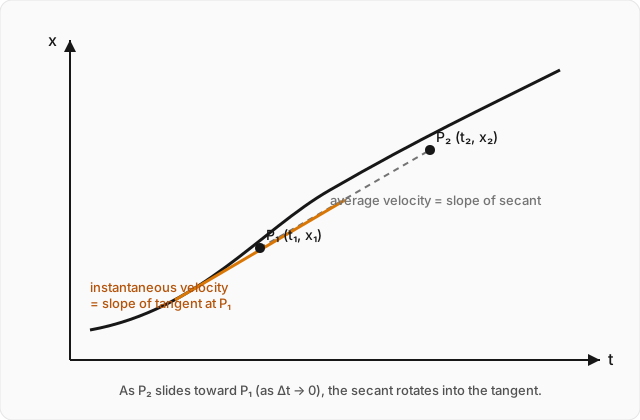
That limiting slope — the slope of the tangent line — is the instantaneous velocity. It's exactly what your speedometer shows you at any given moment. In the language of calculus, this limiting process has a name: it's the derivative of position with respect to time.
If that notation is new to you, don't let it intimidate you — it says nothing more than what we just built up to with the sliding-point picture. is the tangent slope. That's the whole idea, dressed in more compact clothing. We'll be leaning on this notation for the rest of this track, because it turns out to be far more powerful than it looks here.
One more detail worth being precise about: velocity is a vector, meaning it carries a direction as well as a size. "20 m/s east" and "20 m/s west" are different velocities, even though they'd register the same reading — the same speed — on a speedometer. Speed is just the size of the velocity, stripped of its direction.
Acceleration: apply the same trick again
Nothing stops us from asking the identical question one level up: how is velocity changing? Run through the exact same limiting argument — secant becomes tangent, average becomes instantaneous — but on a velocity-vs-time graph instead of a position-vs-time graph, and you get acceleration:
This is the idea that trips people up most, so it's worth being blunt about it: acceleration is not "how fast something is going." It's how fast the going is changing. A car cruising at a rock-steady 100 km/h on a straight highway has zero acceleration, full stop, no matter how large its velocity is. A car crawling out of a parking space at walking pace, but speeding up, has a real, nonzero acceleration — even though its velocity is tiny.
Putting it back together: constant acceleration
Calculus gave us the precise definitions. Now here's the payoff for the common case where acceleration doesn't change — free fall, braking, anything with a steady push. Starting from position and velocity at time zero, under constant acceleration :
These two equations are the workhorses of every introductory mechanics problem you'll meet. They're not new physics beyond what we've already built — they're just what falls out of "acceleration is constant" once you undo the derivatives.
Worked example
A ball is dropped from rest and hits the ground 2.0 seconds later. How fast is it moving at impact, and how far did it fall? (click to reveal the solution)
Setting up: "Dropped from rest" means . Near Earth's surface, gravity gives every falling object a constant acceleration , directed downward. We'll measure as distance fallen, so too.
Velocity at impact, using :
Distance fallen, using :
So the ball is falling at 19.6 m/s (about 70 km/h) when it lands, having fallen 19.6 m — a little taller than a five-story building. Notice that we never once had to ask "what was its speed after one second, versus after two" as separate case-by-case measurements. The equations already encode the entire motion; we just plug in the moment we care about.
Why this matters
Every topic that follows leans on these three quantities and, more specifically, on the derivative relationship between them: acceleration is the rate of change of velocity, which is the rate of change of position. Newton's laws, which come next, are really just a statement about what causes to be what it is. Once the sliding-secant picture feels natural to you — once stops looking like notation and starts looking like "the slope of that tangent line" — the rest of mechanics is just asking, again and again, in more and more interesting situations: what makes what it is?