In the previous topic, we built a precise vocabulary for describing motion: position, velocity, acceleration, tied together by that sliding-secant-into-tangent picture. But description was always the easy half of the problem. Now comes the question that actually matters to anyone who's ever pushed a stalled car, or wondered why a spacecraft can coast for years with its engines off: what causes acceleration in the first place?
This is where Isaac Newton comes in, and where mechanics stops being geometry and starts being physics.
The First Law: an idea that fought two thousand years of common sense
An object at rest stays at rest, and an object in motion stays in motion at constant velocity, unless acted on by a net external force.
Before you nod along, notice how strange this actually is. Watch anything move across your desk — a book, a coin — and it slows down and stops on its own, with no force visibly acting to stop it. For nearly two thousand years, the reasonable-sounding conclusion (Aristotle's, among others) was that motion itself requires a continuous push to sustain it, and that "no push" naturally means "come to rest."
Newton's first law says this is backwards. The coin doesn't stop because motion needs upkeep. It stops because friction — an actual, physical force from the desk — is acting on it the whole time, and we'd just gotten so used to friction being everywhere that we mistook "friction always wins eventually" for "rest is the natural state." Take the coin to a hockey rink, or better, to deep space, and it keeps going, unbothered, forever. No force is required to maintain velocity — only to change it.
This law is really doing something sneaky: it's defining what "no net force" means, operationally, by tying it to "no change in velocity." Keep that in mind; it's about to become the special case of something bigger.
The Second Law: the equation that runs the universe
The acceleration of an object is directly proportional to the net force acting on it, and inversely proportional to its mass.
Three symbols, and arguably more predictive power packed into them than in any other line of algebra you'll ever write. Read it exactly as it's written: force causes acceleration, not velocity. A large force produces a large acceleration; a large mass resists that same force with a smaller acceleration. This is exactly the everyday sense in which a loaded truck is "hard to get moving" and just as hard to stop — not because it resists motion, but because it resists changes in motion, in proportion to its mass.
Set in this equation and out pops — constant velocity, no change. The first law was hiding inside the second one all along, as the case where nothing is pushing.
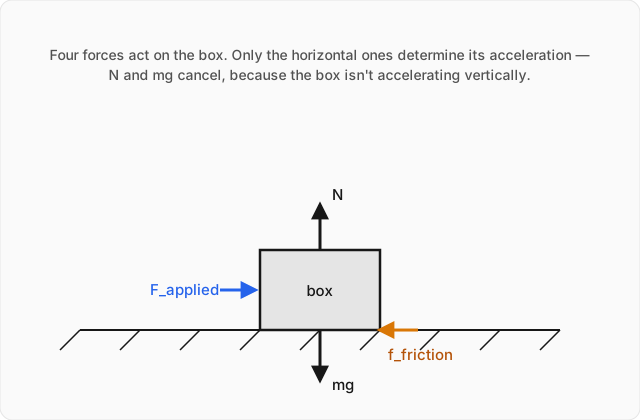
Look at the diagram below: a box being pushed across a rough floor. Four separate forces are acting on it simultaneously — an applied push, gravity, the floor pushing back up (the normal force), and friction resisting the slide. The vertical ones cancel outright, because the box isn't leaping off the floor or sinking into it. It's the leftover, horizontal imbalance between the push and the friction that Newton's second law actually cares about.
The Third Law: forces come in pairs, and they act on different things
For every action, there is an equal and opposite reaction.
Stated more carefully: if object A pushes on object B, then B pushes back on A with equal magnitude, opposite direction. The detail that trips almost everyone up the first time: these two forces act on two different objects. They never cancel each other out, because canceling only makes sense for forces acting on the same object.
Push on a wall, and the wall pushes back on you exactly as hard — that's why your hand doesn't sink through it, and also why leaning hard enough on a wall on frictionless ice will send you sliding backward. The wall's reaction force is real, and it's acting on you, not on itself.
Why three laws, and not just one
A natural question: since the second law seems to contain the most information, why bother stating three separate laws at all? Because alone is silent on two things it turns out you can't do without: what happens when there's no force (that's the first law, and it's not a trivial consequence — it's what tells you rest and constant-velocity motion are physically the same kind of state), and how objects push back on each other (the third law, without which you couldn't analyze so much as two blocks stacked on top of one another, let alone rockets, collisions, or rope tension).
Worked example
A 5.0 kg box is pushed across a floor with a horizontal force of 20 N. Friction resists the motion with a force of 6.0 N. Find the box's acceleration. (click to reveal the solution)
Setting up: Two horizontal forces act on the box: the 20 N push forward, and 6.0 N of friction acting backward, opposing the motion. Take the direction of the push as positive.
Net force:
Acceleration, from , rearranged to :
Notice what we didn't need: the normal force and gravity never entered the calculation, because they're vertical and the box isn't accelerating vertically — they cancel each other in that direction, exactly as the free-body diagram above shows. This is the recurring pattern in almost every introductory mechanics problem: draw every force, then let the ones that cancel actually cancel, and solve only what's left.
What comes next
Newton's laws hand you a direct route from force to acceleration — draw the free-body diagram, sum the forces, divide by mass. But that route gets painful fast once a force varies as an object moves, the way a stretching spring pushes back harder the more you stretch it. Computing the acceleration at every single instant of a changing force is a nightmare; it turns out there's a far smarter way to track motion in exactly this situation, one that sidesteps force entirely and works with energy instead. That's the subject of the next topic.