Suppose two countries each produce 1,000 units of output today. One has twice as many people as the other. If you ask how large each economy is, total GDP helps. If you ask what production is available per person on average, population matters too. And if you ask why output per person can keep rising for decades, we have to look beyond a temporary boom to productivity.
The previous topics focused on short-run movements—recessions, inflation, and policy responses. Long-run growth asks a different question: what allows an economy to produce more, sustainably, with the resources it has? The answer is not simply “work harder” or “buy more machines.” It involves how effectively people combine labor, skills, capital, ideas, and institutions.
Total output, output per person, and productivity
Real GDP measures the inflation-adjusted value of domestic production. Total real GDP can rise because a country has more people working, more hours worked, more productive workers, or some combination. Real GDP per person divides total real GDP by population. It is a rough average, not a description of a typical household or of how output is distributed.
Labor productivity measures output relative to labor input—often output per worker or output per hour. These measures are not identical: a country can produce more per worker partly because workers work longer hours, while output per hour asks about production for each hour of labor. Productivity is about output, not how hard a person appears to be working.
As a rough approximation for modest growth rates,
If total real GDP grows 3% while population grows 4%, output per person falls by about 1%. A growing economy in total can therefore still have declining average output per person. The exact rate uses the ratio of the two growth factors rather than simple subtraction, but the approximation is often useful.
What helps productivity grow?
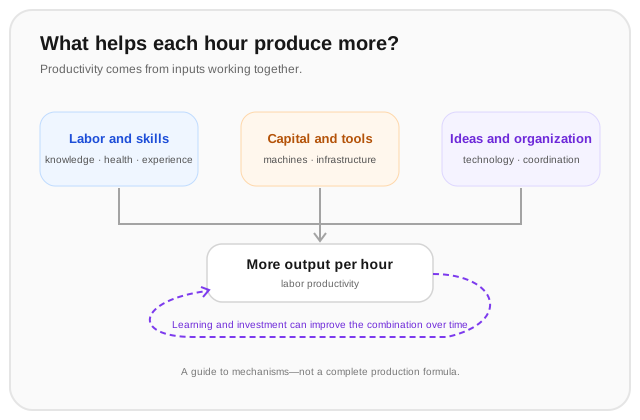
Several forces can raise how much output is produced per hour or per worker:
- Physical capital: tools, machinery, buildings, transport, and digital infrastructure that help workers produce.
- Human capital: knowledge, skills, experience, and health that affect what people can do.
- Technology and ideas: new products, processes, scientific knowledge, and methods of organizing production.
- Institutions and coordination: rules, trust, competition, infrastructure, and organizations that help people invest, exchange, and combine resources.
These inputs complement one another. A sophisticated machine may not raise output much without trained workers, reliable electricity, maintenance, and a process that uses it well. Education can be more productive when people have tools and opportunities to apply what they know. There is no single recipe that guarantees growth in every place.
Adding capital can raise output, but many models feature diminishing returns: with other inputs unchanged, each additional machine may add less output than the one before. That is one reason sustained gains in living standards cannot be explained by endlessly adding the same type of capital alone. Better methods, skills, health, and ideas can change what existing resources make possible.
Compounding makes small growth rates matter
Growth compounds. If output per person grows by 2% in one year, the next year’s 2% increase applies to a slightly larger base. For a rough doubling-time estimate, economists often use the rule of 70:
At 2% annual growth, the rough estimate is 35 years. This is a mathematical illustration, not a promise about the future. Growth rates change, and a long-run average can hide recessions, booms, and shifts in population.
Compounding also helps explain why differences in long-run growth rates can accumulate into large differences in average production. But it does not tell us who receives the gains, whether the environment can sustain the production path, or whether a higher average corresponds to better health, leisure, security, or freedom. Those require additional measures and judgments.
Growth is not the business cycle
An economy can be in recession while still having higher output than it had decades ago. A recession is a short-run decline in activity; long-run growth is a change in productive capacity over time. Actual output may move around potential output while the potential path itself rises, flattens, or falls.
This distinction matters for policy. Measures that support spending during a downturn may help close a negative output gap, but they do not automatically improve productivity. Investments in education, infrastructure, research, health, or institutions may affect productive capacity, but their results can take years and depend on design. The same policy can influence both demand in the short run and capacity over the longer run, but those channels should not be conflated.
Nor is GDP per person a complete welfare measure. Average output can increase while gains are unevenly distributed; unpaid care, environmental costs, leisure, and many dimensions of health are not fully represented. Growth is an important question because resources and choices matter—not because one number settles every question about a good society.
Worked example
An economy’s real GDP per person is 40,000 units this year. If it grows at 2% per year for five years, what is the approximate level after five years? About how long would it take to double at that constant rate, and why should neither calculation be treated as a forecast?
Step 1 — compound the growth rate.
At a constant 2% rate, real GDP per person would be about 44,200 units after five years, roughly 10.4% higher—not exactly 10%, because the increases compound.
Step 2 — estimate doubling time.
The rule of 70 suggests about 35 years for a doubling if 2% growth continued.
Step 3 — interpret the assumptions. The calculation assumes the same growth rate every year and comparable measurement. Actual productivity, population, and economic conditions change. It illustrates compounding; it does not predict that this economy will follow the path.
Where this leads
We now have a coherent introductory macroeconomic map: measure output, prices, and work; explain short-run fluctuations with aggregate demand and supply; follow monetary and fiscal responses; and distinguish stabilization from long-run growth. That is a good first stopping point for the macro foundation. Further depth should build from here into open-economy macroeconomics, inflation expectations, and formal growth models rather than adding disconnected definitions.