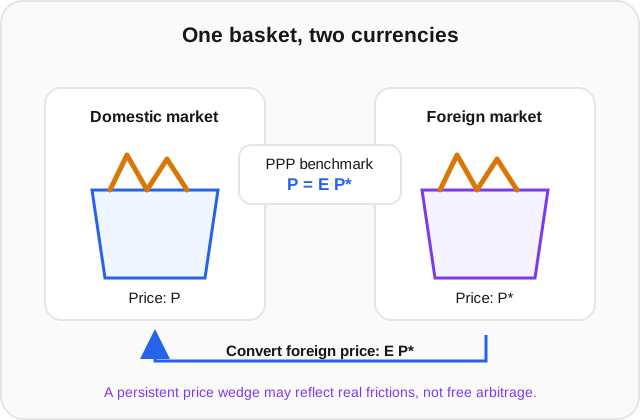
Suppose the same basic basket of goods costs 100 units of domestic currency here and 5 units of foreign currency abroad. If one foreign unit trades for 20 domestic units, the converted prices match exactly. Is that coincidence, a deep law of exchange rates, or just a useful comparison? The answer is subtler than any one of those: equal prices are a natural benchmark when arbitrage is easy, but real economies give that arbitrage plenty of reasons to be slow or incomplete.
In the previous lesson we defined as domestic currency per one unit of foreign currency, and as the foreign basket's domestic-currency price relative to the domestic basket. Purchasing-power parity (PPP) asks what exchange rate would make comparable baskets cost the same. It is a theory about a long-run anchor—not a claim that the market must sit on that anchor today.
Absolute PPP: equal baskets, equal converted prices
Let be the domestic-currency price of a comparable basket and its foreign-currency price. Converting the foreign basket into domestic currency gives . If the law of one price held for every item in the basket, the baskets were truly comparable, and there were no costs or barriers to moving goods, then
Rearranging gives the absolute-PPP exchange rate:
This has the right units: domestic currency per basket divided by foreign currency per basket leaves domestic currency per foreign currency. If domestic units and foreign units, parity gives domestic units per foreign unit.
The real exchange rate from the preceding lesson was . Substitute the absolute-PPP rate and we get
The value one is not sacred; it follows from our normalized comparison of comparable baskets. In practice, indexes may use different base years and scaling, so an observed real-exchange-rate index need not literally equal one at parity. What matters is the economic idea: comparable goods should not remain systematically cheaper in one market once conversion and trading costs are accounted for.
Relative PPP: inflation differences accumulate
Absolute PPP compares price levels at one date. Relative PPP asks how the exchange rate should move when the two price levels grow at different rates. If parity holds at both dates,
Divide the second equation by the first. Define domestic and foreign gross inflation as and :
For modest inflation rates, the percentage-change approximation is
If domestic inflation is higher, tends to rise under our quote convention: one unit of foreign currency costs more domestic currency, so the domestic currency depreciates. This is a statement about the price-level benchmark over time. It does not say a central bank can predict next month's exchange rate by subtracting two inflation forecasts.
Another way to see the benchmark is through . Under relative PPP, the nominal exchange rate adjusts just enough to offset the inflation difference, leaving approximately stable. Real exchange rates can still move substantially when relative prices, productivity, demand, or risk change.
Why the benchmark misses—and why that is useful
PPP works best as an intuition for comparable tradable goods that can be shipped and resold. Many things in a consumer basket cannot: haircuts, housing services, local transport, and much health care are non-traded. Their prices are set largely in local markets. Even for tradable goods, shipping, insurance, tariffs, taxes, regulations, and distribution costs create a band within which price differences need not be arbitraged away.
The baskets themselves pose a problem. National price indexes differ in what they include, how they weight households' purchases, how they handle quality improvements, and when they update prices. A laptop in two countries may share a model name but not a warranty, tax treatment, or retail bundle. A measured price ratio is not a laboratory comparison of identical objects.
Productivity can also move aggregate price levels in a way that looks like a persistent PPP deviation. In the Balassa–Samuelson mechanism, rapid productivity growth in tradable industries raises the wages firms can afford there. Workers can move across sectors, pushing up wages in local service industries too. If productivity in non-tradables rises less, their unit costs and prices increase. The country's overall consumer price level may rise relative to a lower-productivity economy even though its tradable sector remains competitive. The price-level gap is not simply evidence of an “overvalued” currency.
Finally, prices and exchange rates do not adjust on the same clock. Firms may set prices in advance, contracts may be sticky, and retailers may change markups rather than pass through a currency move immediately. Financial markets can reprice currencies in seconds while many goods prices move over months or years. PPP therefore gives us a long-run comparison point and a way to organize thinking; deviations are not necessarily a market mistake waiting to be corrected next week.
Worked example
The exchange rate is initially domestic units per foreign unit. Domestic prices then rise by 8%, while foreign prices rise by 3%. Under relative PPP, what exchange rate is predicted for the next period, what is the approximate depreciation rate, and what happens to ?
Step 1 — use the exact gross-inflation relation. Relative PPP gives
The benchmark is about 20.97 domestic units per foreign unit.
Step 2 — calculate the change. The exact change is
The convenient approximation is . Because rises, the domestic currency depreciates against the foreign currency under our quote convention.
Step 3 — check the real exchange rate. Let initial prices be and . At the predicted rate,
The inflation difference is exactly offset by the nominal exchange-rate movement in this benchmark, so the real rate is unchanged. That result depends on the PPP assumption; it is not a prediction that actual real exchange rates never move.
Where this leads
PPP connects exchange rates to the prices of goods. But people also choose between assets denominated in different currencies, and their returns depend on interest rates, forward contracts, expectations, and risk. The next lesson develops interest parity: one version follows from a no-arbitrage hedge, while another depends on expectations and can be distorted by risk premia.