Imagine a domestic bakery pricing a loaf at 120 units of local currency while a bakery abroad charges 4 units of foreign currency. Which loaf is cheaper? We cannot answer by comparing 120 with 4; the numbers are in different currencies. We need a conversion rate. But even after converting, inflation can change the comparison over time. A currency’s market quote and its purchasing power are connected, yet they are not the same thing.
The first open-economy lesson separated a country’s transactions from its external balance sheet. Now we need a language for the price at which one currency trades for another—and a way to compare baskets of goods across countries. The key is to choose a quote convention once and follow it carefully. Many apparent disagreements about whether a currency “rose” come from people silently using opposite conventions.
The nominal exchange rate is a price
Let denote the number of units of domestic currency needed to buy one unit of foreign currency. For example,
means one euro costs 30 units of domestic currency. Under this convention:
- If rises from 30 to 33, foreign currency costs more; the domestic currency has depreciated nominally.
- If falls from 30 to 27, foreign currency costs less; the domestic currency has appreciated nominally.
The same market price can be quoted in the opposite direction, as foreign currency per unit of domestic currency. That number is , so its movement has the opposite sign. Whenever you read “the currency rose,” ask: which currency is in the numerator, and which one unit is being priced?
A nominal exchange rate is not an index of how much a household can buy. It converts money amounts. To compare goods, we also need price levels.
From the currency quote to the real exchange rate
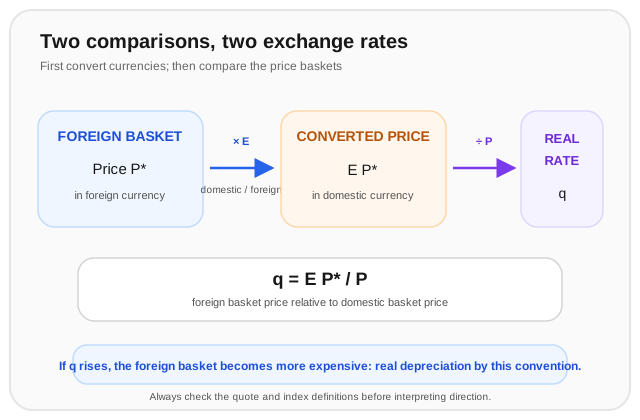
Let be the domestic-currency price of a representative domestic basket, and the foreign-currency price of a comparable foreign basket. A resident can compare the two by converting the foreign price into domestic currency:
Divide by the domestic basket price. Define the real exchange rate under our convention as
This is a relative price: how many domestic baskets’ worth of money it takes to buy one foreign basket. If rises, the foreign basket has become more expensive relative to the domestic basket. Under this definition, that is a real depreciation of the domestic currency; if falls, it is a real appreciation.
This direction follows from the formula, not from a universal rule about which way every published index must move. Some statistical agencies define the real exchange rate as , the reciprocal of ours. Their appreciation index rises where our falls. Both can be internally consistent. Always check the formula and the label.
Inflation can move the real rate even when the quote barely moves
Take growth rates of the definition . For small percentage changes, the change in a ratio is approximately the changes in its numerator minus the change in its denominator:
where is foreign inflation and domestic inflation. In discrete time, the exact relationship for gross changes is
Suppose the nominal quote is fixed. If domestic prices rise faster than foreign prices, grows faster than , so falls. Under our convention, the domestic basket becomes more expensive relative to the foreign basket: the real exchange rate appreciates even though the nominal exchange rate did not move.
Conversely, a nominal depreciation can be partly or wholly offset by faster domestic inflation. That is why a headline nominal exchange-rate movement does not by itself tell us whether domestic goods became cheaper relative to foreign goods. We need the exchange-rate quote and price developments on both sides.
Bilateral and effective rates
A bilateral exchange rate compares two currencies, such as domestic currency and the euro. It is the right measure for a particular payment or bilateral relationship. But a country may trade with many partners, whose currencies can move in different directions. A single bilateral rate can therefore give an incomplete picture of its overall exposure.
A nominal effective exchange rate combines bilateral rates into a trade-weighted index. If is domestic currency per unit of partner ’s currency and is that partner’s weight, one possible index is a weighted geometric average:
The geometric form makes percentage changes approximately a weighted average of the bilateral percentage changes. A partner with a larger trade weight contributes more to the index. The exact weights can be based on imports, exports, or broader competition measures, so different institutions may publish different effective indexes.
To include prices, let be a weighted partner price index and the domestic index. A corresponding real effective exchange-rate measure under our convention is
An increase means foreign goods have become more expensive relative to domestic goods under this definition. A real effective index is useful for summarizing broad price competitiveness, but it is not a direct measure of productivity, quality, shipping costs, tariffs, or what every household experiences. Nor is it automatically the “correct” value of a currency.
Competitiveness is not the same as the trade balance
When rises under our convention, domestic goods become cheaper relative to foreign goods in the comparison above. That can encourage exports and discourage imports, all else equal. But “all else equal” does a lot of work. The effect depends on how strongly buyers and sellers respond to relative prices, whether firms can change production, how much imported input costs rise, and whether contracts are fixed in advance.
A depreciation also raises the domestic-currency cost of imports. That may feed into consumer prices and firms’ production costs. Quantities may adjust only after a delay, so the value of imports can initially rise even if people eventually buy fewer imported goods. A real depreciation is therefore not a mechanical guarantee of an improving current account. The balance-of-payments accounts tell us how transactions add up; exchange-rate measures tell us how relative prices move. A causal model is needed to connect the two.
Worked example
A comparable domestic basket costs 1,200 local units and a foreign basket costs 100 euros. The exchange rate is 30 local units per euro. Later, the exchange rate rises to 33, domestic prices rise by 5%, and the foreign basket’s euro price is unchanged. Calculate the initial and later real exchange rates using . Did the domestic currency appreciate or depreciate in nominal and real terms?
Step 1 — calculate the initial real exchange rate. Convert the foreign basket into local currency:
Compare that with the domestic basket:
The foreign basket costs 2.5 times as much as the domestic basket in the price comparison used here.
Step 2 — update the prices. The new nominal rate is . Domestic prices rise by 5%, so
Step 3 — calculate the new real rate.
The real exchange rate rose from 2.5 to about 2.619, an increase of roughly
The nominal quote rose by 10%, so the domestic currency depreciated nominally. After the 5% rise in domestic prices, it also depreciated in real terms under our convention, but by about 4.8%, not 10%. Domestic inflation absorbed part of the nominal movement.
Where this leads
We now have a consistent way to read a currency quote and compare price baskets across borders. The next lesson asks whether price differences should disappear over time: purchasing-power parity gives a benchmark for long-run exchange rates, while also showing why non-traded goods, transport costs, and slow price adjustment can keep actual currencies away from that benchmark. After that, interest parity will connect exchange rates to financial returns and expectations.