On September 23, 1999, a spacecraft called the Mars Climate Orbiter fired its engine to slip into orbit around Mars, and then it was simply gone. NASA had spent $327 million building it. The investigation that followed didn't find a flaw in the physics, or a bug in the rocket engine, or a miscalculated orbit in the usual sense. It found something almost embarrassing: one team of engineers had written their software to output thrust data in pound-force-seconds, a unit from the old imperial system. Another team's software read that number in and treated it as if it were newton-seconds, the metric unit for the same kind of quantity. Nobody caught the mismatch. The spacecraft's trajectory was nudged, quietly and consistently, by a factor of about 4.45 — the conversion factor between the two units that nobody applied — until it dipped far too close to the Martian atmosphere and was destroyed.
That story is worth sitting with, because it's easy to treat "units" as the most tedious part of a physics course — the part where you get docked half a point for forgetting to write "m/s" next to a number. The Mars Climate Orbiter shows the opposite. A number without its unit isn't a physical quantity at all; it's just a number, floating free of any claim about the world, and two teams can silently disagree about what it means while agreeing completely about the digits. Getting units right isn't bookkeeping bolted onto physics. It's part of what it means for an equation to say anything true.
The base units: what everything else is built from
Physics needs to measure a handful of fundamentally different kinds of thing — how much space, how much time, how much stuff — and it turns out that once you fix a standard for a small set of these, every other physical quantity you'll ever need can be built out of them by multiplication and division. The International System of Units (SI) settles on seven base units; three will carry almost the entire weight of this track:
- length, measured in meters (m)
- time, measured in seconds (s)
- mass, measured in kilograms (kg)
(The other four — ampere for current, kelvin for temperature, mole for amount of substance, candela for luminous intensity — will matter later, and current gets its own treatment in this track soon.) Every other unit you'll meet is a combination of these. Speed is meters per second, m/s. Acceleration is meters per second per second, m/s². Force, as Newton's laws will show, works out to kg·m/s², a combination so common it gets its own name, the newton (N). Nothing mysterious is happening when a unit gets a special name — a newton is a kg·m/s², the same way a dozen is twelve; the name is a convenience, not a new ingredient.
This gives every physical quantity a dimension — the specific combination of length (), time (), and mass () it's built from, independent of which actual units (meters versus feet, seconds versus hours) you happen to be using. Velocity has dimension whether you measure it in m/s or miles per hour; the dimension is a statement about the kind of quantity it is, and the unit is a choice of ruler for measuring it. That distinction is exactly what the Mars Climate Orbiter's two teams got right and wrong at the same time: both teams agreed the quantity in question had dimensions of force — mass times length over time squared — and disagreed, fatally, about which unit to report it in.
Dimensional analysis: a truth serum for equations
Here's what makes tracking dimensions worth the trouble beyond just correctness: it hands you a fast, purely mechanical way to check whether an equation could possibly be right, before you even get to whether it actually is. The rule is simple to state:
Every term added or subtracted in a physical equation must carry the same dimensions. And the two sides of an equals sign must carry the same dimensions.
You cannot add a length to a time any more than you can add three apples to five hours and get a sensible answer — the operation doesn't even parse. So if you ever derive an equation and find yourself with, say, (dimensions of added to ), you don't need to hunt for the arithmetic mistake by rechecking every line — you already know, instantly, that something is wrong, because the dimensions on the two added terms don't match. This won't catch every error (a stray factor of 2, or a that should have been , is dimensionless and sails right through), but it catches an enormous and embarrassingly common class of mistakes for almost no effort. Treat it as a habit: after deriving any equation, check the dimensions on both sides before trusting the algebra.
The same idea, run in reverse, becomes something much more powerful than error-checking — a way to guess the shape of an unknown physical law using nothing but a list of what it could plausibly depend on. That's the real content of this topic, and it deserves a full worked example rather than a quick mention.
Order-of-magnitude estimation
A close cousin of dimensional analysis is the art of the order-of-magnitude estimate: getting an answer's power of ten right — is it 1, or 100, or 10,000? — without pretending to know its exact digits. Physicists sometimes call this a "Fermi estimate," after Enrico Fermi's famous habit of estimating wildly unfamiliar quantities (how many piano tuners are there in Chicago?) by breaking them into a chain of individually plausible guesses and multiplying them together. The errors in each individual guess tend to partially cancel rather than compound, and the result lands surprisingly close to the truth far more often than it has any right to. The skill matters here for a practical reason: once you've derived an equation and checked its dimensions, a quick order-of-magnitude estimate is often the fastest possible sanity check on the final number — if a calculation for a ball's fall time spits out seconds, you don't need to recheck the algebra to know something went wrong; that's over an hour for something you can watch hit the ground in a couple of seconds.
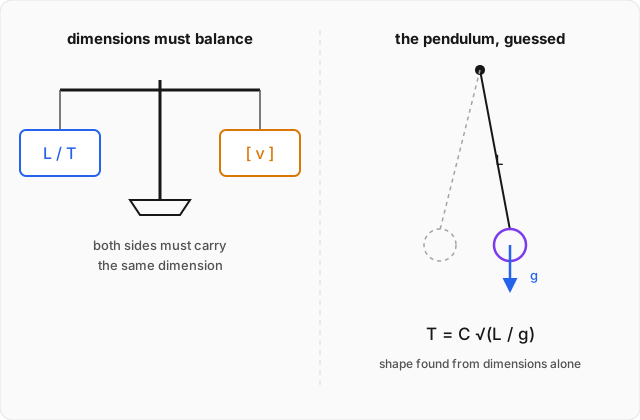
Worked example
A small mass swings on a pendulum of length near a planet with gravitational acceleration . Using only dimensional analysis, find how the period of the swing depends on , , and — up to an unknown dimensionless constant. (click to reveal the solution)
Setting up: we don't yet have the tools (that's Newton's laws and, later, the full swing equation) to derive the pendulum's motion from a force law. But we can still ask a more modest question: given that the period presumably depends on some combination of , , and — the only three quantities in the problem — what combination is even dimensionally possible? Propose the most general product form:
where is some dimensionless number (no units at all) that dimensional analysis alone can never pin down, and , , are exponents to be determined.
Writing down the dimensions of every quantity involved. Period has dimension of time: . Mass: . Length: . Gravitational acceleration is a length per time squared (it's an acceleration, same dimension as any other): .
Substituting into the proposed formula and collecting dimensions on the right-hand side:
Matching exponents on both sides, one dimension at a time, since , , and are independent — a power of can never be produced by any combination of 's and 's, so each dimension's exponent must match separately.
Left side is . Right side is . Matching each:
Assembling the result:
Interpreting the result: two things fall out of this, and both are genuinely striking for how little work went into them. First, — the mass simply cannot appear, at any power, without breaking the dimensional balance, since nothing else in the problem carries a factor of mass to cancel it against. The period of a pendulum cannot depend on how heavy the bob is, a fact you would otherwise have needed real dynamics to discover. Second, the period must scale as — longer pendulums swing slower, and the same pendulum swings slower on a planet with weaker gravity, both by a square-root relationship, not a linear one.
What dimensional analysis cannot tell you is the constant — it could be , or , or anything else dimensionless, and no amount of unit-counting will reveal which. That requires the actual dynamics: setting up for the pendulum and solving the resulting equation of motion, which is exactly what happens later in this track, in simple harmonic motion. There, the small-angle pendulum equation is solved in full and gives — matching this result exactly, with the mysterious constant revealed to be . It's worth appreciating how much was won here for so little cost: a two-line argument about dimensions anticipated the entire functional shape of a result that otherwise takes a real differential equation to derive.
Where this leads
Every quantity this track is about to define — velocity, acceleration, force, energy, charge, field — comes with a dimension, and every equation relating them is a claim that those dimensions balance. Getting comfortable with that bookkeeping now means that, from here on, a wrong-looking equation will often announce itself before you've even finished checking the algebra. The next topic picks up the very quantities this one has been gesturing at in the abstract — position, velocity, and acceleration — and asks the question this track has been building toward since the Mars Climate Orbiter: not just what units they're measured in, but what they actually are. That's kinematic quantities, the true first step into mechanics.