A domestic bank has borrowed dollars for three months and lent local currency for five years. The exchange rate is stable, and the bank’s borrowers appear able to repay over time. Then global lenders refuse to roll over the dollar funding. Is the bank insolvent, illiquid, or both? The balance sheet alone does not settle the question—but it tells us exactly what to inspect first: currency, maturity, liquidity, and who ultimately bears the exchange risk.
The preceding lessons gave us the balance-of-payments ledger, exchange-rate prices, returns across currencies, and the policy constraints of open capital markets. Now we put those pieces on the balance sheets of banks, firms, households, and governments. A sudden stop is a sharp contraction or reversal in external financing. It can expose vulnerabilities that were hidden while refinancing was easy, but the event itself does not prove that the country or every borrower was fundamentally insolvent.
Follow gross positions, not only the net number
The net international investment position is external assets minus external liabilities. That net measure is useful for national wealth, but a crisis often turns on gross positions. Consider an economy with foreign assets of 100 and foreign liabilities of 100. Its NIIP is zero. Yet if a bank must repay 40 in dollars next month while its dollar assets mature next year, it may have a serious liquidity problem. The net number does not tell us which institution holds each asset, whether it can be sold, or whether it matures in time.
A balance-sheet inventory should ask at least:
- Who owes the money: sovereign, central bank, bank, nonfinancial firm, or household?
- In which currency is each asset and liability denominated?
- When does each payment fall due, and can it be rolled over?
- Are positions hedged with derivatives, and will those hedges remain effective under stress?
- Are foreign assets liquid, legally accessible, and held by the borrowers who need cash?
- What income or export receipts will service the obligations?
These details distinguish three often-confused exposures. A currency mismatch occurs when foreign-currency liabilities are not offset by foreign-currency assets or revenues. A maturity mismatch occurs when liabilities come due sooner than assets or income arrive. A liquidity mismatch occurs when claims must be paid immediately but the assets backing them cannot be converted into cash quickly without a large loss.
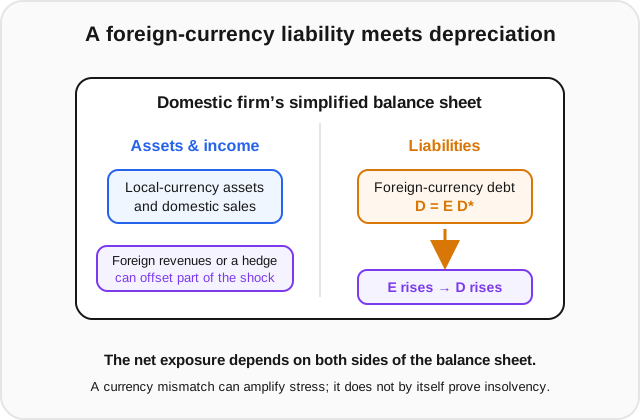
Currency mismatch turns a price move into a balance-sheet shock
Let again denote domestic currency per unit of foreign currency. A borrower with a foreign-currency liability has a domestic-currency liability value
If rises, the domestic-currency amount required to repay the same foreign-currency principal rises. A firm that earns export revenue in that foreign currency may be naturally hedged: the same depreciation also raises the local value of its revenue. A firm that sells only at home may not be. Financial hedges can reduce exposure too, but a hedge can create counterparty and rollover risk of its own.
The balance-sheet channel can amplify a shock. Depreciation raises debt burdens; weaker net worth can make lenders demand more collateral or refuse refinancing; forced asset sales and spending cuts can weaken output and cash flow further. That feedback is sometimes called a financial accelerator. It is a possible mechanism, not a claim that every depreciation or every foreign-currency liability produces a crisis.
Foreign-currency borrowing is sometimes described as “original sin”: borrowers in some economies may be unable to issue long-term debt in their own currency to international investors. The label highlights a financing constraint, not a timeless property of a country. Local-currency bond markets, hedging access, reserve assets, and institutional arrangements differ and can change. Even when liabilities are formally in domestic currency, foreign investors can withdraw, prices can fall, and market access can disappear; the underlying risks are not limited to dollar debt.
A sudden stop: funding flow meets payment calendar
Suppose foreign lenders decline to renew short-term claims. Borrowers must then pay from cash, reserves, new funding, or asset sales. If many try to sell the same assets at once, prices can fall. A currency may depreciate, which helps some exporters but worsens unhedged foreign-currency debts. A government or central bank may provide foreign-currency liquidity, but reserves are finite and may not be available to every private borrower. Capital controls, emergency lending, fiscal support, and exchange-rate adjustment each redistribute costs and create trade-offs.
It is helpful to separate liquidity from solvency. A solvent institution can have assets and future income whose value exceeds obligations but still lack cash on the exact date a payment is due. A credible lender of last resort or temporary foreign-currency facility may bridge that timing gap, if the borrower is fundamentally viable and the lender has capacity. An insolvent borrower, by contrast, cannot cover obligations even over time without restructuring, transfers, or a change in its resources and claims. Liquidity support can prevent a needless fire sale; it cannot turn every bad investment into a good one.
Crises can begin through different combinations of fundamentals and expectations. A large short-term foreign-currency debt, weak fiscal capacity, or a banking system dependent on wholesale funding can make rollover fears understandable. In other cases, one lender’s refusal can make repayment impossible for others, validating a pessimistic expectation. These mechanisms can coexist. Observing a crisis does not by itself identify which force was decisive; causal claims require evidence about contracts, institutions, shocks, and the sequence of events.
Why the current account is not a crisis score
A current-account deficit is a flow over a period; it says a country used more current resources than it provided under the relevant accounting definitions, with a financial counterpart. It does not tell us whether the funds financed productive investment, consumption, or an asset-price boom. Nor does it reveal the borrower, currency, maturity, hedges, or expected returns. A deficit financed by long-term equity-like investment has different contractual risks from one financed by short-term foreign-currency bank debt, though neither category is automatically safe or unsafe.
Likewise, a surplus does not guarantee resilience. Residents and banks may have large short-term liabilities alongside large foreign assets; those assets might be illiquid or held by someone other than the institution under pressure. A country-level aggregate can conceal a fragile sector. Crisis analysis therefore combines flow accounts with gross positions, institutional maps, contract-level maturity, and stress scenarios.
Worked example
A domestic firm owes E_0=20E_1=25$. Ignoring interest, fees, taxes, and any change in the foreign-currency principal, calculate the local-currency liability before and after the depreciation. What can—and cannot—you conclude?
Step 1 — value the liability initially.
The principal is worth 2 billion domestic units.
Step 2 — value it after the exchange-rate move.
The liability rises by 500 million domestic units, or 25%, because rose by 25% while the foreign-currency principal stayed fixed.
Step 3 — interpret the balance-sheet effect carefully. Since the firm has no offsetting foreign-currency assets, income, or hedge in this example, the depreciation worsens its domestic-currency net worth, all else equal. But this calculation alone does not prove insolvency. We would need the value and liquidity of its other assets, future cash flows, payment dates, access to refinancing, and the possibility of restructuring. It does show why the exchange rate can matter even when a foreign-currency debt’s face value never changes.
Where this leads
This capstone completes the open-economy path: the balance of payments records flows, exchange rates price cross-border claims and goods, parity conditions connect returns, and policy regimes shape adjustment. External crises emerge from the interaction of those mechanisms with gross balance sheets, contracts, and institutions. No single current-account number or exchange-rate move is a diagnosis; the careful economist traces who owes what, in which currency, on what date, and against which resources.