Imagine you have one unit of domestic currency and must choose where to invest it for a year. You can leave it at home, or convert it, invest abroad, and later convert back. Is the foreign deposit better just because its interest rate is higher? Not until we say how the currency will be converted back—and whether the exchange risk is hedged. Interest parity is the family of conditions that makes those comparisons precise.
We will keep the same quote as before: is domestic currency per one unit of foreign currency. Let be the one-period forward rate quoted in the same units. Let and be domestic and foreign nominal interest rates for the same horizon. The central distinction is between a return whose exchange rate is fixed today and one whose future conversion rate is uncertain.
Covered interest parity: lock in both legs
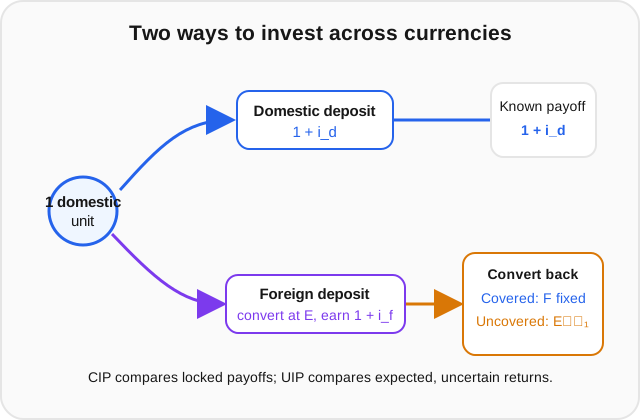
Start with one domestic unit. A domestic deposit turns it into domestic units at the end of the period. Alternatively, convert the unit into foreign currency at the spot rate. Since is domestic per foreign, one domestic unit buys foreign units. Invest those funds abroad to obtain
foreign units. Today, also sign a forward contract to convert that amount back at domestic units per foreign unit. The final domestic payoff is
If the investments have the same horizon and comparable risk, and there are no transaction costs, taxes, capital controls, or balance-sheet constraints, arbitrage should eliminate a predictable payoff difference. The covered interest parity (CIP) condition is
This is not a claim that all countries have identical interest rates. The forward premium or discount adjusts to offset the rate difference. Rearranging,
For low rates, the forward premium on foreign currency is approximately . CIP is a no-arbitrage comparison with the exchange conversion hedged. In actual markets, persistent deviations—often discussed through the cross-currency basis—can reflect funding constraints, counterparty risk, regulation, and scarcity of balance-sheet capacity. “Arbitrage” is not frictionless when intermediaries themselves face limits.
Uncovered parity: expectations enter
Now remove the forward contract. At the end of the period, the foreign investment is converted at the then-unknown spot rate . Its domestic payoff is
The investor cannot lock this number in at date . A simple uncovered interest parity (UIP) condition says that expected gross returns are equal when investors are risk-neutral and assets are otherwise comparable:
If rates are known today, this simplifies to
For modest rates and changes, the approximate relation is
With our quote, a higher domestic interest rate is associated with expected growth in : the domestic currency is expected to depreciate enough to offset its interest advantage. This is not a promise that it will depreciate, and it is not a rule that a high-yield currency must deliver a low realized return. The forecast can be wrong.
Risk premia separate an expectation from a law
Investors may dislike currency risk, default risk, illiquidity, or political uncertainty. If holding one asset requires compensation, expected returns need not be equal. Define a risk-premium term as the expected foreign-investment payoff in excess of the domestic payoff, in domestic-currency units per domestic unit invested. One convenient additive representation is
Under this sign convention, a positive means investors require extra expected payoff to hold the foreign position. Rearranging at low rates gives
Other texts define the premium with the opposite sign or as a return per unit of risk; the economic point is invariant: interest differences alone do not pin down expected currency changes unless we specify risk preferences and the assets being compared. Expectations, risk compensation, and realized exchange rates must not be conflated.
Worked example
The spot rate is domestic units per foreign unit, the one-year forward rate is , and the foreign deposit rate is 4%. What domestic deposit rate is implied by covered interest parity? Explain why this calculation does not reveal the future spot rate.
Step 1 — write the hedged foreign payoff. One domestic unit buys foreign units. After earning 4%, and converting back at the forward rate, its domestic payoff is
Step 2 — equate it to the domestic deposit payoff. Covered parity requires , hence
The domestic deposit rate implied by the quoted spot, forward, and foreign rate is 7.12%, abstracting from market frictions.
Step 3 — identify what is and is not known. The forward contract fixes the conversion at 20.6 for the covered strategy. It does not assert that the future spot rate will equal 20.6. A forward price is a market price for a contract that removes exchange uncertainty from this payoff; the realized spot rate can be higher or lower.
Where this leads
We now have a goods-market benchmark from PPP and an asset-return framework from interest parity. The next lesson combines exchange rates, capital mobility, and aggregate demand in the Mundell–Fleming model. Its impossible trinity will show why a small open economy cannot simultaneously maintain a fixed exchange rate, free capital mobility, and independent monetary policy under the model's assumptions.