Suppose a small country cuts interest rates to support a recession. Investors can move money across borders quickly, and the exchange rate is fixed. What happens when the return at home falls below the world return? If the country instead lets its currency float, does the answer change? This is the puzzle the Mundell–Fleming model was built to make visible: the same policy tool can have different consequences depending on how the exchange rate is managed.
The model extends short-run aggregate-demand analysis to a small open economy. “Small” means the country takes the world interest rate as given. Prices are sticky over the horizon being studied, so output can respond to demand. Capital is highly mobile, so investors react to interest-rate differences. These assumptions simplify the logic; they are not claims that every economy is small, frictionless, or literally able to move capital without delay.
Three equilibrium conditions in one economy
The familiar goods-market condition can be written schematically as
where is domestic output, taxes, government purchases, the domestic interest rate, and net exports. A real depreciation—higher under our earlier convention—may raise net exports if quantities respond enough, though the effect is not automatic or instantaneous.
Money-market equilibrium is represented by
where real money supply equals real money demand. With sticky , a monetary expansion can lower at a given level of output. Fiscal expansion can raise goods demand and output, increasing money demand and putting upward pressure on .
The external-balance condition links the current account and financial flows. With very high capital mobility and low perceived risk, even a modest gap between and the world rate can induce large flows. The textbook limiting case is drawn as a horizontal BP schedule:
If domestic rates rise above the world rate, inflows put pressure on the currency to appreciate; if they fall below, outflows put pressure on it to depreciate. A floating rate can move to absorb that pressure. A fixed rate requires the central bank to buy or sell currencies and manage reserves; those transactions also change the domestic money supply unless sterilized, and sterilization has limits under the model's assumptions.
The impossible trinity
There are three objectives a policymaker might want:
- A fixed exchange rate.
- Free cross-border capital mobility.
- Independent monetary policy aimed at domestic conditions.
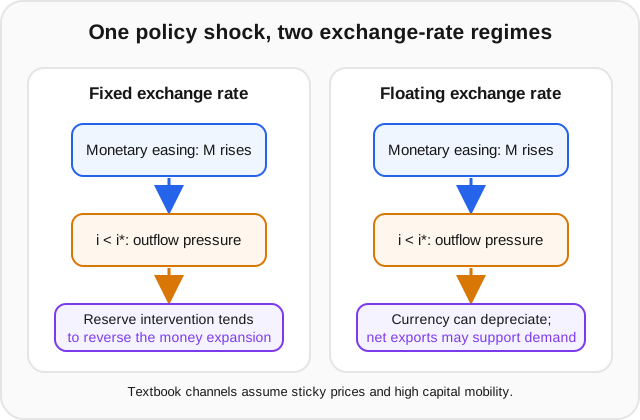
The impossible trinity, or monetary trilemma, says that under the model’s assumptions a country cannot fully achieve all three at once. To see why, suppose the currency is pegged and capital is mobile. If the central bank cuts its interest rate below , funds seek the higher return abroad. Investors sell domestic currency for foreign currency, creating depreciation pressure. To defend the peg, the central bank sells foreign reserves and buys domestic currency. That tends to drain domestic money, undoing the attempted monetary expansion. Sustaining the peg therefore constrains the interest rate and monetary autonomy.
A country can instead keep capital open and let the exchange rate float. Then the currency moves, and the central bank has more room to set the interest rate. Or it can maintain a peg and monetary autonomy by limiting capital mobility. The choices are institutional and political as well as technical; countries use managed regimes and partial controls that soften, but do not erase, these trade-offs.
Why fiscal and monetary policy depend on the regime
Under a float, monetary easing lowers the domestic interest rate in the short run. Outflows put downward pressure on the currency (a rise in under our quote); a real depreciation may boost net exports and reinforce demand. Fiscal expansion also raises demand, but its associated interest-rate pressure can attract capital inflows and appreciation. If that appreciation reduces net exports sufficiently, some of the initial fiscal impulse is crowded out.
Under a peg, monetary easing is difficult to sustain: outflows and depreciation pressure trigger intervention that tends to reverse the money expansion. Fiscal expansion can be more powerful in the textbook model. Higher demand and interest rates attract inflows; appreciation pressure leads the central bank to buy foreign currency and issue domestic currency to defend the peg, accommodating the expansion. This conclusion depends on the maintained assumptions—especially the ability and willingness to intervene, sticky prices, and high capital mobility.
The model is a comparative-static teaching device. Modern economies have risk premia, imperfect capital mobility, financial intermediaries, expectations of regime changes, and supply shocks. Exchange-rate pass-through and trade elasticities vary. So the useful question is not “Which policy always works?” but “Which channel is active under these assumptions, and which assumption might fail here?”
Worked example
A small economy has sticky prices, high capital mobility, and a domestic interest rate near the world rate. Trace the likely textbook effects of a monetary expansion first under a float and then under a credible peg. State the key external pressure in each regime and explain why the outcomes differ.
Floating exchange rate — Step 1: the initial monetary impulse. The central bank increases . At the initial price level and output, real money supply rises, putting downward pressure on the domestic interest rate.
Step 2: capital-flow pressure. With , investors seek the relatively higher return abroad. They sell domestic assets and currency, creating outflow and depreciation pressure.
Step 3: the exchange rate adjusts. Because the rate floats, the currency can depreciate rather than being defended at a fixed parity. If the real depreciation raises net exports, it adds to aggregate demand and output. How much depends on demand elasticities, imported-input costs, and the time allowed for trade quantities to adjust.
Fixed exchange rate — Step 1: the same initial impulse. Monetary expansion again pushes below , so investors seek foreign returns and sell domestic currency.
Step 2: the peg creates an intervention obligation. To prevent depreciation, the central bank sells foreign reserves and buys domestic currency. That operation withdraws domestic money from circulation, offsetting the attempted monetary expansion in the textbook case.
Step 3: identify the trade-off. The peg is maintained, but monetary policy cannot independently hold the expansion in place while capital remains mobile. The float lets the exchange rate absorb pressure; the peg makes the money supply and reserves absorb it instead. A central bank may temporarily sterilize intervention or use controls, but those actions alter the simple model's assumptions and constraints.
Where this leads
The Mundell–Fleming model makes the policy regime part of the causal story. But capital flows are not just arrows in a diagram: they create gross assets, liabilities, currencies, and repayment dates on real balance sheets. The graduate-level capstone turns to sudden stops and external crises, asking when a loss of foreign funding becomes a liquidity problem, when it becomes a solvency problem, and why a current-account deficit alone cannot answer that question.