A country can import more than it exports this year and still have a large stock of wealth abroad. Another can export more than it imports and still owe heavily to foreign investors. Those statements sound contradictory only if we mix up two different questions: what crossed the border during a period, and what claims and obligations exist at a point in time. Macroeconomics needs an accounting system that keeps both questions straight.
You already met two pieces of the puzzle. International trade tracked goods crossing a border, and the saving–investment identity connected national saving and investment to the current account. Now we widen the lens. A country also buys and sells services, pays wages and interest across borders, sends transfers, and trades financial claims. The balance of payments records these transactions; the international investment position records the resulting stock of external assets and liabilities.
Four kinds of cross-border transactions
The first distinction is between a flow and a stock. Exports in a year are a flow: they are measured over an interval. A foreign bond held by a household on December 31 is a stock: it is measured at a date. The balance of payments is organized around flows; the international investment position (IIP) is the snapshot of the external financial balance sheet.
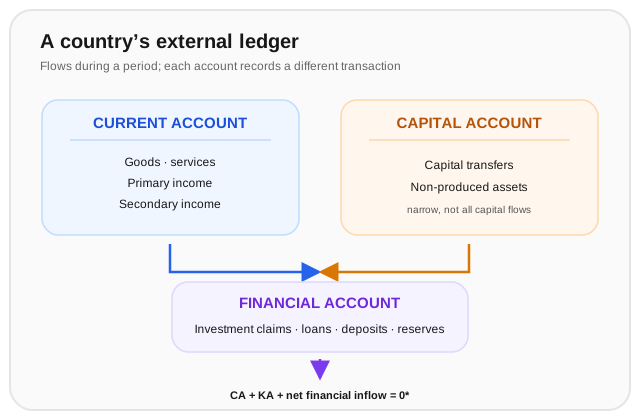
The balance of payments divides current transactions into accounts. The current account has four broad components:
- Goods: physical products crossing borders.
- Services: for example, transport, tourism, insurance, software, and consulting.
- Primary income: compensation of employees and investment income such as interest, dividends, and reinvested earnings.
- Secondary income: transfers where no equivalent good, service, or asset is exchanged, such as personal remittances and some international grants.
The capital account is narrower than the phrase “capital flows” suggests. It records capital transfers and transactions in certain non-produced, non-financial assets—for example, a debt forgiveness transfer or a transferable lease. It is usually much smaller than the financial account.
The financial account records transactions in financial assets and liabilities: direct investment, portfolio shares and bonds, loans and deposits, derivatives, and reserve assets held by the monetary authorities. It answers whether residents acquired claims on foreigners, foreigners acquired claims on residents, or both.
Why the accounts balance
Consider a domestic retailer that imports a 100-unit machine and pays for it by issuing a bond to a foreign investor. The machine is a 100-unit goods import in the current account. The bond gives the foreign investor a claim on the domestic retailer, recorded in the financial account. The country has received a real resource and issued a financial claim in return.
This is the double-entry logic of the balance of payments: most transactions have two sides. A good or service may be exchanged for a financial asset; a wage payment may be exchanged for labor; a gift has no direct counterpart for the recipient, but it is paired with a transfer entry in the payer’s accounts. The ledger must reconcile even when a statistician cannot observe every transaction perfectly.
For clarity, choose this sign convention: let a net financial inflow be positive when foreigners’ new claims on residents exceed residents’ new claims on foreigners. Let be the current-account balance and the capital-account balance, both positive when they provide net resources to residents. In the simplified case with no measurement error,
The equation says that a current- and capital-account deficit must have a financial counterpart: the country receives net financing from abroad, or reduces its existing foreign assets. A surplus means it provides net financing to the rest of the world, or accumulates claims on it. Statistical agencies often present the financial account with a different sign convention, so always check the definition before comparing a published “financial-account balance” with this equation.
This is the full-accounting counterpart to the simplified relation you already derived, . That identity describes net lending or borrowing for consistent national-account definitions. The balance-of-payments ledger shows the transaction categories through which the external financing is realized. It does not tell us whether borrowing is wise, whether an asset will pay off, or whether the exchange rate will move in a particular direction.
The stock: net international investment position
Now take a snapshot of the country’s external balance sheet. Its international investment position lists residents’ financial claims on nonresidents as external assets, and nonresidents’ claims on residents as external liabilities. The net international investment position is
If , the country is a net creditor by this measure; if , it is a net debtor. “Net” matters. A country can have very large foreign assets and even larger foreign liabilities, or small amounts on both sides. The net number is useful, but it does not reveal who owns the assets, who owes the liabilities, their currencies, maturities, liquidity, or risk.
In a stripped-down example with no capital transfers, valuation changes, or other adjustments, the current account changes the net external position over time:
A surplus adds to net claims on the rest of the world; a deficit reduces them. But this is not the exact law of motion in real data. An exchange-rate movement can change the domestic-currency value of foreign-currency assets and liabilities. Asset prices can rise or fall. Debt can be written off, and other changes can occur without a current-account transaction. A more complete relationship is
Net external transactions are linked to the current and capital accounts under the relevant accounting conventions. Valuation and other changes explain why the change in the stock need not equal the current-account balance for a particular year. This distinction is essential: a flow deficit is not itself a balance-sheet diagnosis.
A deficit is a description, not a verdict
Suppose a country runs a current-account deficit because it imports machinery that raises future productive capacity. That may be easier to sustain than a deficit funding consumption that produces no future income—though the difference is not always so clean, and the investment may fail. A deficit can also reflect a domestic investment boom, low national saving, demographic choices, safe-asset demand, or temporary shocks.
To judge the exposure, we need more than the sign of . Who owes the external liabilities—government, banks, firms, or households? Are they denominated in domestic or foreign currency? Are they short-term or long-term? Are the country’s foreign assets liquid and available to the borrowers who need to repay? How does the external position compare with the income that can service it? The accounting system helps us ask these questions; it does not answer them automatically.
It is equally important not to confuse the capital account with the financial account. News reports sometimes use “capital flows” to mean cross-border lending and investment. In balance-of-payments terminology, those financial transactions mostly appear in the financial account. This vocabulary difference is a common source of confusion, so the account names and definitions matter.
Worked example
During one year, a country exports 260 units of goods and imports 300. It exports 70 units of services and imports 55. Residents receive 18 units of primary income from abroad and pay 25 to foreign owners. They receive 4 units of secondary income and send 2 abroad. The capital-account balance is +1. Ignoring errors and omissions, calculate the current-account balance and the net financial inflow required by the accounting identity. If the initial NIIP is +50 and there are no valuation or other changes, what is the final NIIP?
Step 1 — calculate the goods balance.
Goods trade contributes a deficit of 40.
Step 2 — add services, primary income, and secondary income.
Therefore,
The current account has a deficit of 30. It is not the same as the goods deficit: services and income receipts offset part of that gap.
Step 3 — find the financial counterpart. With and the sign convention used here,
so
The country receives 29 units of net financial financing. The 1-unit capital-account surplus supplies the remaining resource counterpart to the 30-unit current-account deficit.
Step 4 — update the net position only under the stated simplification.
The country remains a net creditor, but its net position falls from 50 to 21. In actual data, valuation changes and other adjustments could make the observed change different.
Where this leads
We can now read a country’s external accounts without confusing a trade flow, a financing transaction, and an accumulated foreign position. The next step is to understand the price that converts one country’s money into another’s: exchange rates. From there, purchasing-power parity and interest parity will connect inflation, monetary policy, asset returns, and exchange-rate expectations; later, the Mundell–Fleming model will put those pieces together under different exchange-rate regimes.