When a recession begins, a government’s tax revenue may fall even if lawmakers pass no new tax bill. Some households may also qualify for more support under programs already in place. Is that a deliberate stimulus? Not necessarily. It may be the budget responding automatically to weaker incomes and employment.
Fiscal policy concerns public choices about purchases, taxes, and transfers. These choices affect who receives resources, who pays, and how much demand reaches firms. To understand policy during a downturn, we need to distinguish new decisions from the stabilizing effects already built into the budget.
Three fiscal channels
Government purchases of goods and services enter aggregate expenditure directly. Public investment can build infrastructure; public services employ workers and use resources. Taxes affect disposable income and incentives, while transfers—such as income support—move resources to households without being government purchases of current output themselves.
In the short-run spending framework, a simplified expression is
where is output and income, is taxes, is transfers, and , , , and represent consumption, investment, government purchases, and net exports. The notation is deliberately compact: consumption depends partly on disposable income, . A change in taxes or transfers can therefore influence household spending, while a change in is itself a component of planned expenditure.
This equation is a simplified model, not a complete national budget or a promise that every dollar spent raises GDP by one dollar. People may save some additional income, firms may import inputs, prices may adjust, and other spending may move in response.
Automatic stabilizers
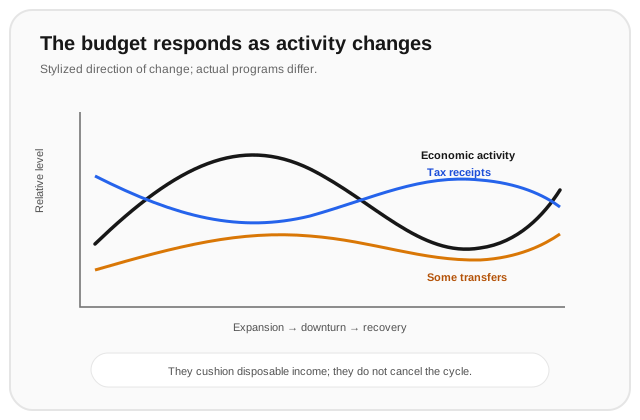
An automatic stabilizer changes its effect as economic conditions change, without a new policy decision for every movement in GDP. A progressive income tax, for example, may collect less when household incomes fall. Some unemployment or income-support payments may rise when more people qualify. Both changes can cushion disposable income relative to what it would otherwise have been.
During an expansion, the process can work in reverse: higher incomes may increase tax receipts, while fewer people qualify for some transfers. This can moderate demand. The strength of the effect depends on the tax system and eligibility rules; it is not the same in every country or for every household.
Automatic stabilizers are distinct from discretionary fiscal policy, in which officials change spending or taxes through a new decision. Discretionary action can be designed for a particular situation, but it may take time to debate, approve, and implement. By the time a project begins, conditions may have changed. Automatic stabilizers operate through existing rules but may be too small to address a severe downturn alone.
Deficits are flows; debt is a stock
A simplified budget balance for a period is revenue minus spending. When spending exceeds revenue, the government runs a budget deficit and must finance the gap. When revenue exceeds spending, it runs a surplus. The outstanding public debt is a stock measured at a point in time; it reflects past borrowing and can also change because of financial transactions and accounting adjustments.
The deficit often rises in a downturn without any new stimulus law: tax revenues weaken and some benefits increase. That can be part of the stabilizing response. A deliberate fiscal package may add to or offset that movement. To assess policy, distinguish the observed budget balance from the part caused by the cycle and from new discretionary choices.
Debt sustainability is not answered by a single slogan. It depends on future income and tax capacity, interest costs, growth, currency and maturity structure, what borrowed resources fund, and the government’s ability to refinance. Borrowing can support valuable investment or cushion a severe shock; persistent obligations also constrain future choices. The distribution of taxes, spending, and debt service matters too.
Multipliers and trade-offs
One dollar of public spending can become income for a contractor or worker, who may spend part of it. That spending becomes income for someone else. This is the intuition behind a fiscal multiplier: the total change in output can be larger or smaller than the initial policy change, depending on how much recipients spend, the state of the economy, monetary conditions, imports, taxes, and expectations.
The multiplier is not a universal constant. If firms have unused capacity and interest rates do not rise in response, additional demand may lead mostly to more production. If the economy is near capacity, it may put more pressure on prices or draw resources away from private uses. A policy can also have distributional or long-term effects not captured by a one-number output multiplier.
Fiscal and monetary policy interact. A central bank may accommodate additional demand, or it may tighten if it expects inflation pressure to become persistent. The government and central bank have different tools and decision processes; their actions can reinforce or counteract one another. Evaluating an intervention means asking what problem it addresses, who bears the cost, and what would likely have happened without it.
Worked example
During a downturn, a simplified budget sees tax receipts fall by 30 units and existing unemployment-related transfers rise by 20 units. No new law changes tax rates or benefit rules. How does the budget balance change, and why is this not automatically a discretionary stimulus package?
Step 1 — compare revenue and spending changes. Revenue falls by 30, so the balance worsens by 30. Transfers rise by 20, adding 20 to spending. Together, the budget balance moves toward a deficit by 50 units, all else equal.
Step 2 — identify the mechanism. The changes occurred under existing rules as incomes and unemployment changed. They are automatic stabilizing effects in this simplified example; no new rate cut or transfer program was enacted.
Step 3 — interpret cautiously. A 50-unit deterioration in the budget balance does not mean GDP rises by 50 units. Some transfers may be saved, other spending and revenues may change, and monetary or price responses matter. The example isolates how the budget can cushion households while the deficit grows.
Where this leads
Fiscal policy can cushion short-run swings, but economies also differ in how quickly their productive capacity grows. The next topic turns from stabilizing demand in a downturn to the longer-run sources of rising output per person: productivity, skills, capital, and ideas.