When a central bank announces a rate change, no one at the bank reaches into a shop and changes the price of bread. So how can that announcement matter for inflation? The answer is a chain of decisions: banks reprice some funding, borrowers reconsider loans, firms reconsider investment, households rethink large purchases, and expectations may shift. Each link is imperfect, and the effects arrive over time.
Monetary policy is the set of actions through which a central bank influences monetary and financial conditions. The goals and legal mandates differ across countries, but price stability and economic stability are common concerns. To see what policy can—and cannot—do, we need to follow the transmission mechanism rather than imagine that one rate controls the whole economy.
From the policy rate to financial conditions
Many central banks announce or target a short-term policy rate, or use an operating framework that keeps overnight market rates close to a chosen level. The details differ. The policy rate is not the interest rate on every mortgage, credit card, business loan, or savings account. Those rates also reflect expected future rates, borrower risk, maturity, competition, and the lender’s costs.
When a central bank raises its policy setting, short-term market rates often rise. Some borrowing becomes more expensive, and saving may become more attractive. A household may delay a car purchase; a business may decide that a project no longer covers its financing cost. If the setting is lowered, some of those incentives can move the other way. But the response depends on people’s circumstances and expectations.
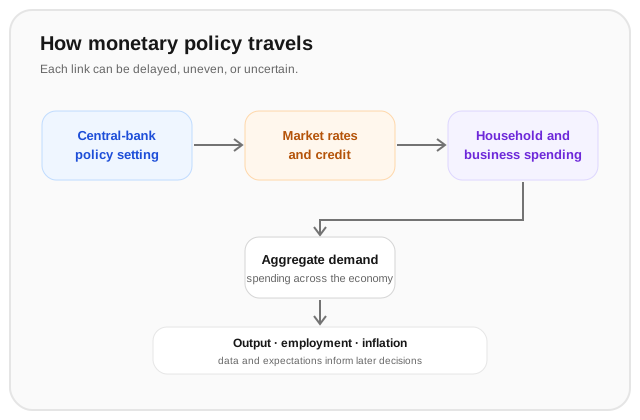
The transmission chain
An introductory version of the chain is:
Higher interest rates can also affect asset prices, exchange rates, and expectations. A stronger currency, for example, may make imports cheaper and exports less competitive, depending on the situation. A lower rate can encourage borrowing, but it cannot make a firm invest if the firm expects no customers or is unable to access credit.
The effect on inflation is indirect. If demand repeatedly exceeds what firms can sustainably supply, businesses may raise prices and workers may seek compensation for rising living costs. Slower demand can reduce that pressure, though it may also slow production and hiring. Monetary policy does not set each price; it tries to influence overall financial conditions and demand in pursuit of a mandate.
Nominal rates, expected inflation, and real rates
A nominal interest rate is stated in money terms. A borrower and lender also care about the purchasing power of the money repaid. The expected real interest rate adjusts the nominal rate for expected inflation. For modest rates, a useful approximation is
where is the expected real rate, is the nominal rate, and is expected inflation. The exact Fisher relation is
If the nominal rate is 5% and expected inflation is 2%, the approximate real rate is 3%. A change in expected inflation can therefore alter the real cost of borrowing even if the quoted nominal rate does not move. Expectations matter because loan, wage, and price decisions are made before the future is known.
Tightening, easing, and limits
An increase in the policy rate is commonly described as monetary tightening; a decrease is commonly described as easing. The labels describe the direction of the policy setting, not a guaranteed final outcome. Banks may change lending standards, borrowers may not respond, and financial markets may already have anticipated the decision.
Policy operates with lags. A household with a fixed-rate loan may not feel a rate change immediately. A firm may wait months before revising an investment plan. Inflation can respond after output and employment have already changed. Central banks therefore use forecasts and a range of indicators, and later revise their assessment as evidence arrives.
There are also limits. If a downturn is driven by damaged infrastructure or a shortage of a critical input, lower rates cannot repair the port or create the missing material. If nominal rates are already very low, there may be less room for conventional rate cuts, though central banks can sometimes use other tools. A supply shock that raises prices while reducing output can make the near-term objectives pull in different directions.
The central bank’s mandate, independence, tools, and communication vary by country. Monetary policy is powerful in some circumstances and weak in others; it is not a remote control for the entire economy. Understanding the context matters as much as knowing the direction of the last rate move.
Worked example
A borrower faces a nominal interest rate of 5%, while expected inflation is 2%. Later, the nominal rate stays at 5% but expected inflation rises to 4%. Calculate the approximate expected real rate in each case. What changed, and what does that calculation not tell us?
Step 1 — use the approximation.
Initially, .
Step 2 — recalculate with higher expected inflation.
The nominal rate did not change, but the approximate expected real rate fell by 2 percentage points. Borrowing may therefore be less costly in expected purchasing-power terms.
Step 3 — state what is missing. The calculation does not reveal the borrower’s actual loan rate, fees, risk premium, future realized inflation, or whether the borrower will take the loan. It isolates one relationship; it is not a complete forecast of spending or inflation.
Where this leads
Monetary policy works mainly through financial conditions and private decisions. Governments can also affect demand directly through purchases, taxes, and transfers. The next topic compares those fiscal tools and shows why some of them respond automatically when incomes and employment change.