Almost nobody you know makes anything they eat. The person who sells you bread did not grow the wheat; the farmer who grew the wheat did not build the tractor; the person who built the tractor could not bake a loaf to save their life. Every meal you have ever eaten is the end product of a long chain of strangers, each doing one narrow thing, each depending on everyone else. Self-sufficiency — actually providing for yourself, alone — is so rare that it survives mostly as a survival-show gimmick. And yet it is not obvious why. If each person in that chain is perfectly capable of feeding themselves in a pinch, what does the long chain of exchange actually accomplish? Why interdependence, rather than everyone tending their own garden?
Return to the island from the previous topic, where this question can be asked in its smallest possible form. Ann and Bob each have 10 hours a day, and each can feed themselves alone: Ann can pick 4 apples an hour or catch 2 fish an hour, while Bob can pick 1 apple an hour or catch 3 fish an hour. Neither needs the other to survive. So why would either of them ever trade?
There is a naive-sounding worry hiding here, and it is worth stating honestly, because some version of it shows up every time trade is discussed in the real world. It goes something like this: trade must have a loser. If Ann hands Bob apples and Bob hands Ann fish, surely one of them got the worse end of the deal — and anyway, what does the more capable partner need the other one for? Ann is worse than nobody at nothing; why would she need Bob? Under this view, exchange is at best a zero-sum shuffle and at worst a swindle, and the sensible thing for both of them is to stay self-sufficient.
The worry is wrong, and proving it wrong — not just asserting so, but computing it — is the entire content of this topic. The correction turns on a distinction that sounds like hair-splitting until you see it work: the difference between being better at something and being cheaper at something. Those are not the same property, and only the second one drives trade.
The setup is deliberately unchanged from the last topic — same two people, same hourly rates, same 10 hours — so that every number from the frontier we already built carries over directly. The precise question this topic answers is: exactly which exchange ratios between apples and fish make both Ann and Bob strictly better off than self-sufficiency, how much better off do they end up, and why does the answer have nothing to do with who is "better" at what?
What "gains from trade" and "terms of trade" actually mean
Before any algebra, two phrases need plain meanings, because everything that follows is just these two ideas made exact.
The terms of trade are simply the exchange ratio — the price tag, except the price is quoted in fish instead of money. Saying "the terms of trade are 1 fish per apple" means: if you hand over one apple, you get one fish back. On an island with no money, fish is what prices are made of.
The gains from trade are the extra consumption that exchange makes possible. Here is the cleanest way to say what "extra" means: in the previous topic we drew each person's production possibilities frontier — the menu of everything they could produce and consume alone. If, after specializing and trading, a person ends up with a bundle of apples and fish that sits outside their own frontier — a combination they literally could not have reached by themselves, no matter how they split their hours — then the trade demonstrably gained them something. The frontier is the perfect yardstick, because it already encodes everything self-sufficiency could ever deliver.
So the whole topic reduces to one concrete question: for which terms of trade do both Ann and Bob land outside their own frontiers?
Absolute advantage is not the point
Start with the comparison everyone makes first. Who is better at each task, head to head, per hour of work?
- Apples: Ann picks 4 per hour, Bob picks 1. Ann is four times as productive — she has what economists call an absolute advantage in apples.
- Fish: Ann catches 2 per hour, Bob catches 3. Bob has the absolute advantage in fish.
In plain words, absolute advantage just means "produces more of one good per hour." Notice that in this little economy, neither person is better at everything — the talent is split, one good each. That might make trade look trivially sensible (each person should obviously do the thing they're best at), but stay skeptical: "each does what they're best at" is a slogan, not an argument, and the real engine underneath it is something else.
That something else is opportunity cost, which we already computed from these exact rates in the previous topic. Recall the two numbers that fell out of each person's frontier:
- Ann: 1 apple costs her a fish (one apple takes her of an hour, in which she would have caught a fish). Flipped around, 1 fish costs her apples.
- Bob: 1 apple costs him fish (one apple takes him a full hour, worth 3 fish). Flipped around, 1 fish costs him of an apple.
Whoever has the lower opportunity cost of a good is said to have a comparative advantage in it. Ann's apple costs a fish against Bob's 3 fish, so Ann has the comparative advantage in apples. Bob's fish costs of an apple against Ann's 2 apples, so Bob has the comparative advantage in fish.
In plain words: absolute advantage asks "who is faster?", but comparative advantage asks "whose time is cheaper, measured in what they give up?" — and it is the second question that decides everything, because trade is not a contest of speed but a swap of costs. Here the two comparisons happen to agree (Ann is both faster and cheaper in apples), but they are different ideas, and the whole weight of what follows rests on the cheaper/faster one.
The range of prices that helps both sides
Now the derivation. Let be the terms of trade: the number of fish that one apple buys. Consider a single trade in which Ann hands Bob 1 apple and receives fish. The question is what each person secretly compares that deal to — and the answer is their own opportunity cost, the deal they could give themselves alone.
Ann's side. Ann's apple cost her a fish of forgone fishing time to produce. Selling it brings in fish. She comes out ahead exactly when
Put plainly: Ann accepts a deal only if it pays her more fish for an apple than the half-fish the apple cost her to make. Any price above that, and trading beats re-doing the work herself.
Bob's side. If Bob wanted an apple on his own, growing it would cost him 3 fish of fishing time. Buying it from Ann costs him fish. He comes out ahead exactly when
And symmetrically: Bob accepts a deal only if the apple costs him fewer fish than the 3 fish he'd burn making it himself.
Put the two conditions together and the entire logic of mutually beneficial trade collapses into one line:
The upshot: any price strictly between the two opportunity costs leaves both people better off — the seller's minimum acceptable price is her cost, the buyer's maximum acceptable price is his cost, and trade is possible precisely because those two costs are different. The boundaries behave exactly as they should: at , Ann is merely indifferent (the deal exactly matches her own cost, so she gains nothing); at , Bob is indifferent; outside the interval, one of them would rather walk away, and no voluntary trade happens.
Here is a self-check, deriving the same interval from the opposite direction. Quote the price of a fish in apples instead: apples per fish, with Bob now the seller. Bob's fish costs him of an apple, so he gains iff ; Ann's fish costs her 2 apples, so she gains iff . Bob's condition is , Ann's is , and since ,
— the identical interval, reached from the other side of the market. The two derivations had to agree, and they do.
Specialize, trade, and land outside your own frontier
An interval of good prices is one thing; watching both people actually end up richer is another. Pick a concrete price inside the range, fish per apple, and run the whole experiment with real numbers.
Before: self-sufficiency. Suppose each person splits their 10 hours evenly between the two tasks. Ann gets apples and fish; Bob gets apples and fish. Both bundles lie exactly on their owners' frontiers — check: hours for Ann, and hours for Bob. The island's total output is apples and fish.
Specialize. Each person now spends all 10 hours on the good in which they have the comparative advantage — Ann on apples, Bob on fish. Ann produces apples and no fish; Bob produces fish and no apples. The island's total output jumps to apples and fish — 15 more apples and 5 more fish than before, from exactly the same 20 hours of labor. That surplus is the raw material of the gains from trade: specialization alone grew the pie.
Trade. At , Ann sells Bob 12 apples for 12 fish. After the swap:
- Ann holds apples and fish — the bundle .
- Bob holds apples and fish — the bundle .
Now compare, person by person, against self-sufficiency. Ann went from to : 8 more apples and 2 more fish. Bob went from to : 7 more apples and 3 more fish. Both are strictly better off in both goods — no loser, no swindle. The naive worry from the opening is now refuted with arithmetic.
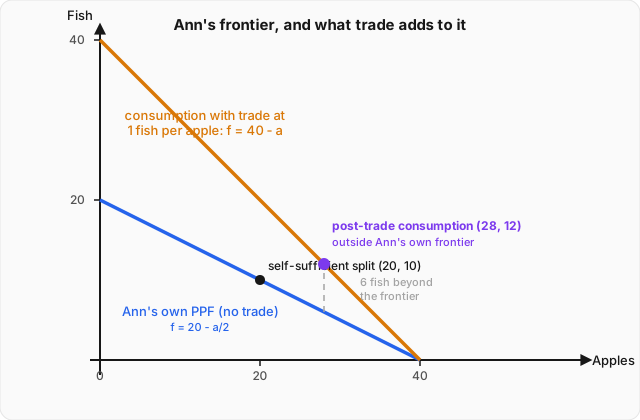
And the frontier yardstick confirms this isn't an artifact of the chosen baseline. Ann's own frontier is , so at 28 apples the very best she could ever do alone is
yet she is sitting on 12 — a full 6 fish beyond her own frontier, a bundle that self-sufficiency could never deliver at that apple count. Bob's frontier is , which tops out at 10 apples no matter what; his 12 apples are simply unreachable alone, and at 18 fish his frontier would allow only apples. Both post-trade points lie strictly outside their owners' frontiers.
One last way to see why the price being inside the interval is what does the work. If Ann specializes fully in apples and can trade at , then keeping apples and selling the other earns her fish, so her consumption possibilities with trade are
a straight line through with slope , lying strictly above her own frontier at every — the gap between them at any point is exactly her gain from trade. What that means: trade at a price better than her own opportunity cost tilts her whole menu upward, and her own frontier stops being the ceiling on her life.
Worked example
Suppose the terms of trade are instead 2 fish per apple. Verify that this price is still mutually beneficial, and compute both Ann's and Bob's gains over self-sufficiency if each fully specializes and they then trade 6 apples.
Step 1 — check the price against the beneficial range. Mutual benefit requires , and
so the price qualifies: it is above Ann's cost of producing an apple ( fish) and below Bob's cost of producing one himself (3 fish).
Step 2 — specialize fully. Ann spends all 10 hours on apples: apples, 0 fish. Bob spends all 10 hours on fish: fish, 0 apples.
Step 3 — trade 6 apples at 2 fish each. Ann hands over 6 apples and receives fish. After the swap:
Step 4 — measure the gains against self-sufficiency. Recall the self-sufficient bundles: Ann had , Bob had . So the gains are
Both gain in both goods, exactly as the interval argument promised. Frontier check: at 34 apples, Ann's own frontier allows only fish, yet she has 12; at 6 apples, Bob's frontier allows fish, yet he has 18. Both sit outside their own frontiers.
Step 5 — notice who gained more. At this price Ann walked away with 14 extra apples, while Bob's apple gain was just 1. That is not a coincidence: sits much closer to Bob's cost (3) than to Ann's (), so most of the surplus landed with Ann. Where the price falls inside the beneficial range decides how the gains are split — and what decides the price itself is exactly the question the next topic takes up.
Where this leads
This topic pinned down a remarkable fact with nothing but arithmetic: any terms of trade strictly between two people's opportunity costs makes both of them richer than self-sufficiency, rich enough to consume beyond their own frontiers. But it left one thing conspicuously undecided. The interval is wide — every price in it "works" — yet nothing said here picks out which price Ann and Bob will actually settle on, and as the worked example showed, the choice matters enormously for who gets what. In a real economy, that missing ingredient is supplied by the interplay of how much each side wants to buy and sell at each possible price — buyers pushing prices down, sellers pushing them up, until one exact price clears the market. That mechanism is the subject of the next topic: Supply, Demand, and Market Equilibrium.