Before money, imagine trying to buy lunch by offering your neighbor a pair of shoes and hoping they happen to want shoes today. A barter economy can work for a tiny group, but every exchange requires the right coincidence of wants. Money removes much of that friction. Yet modern money is not just paper notes, and commercial banks do more than store them.
To understand monetary policy later, we first need a map of what counts as money, how banks create deposit balances, and where the central bank fits into the payment system. The details differ across countries, but the basic accounting gives us a useful starting point.
What makes something money?
Money is an asset widely accepted for making payments. It traditionally performs three functions:
- Medium of exchange: people accept it to buy and sell goods without arranging a barter swap each time.
- Unit of account: prices, debts, and financial records can be stated in a common unit.
- Store of value: purchasing power can be carried into the future, though inflation can erode it.
Currency notes and coins are one form of money. In many economies, balances in transaction accounts are also money: people pay with cards, transfers, and apps that move bank deposits rather than hand over physical notes. Economists distinguish monetary measures by which kinds of assets they include; those definitions vary and can change as payment habits evolve.
Money is not the same as wealth. A home, a machine, or a share of a company may be valuable, but it may not be accepted directly at a grocery checkout. Nor is money the same as income, which is a flow received over a period. A deposit is an asset to its holder and a liability of the bank that promises to honor payments from it.
How a bank loan can create a deposit
Suppose a bank approves a loan of 1,000 units and credits the borrower’s account. In a simplified balance sheet, the bank records:
The borrower now has a deposit they can spend and a debt they must repay. The bank has a loan asset and owes the deposit balance. The deposit was created by the lending transaction; the bank did not simply hand the borrower the exact same notes another customer had previously deposited.
If the borrower pays a seller who banks elsewhere, the buyer’s deposit falls and the seller’s deposit rises. The two banks then settle the payment between themselves, using balances in the central-bank settlement system or another approved arrangement. Lending therefore creates a deposit, but moving that deposit across banks creates a payment obligation that must be settled.
This does not mean banks can lend without limit. They consider whether borrowers are likely to repay, whether the interest earned covers risk and costs, and whether they have enough capital and liquidity. They must meet regulations and manage payment outflows. Credit demand matters too: no bank can force a solvent household or firm to borrow. The simple claim “a reserve is multiplied into a fixed number of loans” is not a reliable description of every modern banking system.
Commercial banks and central banks
Commercial banks serve households and firms: they hold deposits, make loans, process payments, and manage risks. Their balance sheets connect borrowers, savers, businesses, and the payment system.
A central bank is a public monetary institution. Its exact mandate and design differ by country, but it commonly issues or manages central-bank money, supports settlement between banks, and operates a framework that influences short-term interest rates and financial conditions. Some central banks also supervise banks or share that responsibility with other agencies.
The public usually pays with commercial-bank deposits or currency. Banks use central-bank settlement balances to make certain payments to one another. The two forms of money are related, but they are not identical: a household’s bank deposit is a claim on its commercial bank, while a bank’s settlement balance is a claim on the central bank.
Central banks do not choose every bank loan, household purchase, or market price. Nor does a central bank’s ability to create settlement balances mean it can make real resources—workers, fuel, machines, or food—appear by accounting entry. Monetary institutions influence the conditions under which spending and lending occur; the real consequences depend on decisions throughout the economy.
Worked example
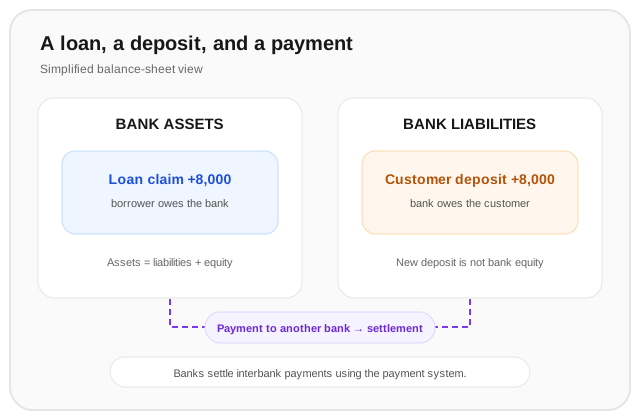
A bank approves a loan of 8,000 units and credits the borrower’s deposit account. The borrower then pays a contractor who uses a different bank. Describe the initial balance-sheet entries and explain what changes when the payment is made. Does the first bank’s loan create 8,000 units of new bank equity?
Step 1 — record the loan at the first bank.
The borrower has an 8,000-unit deposit asset and an 8,000-unit debt. The bank has a claim on the borrower and an equal deposit obligation.
Step 2 — follow the payment. The borrower’s deposit at the first bank falls by 8,000. The contractor’s deposit at the second bank rises by 8,000. The banks settle the transfer between them through the payment system, which can change their settlement balances.
Step 3 — separate deposits from equity. The new loan does not add 8,000 units to the first bank’s equity. Its assets and liabilities initially rise by the same amount. The bank’s eventual income depends on interest and fees, while losses, funding costs, and operating expenses can reduce its equity.
Where this leads
We now have the actors and balance-sheet language needed to discuss monetary policy. When a central bank changes its policy setting, the effects travel through bank funding costs, market interest rates, credit decisions, spending, and expectations—with delays and uncertainty at each step.