Think about a food everyone depends on — bread, wheat, rice, anything like that. When its price climbs high enough, some families start going without, and sooner or later someone asks the obvious question: why doesn't the government just make it cheaper? Pass a law, cap the price, done. It sounds almost embarrassingly simple. If the market is charging twelve dollars for a bushel of wheat and people can't afford it, legislate the price down to eight and let everyone eat.
The trouble is that a price isn't a knob attached to the outside of an economy. It's an answer — the specific number at which everything people want to buy exactly equals everything people want to sell. Push that number down by law and you haven't changed what the wheat costs to grow, or how much of it farmers are willing to produce at the lower price, or how much shoppers want at that price. You've only changed the number. The quantities, which were in balance at the old number, now have no reason to be in balance at all.
A related puzzle shows up with taxes. Suppose the government wants to raise money from the wheat market and writes a law saying sellers must pay five dollars per bushel to the tax office. Sellers will complain, naturally. But does the complaint mean sellers actually bear the five dollars? Buyers pay the market price, sellers hand over the tax — maybe the five dollars quietly lands in buyers' wallets through a higher price, and sellers only appear to pay it. And here's the sharper version of the puzzle: if the law were rewritten to say buyers pay the tax instead of sellers, would anything real change at all?
Both puzzles — the price cap and the tax — collapse into one precise question. The market on its own settles at a price where quantity demanded equals quantity supplied. Legislation that forces prices or taxes to be something other than what the market chose drives a wedge between those two quantities, or between what buyers pay and what sellers keep. The question this topic answers, with nothing more than the demand and supply curves and careful algebra, is: exactly how large is that gap, and exactly who ends up paying for it?
Ceilings, floors, and what it means for a control to "bind"
Before deriving anything, it helps to be exact about what these laws actually do. A price ceiling is a legal maximum — no one may sell above it. A price floor is a legal minimum — no one may sell below it. Simple enough. But there's a subtlety that trips people up constantly, and it's worth pinning down before any symbols appear.
The market, left alone, already settles at one specific price — call it the equilibrium price, the single number where everyone who wants to buy finds someone willing to sell, and vice versa. Now imagine the government passes a ceiling above that equilibrium price. Nothing happens. The market still settles exactly where it always did, comfortably below the legal maximum, and the law sits on the books like a speed limit nobody was approaching anyway. Economists call such a control non-binding, and a non-binding control does literally nothing: the price that would have been chosen is still chosen, because it was never illegal to begin with.
For a control to matter — to be binding — it has to forbid the price the market would otherwise have picked. A ceiling only bites when it's set below the equilibrium price, and a floor only bites when it's set above it. That's the entire conceptual machinery. Everything else is arithmetic: at the legislated price, read off how much people want to buy and how much people want to sell, and measure the gap. A gap where buyers want more than sellers offer is a shortage; a gap where sellers offer more than buyers want is a surplus. Now let's measure both.
The wheat market, one more time
We'll use the same wheat market as before, with quantity measured in thousands of bushels and price in dollars per bushel:
The free-market equilibrium solves : setting gives , so
and it's worth checking the arithmetic directly: , and . Both curves agree at 52 thousand bushels when the price is $12 — that's what it means to be an equilibrium. In plain words: at twelve dollars a bushel, the amount shoppers want to buy is exactly the amount farmers want to grow, so nobody's left wanting wheat and nobody's left holding unsold wheat. This is the benchmark every law in this topic will be measured against.
A binding price ceiling: eight dollars per bushel
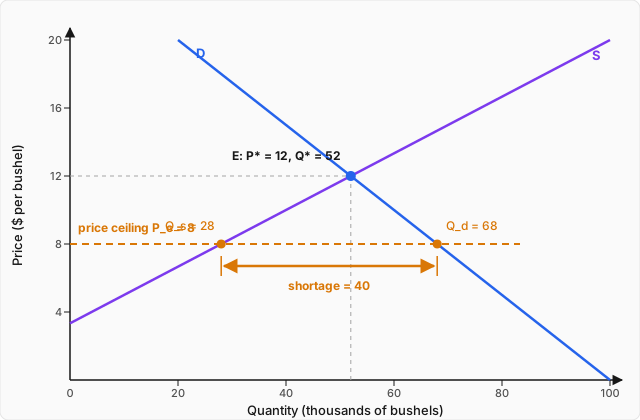
Now suppose the government decides twelve dollars is too much for families to pay, and passes a law capping the price of wheat at
Since , the ceiling forbids the equilibrium price — it's binding, so something has to give. That something is not "the price," which the law has fixed. It's the quantities. How much do people want to buy at eight dollars?
And how much do farmers want to sell at eight dollars?
Concretely: at the cheaper price, shoppers want 68 thousand bushels — more than the 52 they bought at twelve dollars, because wheat is now a better deal. But farmers, who earn less per bushel, are only willing to grow and sell 28 thousand. The two numbers don't match, and they can't be made to match, because the law has frozen the one number — the price — that would have risen to pull them back together. The gap between them is the shortage:
40 thousand bushels' worth of shoppers who want wheat at the legal price will not find any to buy. The law made wheat cheaper for the people who can find it — but the actual quantity available fell from 52 thousand bushels to 28 thousand, because at eight dollars only 28 thousand get produced and sold at all. Everyone else joins a queue, shows up early, calls in favors, or simply goes without. A price ceiling doesn't make wheat cheap; it makes it scarce at the register instead of expensive on the shelf. The rationing still happens — the price just stops being the thing that does the rationing.
A binding price floor: sixteen dollars per bushel
The mirror-image law is a price floor, usually pitched as help for producers rather than consumers: the government decides farmers aren't earning enough and sets a minimum price of
Since , this floor is binding. Run the identical calculation, with the roles of the two curves flipped. At sixteen dollars, how much do farmers want to sell?
And how much do shoppers want to buy?
Put plainly: the high price thrills farmers — they'd gladly grow 76 thousand bushels at sixteen dollars — but shoppers, facing the expensive shelf, only want 36 thousand. This time sellers outnumber buyers, and the gap is a surplus:
40 thousand bushels of wheat get grown that nobody buys — grain piled in storage, or bought up by the government itself to keep the floor from collapsing, which is exactly what real agricultural price supports end up requiring. Notice the symmetry of the two exercises: both laws forbid the equilibrium price, both freeze the one number that could have closed the gap, and both leave the market with quantity transacted equal to the smaller of the two sides — 28 thousand bushels under the ceiling, 36 thousand under the floor, both below the free-market 52. A legislated price doesn't move the market to a new equilibrium; it amputates part of the old one.
Taxes: who actually pays, whoever the law says pays
Price controls forbid the equilibrium price outright. A tax does something subtler: it splits the price in two. From now on, distinguish two numbers that used to be one: the buyer price , what shoppers hand over per bushel, and the seller price , what farmers actually get to keep. With no tax, . Now the government imposes a tax of dollars per bushel, and writes the law so that sellers owe it. A farmer who sells a bushel at the market price pockets only , because five dollars go straight to the tax office. So farmers make their production decisions based on , not — and the supply curve, which answered the question "how much will farmers sell at price ," now has to be evaluated at the price they keep:
where is the price buyers pay. Read it this way: from the farmers' point of view, the whole market now behaves as if every posted price were five dollars lower, because that's what they actually receive. The demand side is untouched — shoppers still follow , since is the price out of their pockets.
The new equilibrium sets the (untouched) demand equal to the (shifted) supply:
The seller's net price is then
and the quantity traded is , with the supply side agreeing: . So: buyers now pay fifteen dollars instead of twelve, sellers keep ten dollars instead of twelve, and the market shrinks from 52 thousand bushels to 40 thousand.
Now the honest question — who bore the five-dollar tax? Compare each side to the old equilibrium price of twelve. Buyers pay $3 more per bushel (); sellers receive $2 less per bushel (). Check that the two pieces account for the entire tax:
The upshot: the five-dollar tax was split — three dollars landed on buyers through a higher price, two dollars on sellers through a lower take — and the shares add up to the tax exactly, as they must, since every dollar of the wedge between and goes to the tax office and has to come out of one side's pocket or the other's. Nobody passed the whole tax to anyone else, and nobody escaped it. The legal fact that sellers owed the tax turned out to matter very little: buyers bore three-fifths of it anyway.
The general rule: the split is decided by the slopes
That three-to-two split didn't come from the number five, and it didn't come from the law's wording. It came from the two curves. To see why, write the market generally: demand with slope (), supply with slope (), and a per-unit tax levied on sellers, so supply becomes . Equating demand and supply:
With no tax (), the equilibrium price would be — the same expression without the term. So the buyer price rises by exactly
What that says: buyers' share of the tax is the supply curve's slope divided by the sum of the two slopes — note the twist, the buyer share depends on the supply slope. Sellers, by exactly the same calculation, absorb — their share depends on the demand slope, and the two shares sum to identically, for any .
Now translate the slopes into the elasticities measured at the free-market equilibrium, where and (negative, since demand slopes down). Dividing the buyer share through by :
Read that as: the buyer's share of any per-unit tax equals the supply elasticity divided by the supply elasticity minus the demand elasticity — and since is negative, the denominator is just the sum of the two elasticities' sizes. The economic meaning falls right out: whichever side is less elastic — less able to walk away when the deal gets worse, whether that means a shopper who needs the wheat or a farmer with no other crop — is the side that ends up holding most of the tax, because the flexible side can shrink its participation and dodge.
Check the formula against the concrete numbers. At , : with and ,
Three-fifths of five dollars is exactly three dollars — precisely the $3 buyers paid in the worked calculation above, derived here a second, independent way.
Worked example
Same wheat market, same per-bushel tax — but this time the law levies it on BUYERS. Find the new buyer price, the price sellers receive, the quantity traded, and compare the incidence split to the seller-side tax.
Step 1 — rewrite demand. When buyers owe the tax, a shopper deciding whether wheat at posted price is worth it cares about the full cost , since five dollars per bushel go to the tax office on top. Demand becomes
where is now the price sellers receive. Supply is untouched: .
Step 2 — solve for the new equilibrium. Set the shifted demand equal to the untouched supply:
Step 3 — read off all three numbers. Sellers receive ; buyers pay ; the quantity is (demand agrees: ).
Step 4 — compare incidence. Buyers pay dollars above the old equilibrium; sellers receive dollars below it; . These are identical to the seller-side tax: , , , buyers bearing $3 and sellers $2.
In short: changing who legally owes the tax changed nothing real at all. The market doesn't read the statute — it just opens a five-dollar wedge between what buyers pay and what sellers keep, and the split of that wedge, to buyers and to sellers, is fixed by the two slopes, not by the law's wording. This is the economists' version of a magician's trick with no hidden compartment: tax incidence genuinely does not depend on statutory assignment.
Where this leads
Everything above measured who pays when the government reaches into a market — and the answer turned out to be stranger than the legal wording suggests: buyers and sellers split the burden in proportions written into the two curves themselves, no matter who signs the check. But there's a quieter cost hiding in the numbers, one that nobody collects. When the tax arrived, the quantity of wheat traded fell from 52 thousand bushels to 40 thousand. Those 12 thousand bushels didn't change hands at all — no buyer got the wheat, no seller got the revenue, and no tax office got a single dollar from them. The trades simply vanished, and with them went the gains those trades would have created for everyone involved. That loss — real, measurable, and received by no one — has a name, and measuring it precisely is the subject of the next topic: The Costs of Taxation: Deadweight Loss.