Two petitions are taped to the noticeboard outside the town hall in Harbor Falls, and if you read them one after the other they sound like they were written about two different species.
The first is from the flood committee. The town sits behind a low earthen levee, and every few winters a storm surge comes close to topping it. The committee has been collecting voluntary contributions to raise it. Every household they ask says the levee matters, several say it matters enormously — and the jar has almost nothing in it. Not because people are lying about wanting the levee. They want it. They simply notice that a levee tall enough to stop a surge stops it for the whole town, and that their own contribution will not be what decides whether it gets built.
The second petition is about the crab beds out in the bay. Every crabber in Harbor Falls will tell you the bay is being fished too hard, that the pots come up lighter every season, and that at this rate there will be nothing left in ten years. All of them say it. And every spring, each of them sets a few more traps than the year before.
So one resource is starved of effort that everybody wants to see spent, and the other is drowning in effort that everybody wishes would stop. It is tempting to file these under "people are selfish" and move on. That explanation is wrong, and provably so — as we will see, the people in both stories are behaving exactly as a careful, honest, well-informed person maximizing their own clearly-stated interest would behave, and the outcome is bad anyway. The two failures are not opposites. They are one arithmetic mistake seen from two sides, and the point of this topic is to write that arithmetic down precisely enough that we can say, in dollars and feet and traps, how far each outcome sits from the best one available.
The tools are already in hand. From consumer and producer surplus we know that the efficient quantity of anything is the one where the marginal benefit of the last unit equals its marginal cost, and that the value lost by stopping short of it is a triangle between the two curves. From externalities we know what happens when a decision-maker's private accounting leaves out a cost or benefit that lands on somebody else. Public goods and common resources are what you get when that omission is not an occasional side effect but the defining structural feature of the good itself.
Two questions that sort every good into four boxes
Everything in economics up to this point — the wheat market, in particular — has quietly assumed two properties of the good being traded, and it is worth dragging both into the open, because dropping either one is what breaks the market.
Excludability. Can the supplier prevent a person who has not paid from consuming the good? A bushel of wheat is excludable: no money, no wheat. A radio broadcast is not: once the signal is in the air, the station cannot make it stop at the property line of people who did not subscribe.
Rivalry. Does one person's consumption reduce what is left for everybody else? Eat the bushel of wheat and it is gone — perfectly rival. Listen to the broadcast and precisely nothing is subtracted from anybody else's listening — perfectly non-rival.
These two questions are independent, so they carve the world into four boxes, and Harbor Falls happens to contain an example of each.
- Private goods — excludable and rival. A bushel of wheat, a crab dinner, a haircut. This is the case every earlier topic assumed, and the case where ordinary markets work: the seller can charge, and charging is the right thing to do, because serving you really does use up something.
- Club goods — excludable but non-rival. The town's fiber-optic internet line on a quiet Tuesday, or the ferry when it is half empty. The operator can charge (there is a gate, a login, a ticket), but an extra user costs essentially nothing, so any price above that near-zero marginal cost turns away people who would have enjoyed the good at no cost to anyone. Markets survive here; they just under-serve.
- Common resources — non-excludable but rival. The crab beds in the bay. Nobody can be kept out, yet every crab hauled up is a crab someone else does not get.
- Public goods — non-excludable and non-rival. The levee. It protects the whole town whether or not you contributed, and protecting your house does not use up any of the protection available to your neighbor.
The two-by-two is worth memorizing, but the reason it earns its place is sharper than a taxonomy. Look at what the two questions actually govern:
Excludability decides whether the market can charge. Rivalry decides whether it should.
Private goods sit in the one box where both answers line up, which is why markets handle them well. The two failing boxes fail for genuinely different reasons, and mixing them up is the most common mistake in this whole subject. A public good is undersupplied because nobody can be made to pay, so the payment that would fund it never arrives. A common resource is overused because nobody can be kept out, so the crowding one user imposes on all the others never shows up in that user's own accounting. Under-provision in one box, over-extraction in the other, from the same missing fence.
Why nobody pays for the levee
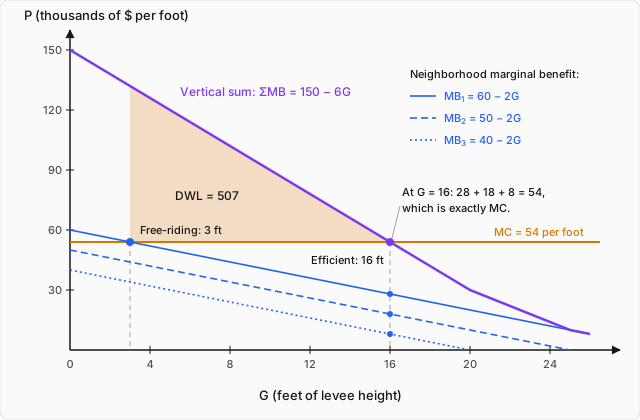
Make the levee concrete. Harbor Falls has three neighborhoods, and we will treat each as a single decision-maker: Dock Street, right on the water; Mill Row, a little higher; and Ridge, up the hill and only lightly exposed. Let be the height of the levee in feet above its current top. Each neighborhood's willingness to pay for one more foot, measured in thousands of dollars per year, falls as the levee already gets tall — the first foot of extra protection stops the floods that come every few winters, the twentieth stops only the once-a-century catastrophe:
The engineering firm charges a constant thousand dollars per foot of height. Those are the only numbers in this section; everything else is derived.
Now suppose the town does nothing collectively and simply lets each neighborhood contribute whatever it likes, with the levee ending up as tall as the contributions pay for. Write for what neighborhood funds and for the height that results. Dock Street, deciding how much to fund, faces a completely ordinary optimization. Its gross benefit from a levee of height is the area under its own marginal benefit curve, and its cost is per foot of what it pays for:
Differentiate with respect to , holding the others' contributions fixed — by the fundamental theorem of calculus the derivative of the integral is the integrand at the upper limit:
There is the private rule, and notice what it says: each contributor pushes the levee up until its own marginal benefit equals the full marginal cost. Dock Street funds three feet. Given those three feet, what do the others do? Mill Row's marginal benefit at is , and Ridge's is . Both are below the it costs to add a foot, so neither adds anything, and neither wants to remove anything it never paid for. Dock Street, for its part, has already equated its own marginal benefit to marginal cost and does not want a fourth foot. No one has a profitable unilateral move. This is a Nash equilibrium, and its content is:
Mill Row and Ridge get three feet of flood protection for nothing. That is free-riding, and it is important to be precise about what it is and is not. It is not cheating: nobody broke a rule or told a lie. It is not even irrational generosity going unrewarded. It is the direct consequence of non-excludability. Because Mill Row cannot be shut out of the protection Dock Street bought, the levee Dock Street builds is, from Mill Row's point of view, free — and the correct response to a free thing is to take it and pay for no more of it than you would want on top.
How much worse does this get in a bigger town?
Three neighborhoods is small. To see what group size does, strip the problem down to its bones: identical households, a flood-protection program costing thousand dollars, and each household valuing the program at thousand dollars. (The square root is doing the same job the downward-sloping lines did above — the first dollars of protection buy much more safety than the last.) Household chooses its own contribution to maximize
Its first-order condition is , that is
Stare at that for a second, because the has vanished. Total voluntary provision is thousand dollars whether the town has two households or two thousand. Adding beneficiaries does not add provision, because each newcomer's private rule is the same rule, and it is already satisfied.
Now the efficient level. Every household enjoys the same — that is what non-rivalry means — so total surplus is copies of the benefit minus one copy of the cost:
and , so it really is a maximum. The efficient program grows with the square of the population while voluntary provision stays pinned at . The value destroyed is
Sanity-check the endpoint: at the loss is exactly zero, which it must be, because a single household is the whole town and its private accounting already contains every consequence of its choice. The failure is not a property of individuals; it is a property of the number of people the benefit spills onto.
Put waterfront households in and the numbers get lurid. Voluntarily: $25 thousand of flood protection, giving each household minus its share, about $47.9 thousand of net benefit. Efficiently: , i.e. $3.6 million, giving each household minus its $300 thousand share, a net $300 thousand — more than six times better, for every single one of them, unanimously. And still nobody does it, because if the other eleven fund their shares of the $3.6 million program, the twelfth household's best move is to pay nothing and collect thousand instead of . Everyone reasons that way; the whole thing collapses back to $25 thousand. It is a prisoner's dilemma with twelve players and a sea wall.
Vertical summation and the Samuelson condition
We have the private rule. Now derive the right one, and the derivation is short enough that the striking part is how much follows from it.
Total surplus from a levee of height is the sum of all three neighborhoods' gross benefits — all three enjoy the same height, because protection is non-rival — minus the single cost of building it once:
Differentiate and set to zero:
That is the Samuelson condition for a public good: the efficient quantity is where the sum of everybody's marginal benefits equals marginal cost — not any one person's marginal benefit, all of them added together. And since it is a sum of marginal benefits at the same quantity, adding them means adding the heights of the individual demand curves at each : vertical summation.
The contrast with a private good is the whole point, and it is worth deriving rather than asserting. For a private good, each person consumes their own and the producer bears the cost of the total :
There are now separate conditions, one per person, and each reads — every consumer equates their own marginal benefit to the same marginal cost. Because they all face the same marginal cost, they all end up at the same height on their demand curves, and to find the total you add their quantities at that common price: horizontal summation. The structural difference is exactly the rivalry assumption. In the private case appeared as separate arguments; in the public case the same appears inside every at once, so all derivatives pile onto a single first-order condition instead of splitting into of them.
Now run both on the levee and watch them disagree. Adding the three curves vertically, for heights where all three are still positive:
Set it equal to marginal cost:
Check the condition directly rather than trusting the algebra: at the three marginal benefits are , , and , and . Exactly. Every neighborhood's willingness to pay for the sixteenth foot is far below its cost — Ridge would pay eight thousand for a foot that costs fifty-four — and yet the sixteenth foot is worth building, because all three get it simultaneously. That single sentence is the entire economics of public goods.
Now do it the wrong way, horizontally, as though the levee were wheat. At a price of per foot, how many feet would each neighborhood buy for itself? Dock Street: . Mill Row: , so zero. Ridge: zero. Horizontal sum: feet — precisely the free-riding outcome we derived, which is no coincidence at all. Treating a non-rival good as if it were rival gives you three feet where efficiency wants sixteen, and the reason is visible in the arithmetic: horizontal summation asks "who alone will pay the full cost?", vertical summation asks "will everyone together pay the full cost?", and for a public good only the second question is the right one.
The cost of getting it wrong is the familiar triangle. Total surplus as a function of height, using the vertical sum as the marginal benefit and as the marginal cost, is
so and , and the loss from free-riding is
Cross-check it geometrically, the way the deadweight loss topic taught: the destroyed surplus is the area between the summed marginal benefit curve and marginal cost, over the feet that never get built. That gap is , which is at and at — a triangle of base and height :
Same number, two routes. Harbor Falls loses about half a million dollars a year, every year, not because anyone is foolish but because there is no gate on a levee.
The general form: adding up marginal rates of substitution
The condition was derived in a partial-equilibrium setting where "benefit" was already measured in dollars. Samuelson's original statement does not assume that, and the general derivation is short and more honest about where the dollars come from, so it is worth doing.
Let there be a private good (think "everything else you could buy") and a public good . Person has utility , increasing in both. The economy can convert private good into public good at a rate given by the production frontier: giving up units of buys one more unit of .
Ask when an allocation is Pareto efficient. Suppose we increase the public good by a small and, at the same time, take some private good away from each person to keep them exactly as well off as before. For person , holding constant requires
So person can hand over units of private good and be exactly indifferent — that is what a marginal rate of substitution is, the amount of the private good this person would trade away for one more unit of the public good. Collect from everybody and we have released
units of private good, at no cost in anyone's welfare. Producing the extra consumes units. If
the collection exceeds the bill, we build the extra , and there is private good left over to hand back — so everybody can be made strictly better off, and the original allocation was not efficient. If , run the same argument backwards: shrink a little, and the private good freed up more than compensates everyone. Efficiency therefore requires
which is the Samuelson condition in its general form. The private-good analogue, derived the same way, is for each separately — no summation — and once again the difference is that one unit of the public good enters everyone's utility function at the same time, while one unit of a private good enters exactly one. When utility is quasi-linear in the private good, is just person 's dollar willingness to pay at the margin and is marginal cost in dollars, and the boxed condition collapses back to the we used on the levee.
The mirror image: the tragedy of the commons
Now the bay. Crab pots are set by four independent boats; write for the traps boat sets, measured in hundreds, and for the total in the bay. Crowding is the whole story: the more traps in the water, the fewer crabs each one catches, because they are all fishing the same finite population. Take the season's catch from a hundred traps to be worth
falling one thousand for every additional hundred traps anyone sets, and let a hundred traps cost thousand dollars to run for the season. Non-excludability is the assumption that nobody can stop anyone from setting traps; rivalry is the assumption that falls in .
The efficient level. A single owner of the whole bay — imagine the town buys it — would choose to maximize total value:
Four thousand traps in the bay, generating $1.6 million of value per season. Note , so it is a maximum.
What actually happens. Boat does not own the bay; it owns its own traps. Its profit is
Differentiating with respect to its own , taking the others' traps as given:
In a symmetric equilibrium every boat sets the same , so and
Check the sanity case first: gives . A sole owner does the efficient thing, exactly as the single household did in the levee model — with one decision-maker there is no "somebody else" for the damage to land on. With boats,
Six thousand four hundred traps instead of four thousand, and $1.024 million of value instead of $1.6 million: $576 thousand destroyed per season by overuse, with more traps, more fuel, more work, and less money.
Where exactly the mistake enters. Compare the two derivatives, which is the cleanest thing in this topic. The social marginal benefit of one more trap is the derivative of total revenue,
while the private marginal benefit to the boat setting it is the derivative of its own revenue,
Subtract:
There it is, exact and unmissable: the private and social calculations differ by precisely , the traps belonging to everybody else. Each extra trap knocks one thousand dollars off the value of every hundred traps in the bay; the boat setting it feels that loss only on its own and ignores it entirely on the other . At the four-boat equilibrium, while : the last traps set are destroying twenty-eight thousand dollars of value each hundred while their owner rationally records a twenty-thousand-dollar gain. This is an externality — congestion imposed on others — and it is negative, which is why the answer comes out too big rather than too small. The levee's externality was the positive kind, which is why that answer came out too small. Same missing term, opposite sign.
And it is a genuine dilemma, not a failure of imagination. Suppose the four skippers meet in the harbor bar and agree to the efficient plan: a thousand traps each, . Each then earns thousand dollars, against the they get in the equilibrium. Everyone is better off; the agreement is not naive. Now let three of them keep the bargain and ask what the fourth's best move is. With fixed,
Its payoff jumps to — a gain of $225 thousand for itself, bought by knocking the other three from down to each, a loss of $450 thousand spread over its neighbors. Total value falls from $1.6 million to . Every skipper sees this arithmetic, every skipper defects, and the bargain never survives a season.
Push the logic to its end with free entry. As , , and
At eighty, the value of a hundred traps' catch is thousand — exactly the cost of running them. Every dollar of value the bay was capable of producing has been competed away, dissipated into the cost of the extra traps sent out to grab it. This is the tragedy of the commons in its strongest form: the resource is not merely overused, its entire economic rent is destroyed, and everyone works harder to earn nothing.
Cost-benefit analysis, and why you cannot just ask
The Samuelson condition tells the town exactly what to do: add up the marginal benefits, compare with marginal cost, build to sixteen feet. That is cost-benefit analysis, and it is what every public agency deciding on a road, a vaccination program, or a flood defense is nominally doing. The uncomfortable part is the step everyone skips over: where did come from? For wheat, nobody had to ask — buyers revealed their willingness to pay by buying or not buying at the posted price, and the demand curve was the record of those choices. A public good has no posted price and no individual purchase decision, so there is no such record. The number has to be obtained some other way.
The obvious idea is to ask. It does not work, and the reason is not that people are dishonest in general — it is that the question is structurally rigged, and we can show it with the levee.
Suppose the town announces it will build to whatever height the reported marginal benefits justify, and split the per-foot cost in proportion to what each neighborhood reported. Truthful reports give the efficient sixteen feet with per-foot shares , and . Ridge, the least exposed, considers reporting that it values the levee at nothing. The remaining reported sum is , so the town builds
paid for entirely by Dock Street and Mill Row. Was lying worth it? Ridge's true gross benefit from a levee of height is . Telling the truth: thousand of benefit, minus its share of per foot over sixteen feet, , for a net of . Lying: thousand of benefit, minus nothing at all, for a net of . Ridge is $108 thousand better off understating, and the town is worse off by
(cross-check: the triangle has base and height , area ).
Note carefully that the incentive to lie flipped direction when the payment rule did. Because Ridge's bill was tied to its report, understating paid. Change the rule so that everyone pays a fixed share regardless of what they say, and the incentive reverses exactly: your report now moves the levee up at somebody else's expense, so you overstate wildly. This is the preference revelation problem, and it is not a detail of these two rules — it is close to a general obstruction. Any mechanism that funds a public good and hopes to be told the truth has to fight the same fact that made free-riding rational in the first place.
So practitioners estimate the numbers indirectly, and it is worth knowing that all the available methods are compromised in different ways:
- Revealed preference from related markets. Houses behind the levee sell for more than identical houses in front of it, and the price gap is a real, money-backed measure of what flood protection is worth to people who actually paid. Clean in principle, but it only works when a private market happens to be entangled with the public good.
- Contingent valuation — surveys asking directly what people would pay. Cheap, applies to anything, and badly contaminated by the incentives above plus hypothetical bias: answers to questions about imaginary money are famously generous and famously insensitive to scale, with respondents often naming similar sums for saving two thousand birds and two hundred thousand.
- The value of a statistical life. A levee saves lives, and cost-benefit analysis has to put a number on that or else it silently puts zero. The number used is not a price on any particular person's life; it is inferred from the wage premium people demand for jobs with slightly higher fatality risk, converted from small risks into a per-life figure. Defensible, and permanently uncomfortable.
- Discounting. A levee built now prevents floods for eighty years, and comparing benefits in 2100 with costs in 2026 requires a discount rate. The choice of that rate is not a technical detail: over eighty years, discounting at 2 percent rather than 5 percent multiplies the present value of a distant benefit by roughly ten, which is often the difference between "obviously build it" and "obviously do not".
None of this makes cost-benefit analysis worthless. It makes it a discipline in which the hard part is the measurement, not the theorem — the theorem, , is the easy and completely settled half.
Worked example
A town is deciding how many nights per month to run its mosquito-abatement spraying, . Three districts have marginal benefits , and (thousands of dollars per extra night), and spraying costs a constant thousand per night. Find the efficient , find what voluntary contributions would produce, verify the voluntary outcome is a Nash equilibrium, and compute the deadweight loss. Careful: one district's marginal benefit hits zero before the optimum does.
Setting up. Marginal benefits can be zero but never negative — a district that has stopped wanting more spraying simply stops adding to the vertical sum; it does not start subtracting. So the summed curve is , and it kinks wherever a district drops out. That is the trap in this problem.
Step 1 — locate the kinks. reaches zero at ; at ; at . So the vertical sum is
Check continuity at the kink: and .
Step 2 — the efficient level, done carefully. The careless move is to use the first branch everywhere:
but , so that branch does not apply there — and the answer is not just imprecise, it is built on district 3 supplying thousand of "benefit", i.e. on pretending a district that wants no more spraying is actively harmed by it. Use the correct branch for :
Confirm lies inside that branch's range , and verify the Samuelson condition directly: at the three marginal benefits are , , and , and . District 3 is a pure beneficiary at the margin, contributing nothing to the last night's justification and paying nothing for it under Lindahl-style shares.
Step 3 — voluntary provision. Each district funds up to the point where its own marginal benefit covers the full marginal cost. District 1: . Districts 2 and 3 would need and , giving and : neither will fund a single night on its own. So
Step 4 — verify it is a Nash equilibrium. Not optional: an equilibrium claim needs the no-profitable-deviation check.
- District 1: at its marginal benefit is , exactly , so adding an eleventh night breaks even and a twelfth loses money; cutting back to nine costs it of benefit for a saving. It stays.
- District 2: at its marginal benefit is . Paying for of benefit is a loss; it contributes nothing.
- District 3: at its marginal benefit is . Nothing.
No unilateral deviation helps, so stands.
Step 5 — deadweight loss. Integrate the gap between the summed marginal benefit and marginal cost over the nights that never happen, using the branch valid on :
Step 6 — cross-check geometrically. On the integrand is a straight line running from at down to at , so the region is a triangle of base and height :
Reading the answer. Voluntary contributions buy ten nights of spraying; efficiency wants fifteen; the five missing nights destroy $75 thousand of value per month. And notice that the shortfall is not because district 1 is stingy — district 1 is doing exactly the right thing by its own accounts, and would lose money buying an eleventh night alone. The gap exists because on nights eleven through fifteen the benefit is spread across districts 1 and 2 in a way that no single district's cheque book can capture.
Where this leads
The two petitions on the Harbor Falls noticeboard turned out to be one equation with a sign flipped. Whenever a benefit or a cost lands on people who are not the one deciding, the decider's private first-order condition is missing a term — the other beneficiaries' marginal benefits in the levee's case, the other boats' congestion losses in the bay's — and the outcome misses the efficient point by exactly the size of what was left out. That is the same machinery as externalities, applied to goods where the spillover is not incidental but total, and it is measured with the same surplus triangles that measured the cost of a tax — which is a small piece of evidence that the tools built up over these topics really are general.
Two loose ends are worth naming, because they do not stay loose forever.
The first is the one the last section left dangling. We showed that asking people what a public good is worth to them is a rigged question under the two most natural payment rules — understate when your bill follows your report, overstate when it does not. That is a statement about two rules, not a proof about all of them. Is there any scheme at all under which telling the truth is each person's own best move, whatever anybody else says? The answer is genuinely surprising, it is yes-with-a-catch, and getting to it requires a language for reasoning about what people do when their best move depends on everyone else's — the language the free-riding and trap-setting arguments in this topic kept borrowing informally every time the phrase "Nash equilibrium" appeared. That language is game theory, and it is what the later topics on strategic behavior are for.
The second is the bay. We proved that a sole owner sets exactly the efficient forty hundred traps, and that four independent boats set sixty-four. The distance between those two numbers is not a law of nature — it is the value of a property right that does not yet exist. If somebody could sell four thousand trap-permits and no more, the bay would produce its full $1.6 million and the permits themselves would be worth something. That is the beginning of the answer to every commons problem from fisheries to carbon, and it turns the tragedy of the commons from a lament into a design problem: not "how do we make people less selfish", but "what is the missing market, and who gets to own it?"