Return to Harbor Falls, the farming town from the taxation topic, and walk a mile downriver from the wheat fields. There is a tannery there. It buys raw hides, soaks them in chromium salts, and sells finished leather to boot makers three counties over. Every single transaction it takes part in is voluntary and mutually beneficial: the boot makers pay $60 a hide because a finished hide is worth more than $60 to them, and the tannery accepts $60 because tanning that hide cost it less than $60. By the standards of the previous two topics this market is behaving perfectly. Price has settled where quantity supplied equals quantity demanded, the eager buyers are matched with the cheap sellers, and the efficiency theorem says total surplus is as large as it can be.
Now walk another two miles downriver, to where the Harbor Falls fishing co-op sets its nets. The chromium the tannery rinses out with each hide arrives here. It does not kill the fish outright; it does something more mundane and more measurable. It forces the co-op to run its catch through a filtration and testing step before the cannery will accept it, and that step costs money — reliably, predictably, about $30 for every hide the tannery processes upstream.
Here is the strange part, and it is worth sitting with before any algebra. Nobody in this story is doing anything wrong. The boot maker is not cheating. The tannery is not lying about its costs. Nobody is exercising market power or hiding information. The price is not being controlled, the market is not being taxed, and every trade that happens is voluntary and makes both parties to it better off. And yet the fishing co-op is paying $30 a hide for a decision it was never asked about and receives nothing for. The tannery, when it decides whether to tan one more hide, consults its own cost sheet — wages, chemicals, power — and that sheet does not contain the co-op's $30. It has no reason to contain it. The co-op is not a party to the transaction.
So the tannery is making a perfectly rational decision using a cost number that is incomplete. And the market, obediently equating supply to demand, is equating demand to the wrong supply curve — a curve built from costs that leave out a real, physical, dollar-denominated cost that a real person is really paying. The efficiency theorem from the surplus topic has not been repealed; it has been fed the wrong inputs. This topic works out, precisely, how far wrong the answer goes, how much value that costs, and what a regulator would have to do to fix it.
An effect like the co-op's filtration bill — a cost or benefit that a transaction imposes on somebody who is neither the buyer nor the seller — is called an externality, because it falls outside the transaction. Externalities come in both signs, and by the end we will have handled both: the negative kind (pollution, congestion, antibiotic resistance) where the market does too much, and the positive kind (vaccination, education, basic research) where it does too little.
Three cost curves, and being exact about which is which
Everything here turns on carefully distinguishing three quantities that ordinary language runs together as "cost". Write them for the tannery, with in thousands of hides per year and prices in dollars per hide.
Marginal private cost, , is what the tannery itself gives up to produce one more hide. It is the ordinary supply curve of the previous topics — the inverse supply curve, read vertically as "what the seller of the -th unit must receive to bother". Suppose
Marginal external cost, , is what that same extra hide costs everyone who is not the buyer or the seller. Here it is the co-op's filtration bill:
Marginal social cost, , is the total resource cost to the community of that extra hide — the sum of the two, because a dollar of filtration is just as real a sacrifice as a dollar of chromium:
On the benefit side the tannery's customers are the only ones who gain, and they gain exactly what they are willing to pay, so marginal private benefit and marginal social benefit coincide and are both just the inverse demand curve:
Read that last curve the way the surplus topic taught: at the boot maker buying the 20-thousandth hide values it at dollars, and nobody beyond that point values one so highly.
The whole content of "externality" is now visible in one line of notation: . The market clears where , because those are the two curves belonging to people who are actually in the room. Efficiency, as proved in the surplus topic, requires . When these are the same equation and the market is efficient; when they are different equations with different solutions, and the gap between those solutions is the entire subject.
Where the market stops, and where it should have stopped
Solve both equations. The market equilibrium is where demand meets the tannery's own supply curve:
with market price dollars per hide (check the other side: , the same number, as it must be). Thirty thousand hides a year, at sixty dollars each.
The socially optimal quantity is where the marginal social benefit of one more hide equals its marginal social cost — where the last hide produced is the last one whose value to its buyer still covers everything the community gives up to make it:
At that quantity the buyer of the marginal hide values it at dollars, and dollars. The two match exactly, which is the definition of the optimum.
So the market makes 30 thousand hides and it should make 20. Why the market overshoots is worth spelling out at the level of a single hide, because the algebra is only bookkeeping for this argument. Consider the 25-thousandth hide. Its buyer values it at dollars. The tannery's own cost of making it is dollars. Both parties see a 15-dollar gain and the trade happens — correctly, from their point of view. But the true cost of that hide to Harbor Falls is dollars, and 85 exceeds 70. So the tannery and its customer split 15 dollars of gain while the co-op absorbs 30 dollars of cost, and the town's books show a net loss of dollars on that single hide. Every party has acted sensibly and the community is poorer.
The general statement is worth having in symbols, because it shows the overshoot is not a coincidence of these particular numbers. Take any linear market with , and a constant marginal external cost , with . Then
The market always overproduces when , the overshoot is proportional to the size of the external cost, and it is larger the flatter the curves are — that is, the more responsive buyers and sellers are to price. Compare this with the tax topic, where the quantity reduction caused by a tax was . It is the same expression. That is not an accident, and the reason will be the punchline of the next section but one: an unpriced external cost of and a tax of move quantity by exactly the same amount, in opposite directions, which is precisely why one can cancel the other.
Counting the destroyed value
The market produces 10 thousand hides too many. What is that worth? Each hide between and costs the community more than it is worth to its buyer, and the loss on each one is the vertical gap . Add them up:
A hundred and fifty thousand dollars a year of value destroyed — burned, not moved. Because the integrand is a straight line running from at (where the curves cross) to at , the integral is again a triangle, and its height at the market quantity is exactly the marginal external cost:
Same number, and in symbols the formula falls straight out of the overshoot expression above:
Check it on our numbers: , , , so . Third confirmation. And notice the shape of the formula — over twice the sum of the slopes — is identical to the deadweight loss of a tax, . An unpriced externality damages a market in exactly the way a tax of the same size would, with one crucial difference: a tax at least collects revenue, so its loss is only the triangle. An externality collects nothing for anyone.
A distinction that is missed constantly, so state it flatly. The deadweight loss is not the pollution damage. Total damage at the market quantity is thousand dollars a year; the deadweight loss is 150. The other 750 is damage attached to the 20 thousand hides that should be made — hides whose value to their buyers genuinely exceeds their full social cost, chromium included. That damage is a real cost borne by real fishermen, and a policy that eliminated it entirely by shutting the tannery would destroy far more value than it saved. The deadweight loss measures something narrower and more precise: the value destroyed by the wrong quantity, over and above the damage that an optimally-run tannery would still cause.
It helps to see the whole ledger at once. At the market outcome (, ), consumer surplus is the triangle under demand above the price, producer surplus the triangle above below the price, and the co-op's damage is a straight subtraction:
Hold on to that 450. Every policy below will be graded against it.
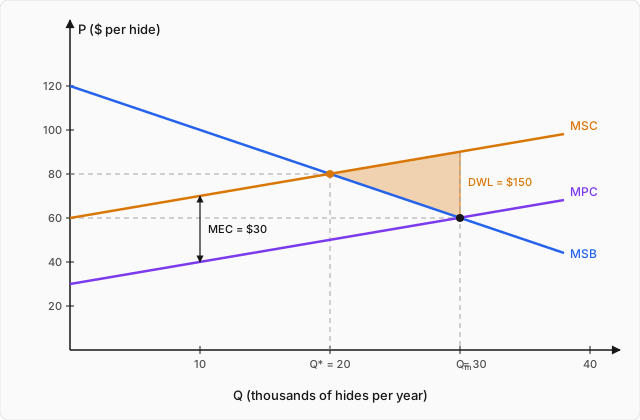
The Pigovian tax: making the tannery see the co-op's bill
The diagnosis suggests its own cure. The tannery overproduces because its cost sheet is missing a line. Add the line. Levy a tax of dollars per hide on the tannery, and its private cost of producing the -th hide becomes . Choose
and the tannery's perceived marginal cost becomes , which is exactly. A tax equal to the external damage does not distort this market; it undistorts it. The tannery, still selfishly maximising its own profit and consulting only its own books, now happens to be consulting the community's books, because they have been made to coincide. Such a tax is called Pigovian, after A. C. Pigou, who proposed it in 1920.
Verify it moves the quantity where it should. With the tax, the market clears where buyers' willingness to pay meets the tannery's new cost:
Buyers pay , the tannery keeps (check: , so the marginal hide is exactly worth making and no more), and the treasury collects thousand dollars.
Now run the full welfare ledger again and compare with :
And — precisely the deadweight loss computed three ways above. The tax recovers all of it and not a dollar more, which is the honest confirmation that the diagnosis and the cure are the same calculation read in opposite directions.
Two features of this ledger deserve attention because they are where intuition usually goes wrong.
The optimal amount of pollution is not zero. At the co-op still pays 600 thousand dollars a year in filtration. That is not a policy failure. Those 20 thousand hides are worth more to their buyers than everything they cost the community, chromium included. Driving discharge to zero would mean giving up hides whose social value is positive; the correct target is not "no pollution" but "pollution up to the point where one more unit of damage is exactly balanced by the value of the output that causes it". Notice also that the revenue and the damage happen to both equal 600 here — this is a coincidence of a constant and does not hold in general, as the worked example will show.
The tax rate is set at the optimum, not at the status quo. With constant this distinction is invisible, so make it visible with symbols. Let instead, so . The optimum solves , giving
and the correct Pigovian tax is the marginal damage evaluated there:
A regulator who instead measures the damage the plant is doing today, at , and taxes at will overshoot, because makes , and will drive output below the optimum — creating a deadweight loss in the opposite direction. The worked example puts numbers on exactly this mistake.
Positive externalities: the same algebra with one sign flipped
Not every spillover is a harm. When a pharmacy sells you a flu shot, the transaction is between you and the pharmacy, and the price you are willing to pay reflects your own reduced chance of getting sick. It does not reflect the fact that an immune you cannot infect your colleagues, your bus driver, or the elderly neighbour you help with groceries. That benefit is real, lands on third parties, and appears in nobody's willingness to pay.
Take a small clinic market, with in hundreds of shots per season and prices in dollars per shot:
The market clears where private benefit meets cost:
The optimum equates social benefit to social cost:
Now the market under-provides — 2,500 shots when 3,500 is right — and the logic is the mirror image of the tannery's. Consider the shot at . Its recipient privately values it at dollars and it costs dollars to deliver, so no one buys it and no one is being foolish. But its full social value is dollars, comfortably above 40. Every shot between 25 and 35 is like this, and the value forgone is again a triangle:
matching the triangle . The corrective instrument flips sign too: a Pigovian subsidy of dollars per shot. Paid to buyers, it lifts the effective demand facing the clinic to , which is , and the market lands at with buyers paying out of pocket and the clinic receiving . The subsidy costs ; the gain in social welfare, by the same ledger arithmetic as before, is exactly the 100 of recovered deadweight loss. This is the formal case for publicly funded vaccination, for subsidised education, and for research grants: not charity, but the correction of a systematic under-purchase of things whose benefits leak.
Coase: could the tannery and the co-op just talk?
Pigou's answer assumes a regulator who knows . Ronald Coase, in 1960, asked an awkward question: why is a regulator needed at all? There is 150 thousand dollars a year lying on the table. Two parties, both of whom would like some of it, live three miles apart. Why do they not simply negotiate?
Work out whether there is really a deal to be had. Suppose the co-op offers to pay the tannery to cut back from 30 to 20. What does cutting back cost the tannery and its customers? It is the surplus they jointly earn on those hides — the gap between what buyers pay and what production privately costs:
And what is the cutback worth to the co-op? Ten thousand fewer hides at 30 dollars of filtration each:
So the co-op values the cutback at 300 and it costs the tannery side 150. Any payment between those two numbers makes both parties strictly better off, and the size of the bargaining zone is
which is the deadweight loss, exactly. That is not a coincidence and it is the cleanest way to understand what deadweight loss is: it is the money on the table, the total gain available from fixing the misallocation, and therefore precisely the amount two rational parties would be willing to fight over.
Coase's sharper claim is that the outcome does not depend on who holds the legal right. Suppose instead the co-op holds a right to clean water, so the tannery may not discharge at all unless it buys permission. Starting from , what is the tannery side willing to pay for the right to make 20 thousand hides?
against a cost to the co-op of . A deal is struck somewhere between 600 and 1200 — and the quantity settles at 20 for a reason the margin makes exact. The tannery side's private surplus on the -th hide is , while the co-op will not release that hide for less than the 30 dollars of filtration it triggers. Permission is worth buying exactly while , that is while ; at the two are equal, and beyond it the tannery would be paying more for permission than the hide earns it. Same quantity, wildly different distribution of the money. This is the Coase theorem: with well-defined property rights and costless bargaining, private negotiation reaches the efficient quantity regardless of how the rights were initially assigned; only the division of the gains depends on that.
The theorem is a genuine insight and also, in most real cases, a diagnosis of why bargaining fails rather than a recipe for making it work. The tannery-and-co-op story was rigged to be easy: two parties, one obvious harm, a damage figure both sides can read off an invoice. Change any of that and the bargaining zone gets eaten alive by transaction costs — the costs of finding the parties, negotiating, and enforcing the deal:
- Numbers. Chromium in a river has two parties. Carbon dioxide in the atmosphere has eight billion, unborn ones included. There is no table large enough.
- Free riding. If ten thousand downstream residents are harmed, each one benefits from a cutback whether or not they chip in, so each waits for the others. The co-op works as a bargaining party only because it is a single legal entity that already internalised its members' interests.
- Measurement. The tannery knows its own abatement costs; the co-op knows its own damages; neither can verify the other's claims, and both have an incentive to exaggerate.
- Holdout. With rights split among many holders, each can demand nearly the entire surplus as the price of the last signature.
And note the bargaining zone here is only 150 thousand dollars a year. Any bargaining process that burns more than that in lawyers and delay leaves both sides better off not bargaining — the inefficiency persists, not because anyone is irrational, but because fixing it costs more than it is worth. Coase's real lesson is therefore not "leave it to the market" but something more useful: externalities are a problem of transaction costs, and the right policy is whichever institution has the lowest ones for the case at hand. Two parties by a river: let them bargain. Eight billion parties and a global atmosphere: do not wait for the meeting.
Taxes versus tradable permits
When bargaining is hopeless, a regulator picks an instrument. A Pigovian tax fixes the price of pollution and lets quantity fall where it may. A cap-and-trade scheme does the reverse: it fixes the quantity by issuing a limited number of permits, and lets the market discover the price. It is worth seeing why both, done right, achieve the same thing, and why either beats the instrument regulators reach for first — telling every firm to cut by the same amount.
Suppose Harbor Falls has two tanneries. Alpha currently discharges 20 units of chromium a year, Beta 30, and the county wants total discharge down to 20 — a cut of 30 units. Their abatement cost functions differ, because Beta's older plant has cheap easy fixes available and Alpha has already done the easy things:
The obvious-seeming rule is "each firm cuts 15". That costs
Now ask what the cheapest possible way to cut 30 units is. Minimise :
The condition that pops out is worth naming, because it is the whole theory of pollution control in one line: at the cost-minimising allocation, . (Check: and .) If the marginal costs differed, the high-cost firm could abate one unit less and the low-cost firm one unit more, holding total abatement fixed and saving the difference. Total cost at this allocation:
which is 75 cheaper than the equal-cuts mandate, for exactly the same environmental result. The mandate's extra 75 buys nothing at all.
Both market instruments find this allocation automatically, and neither requires the regulator to know or . Under a tax of $40 per unit discharged, each firm abates until its own marginal abatement cost reaches 40 — Alpha stops at , Beta at — and total abatement comes to 30 on its own. Under cap-and-trade with 20 permits issued, suppose they are handed out in proportion to historic discharge: Alpha gets 8, Beta 12, forcing cuts of 12 and 18 respectively. At that point and : Alpha would pay up to 48 for one more permit, Beta would sell one for as little as 36, so they trade. Trading continues until the marginal costs meet, at a permit price of 40 and cuts of 10 and 20 — the efficient allocation again, reached from a different starting point, which is the Coase invariance result showing up in a second setting. The initial handout determined who got rich, not who abated.
If the two instruments are equivalent, why choose? Because the world is uncertain, and they fail differently. A tax pins down the marginal cost the economy bears but leaves the resulting quantity unknown; a cap pins down the quantity but leaves the cost unknown. Where the damage curve is steep — where crossing some threshold is catastrophic — fix the quantity. Where marginal damage is fairly flat but abatement costs might turn out ruinous, fix the price. Every real scheme is some hybrid of the two, and the choice between them is an argument about which uncertainty you would rather be wrong about.
Worked example
A district generator sells electricity with inverse demand , where is in thousands of megawatt-hours per month and prices are dollars per megawatt-hour. Its private cost is . Its smoke imposes a marginal external cost that rises with output, , because higher output means firing dirtier reserve units. Find the market and socially optimal quantities, compute the deadweight loss, find the correct Pigovian tax, and then compute the damage done by a regulator who sets the tax equal to the marginal damage observed at the current market quantity.
Step 1 — the market outcome. The generator consults only its own costs:
Step 2 — marginal social cost and the optimum. Add the external cost to the private one:
Check both sides at : and . ✓ The generator should be running two-thirds as hard as it is.
Step 3 — deadweight loss of the unregulated outcome. Integrate the excess of social cost over social benefit across the 15 thousand megawatt-hours that should not be produced:
Triangle cross-check: the vertical gap at is , and the base is , so . ✓ Note that the triangle's height is the marginal damage at the market quantity, 45, not at the optimum — the height of the triangle and the correct tax rate are different numbers here, which is exactly the trap Step 5 springs.
Step 4 — the correct Pigovian tax. The tax must equal marginal external cost evaluated at the optimum:
Verify it works. With the tax, the generator's perceived cost is , so the market clears at
Buyers pay 70, the generator nets 40, and revenue is . Note that total external damage at the optimum is , only half the revenue — the coincidence that made them equal in the tannery case came from being constant and does not survive here.
Step 5 — the regulator's mistake. A regulator who measures the smoke damage the plant is doing right now observes and taxes at 45 dollars. The generator's perceived cost becomes :
well below the optimal 30. Now output is too low, and the loss is the value of the megawatt-hours between 22.5 and 30 that are worth more socially than they cost:
Triangle cross-check: the gap at is , base , so . ✓
The verdict. Doing nothing costs 337.5 thousand dollars a month. The correct tax costs nothing. The plausible-sounding wrong tax — set by measuring today's damage rather than the damage at the target — recovers of the loss, so it is still far better than nothing, but it throws away a quarter of the available gain by overcorrecting. When marginal damage rises with output, the tax and the observed damage are simply different numbers, and only the algebra tells them apart.
Where this leads
The externality is the first genuine crack in the efficiency theorem. Consumer and Producer Surplus proved that a competitive market maximises total surplus; that proof is still valid, but it silently assumed that the only people affected by a trade are the two people making it. Drop that assumption and the market still maximises something — it just maximises the wrong thing, the surplus of the parties in the room, and the gap between that and the surplus of everyone is measured by the same triangle that measured the deadweight loss of a tax. The symmetry is exact and worth remembering: an unpriced external cost of acts like a hidden subsidy of , distorting quantity upward by and destroying ; a Pigovian tax of the same size cancels it perfectly. This is the one case in economics where a tax makes a market more efficient rather than less, and it is why the international trade argument — free trade raises total surplus — has to be re-examined when the goods being traded carry pollution across borders with them.
But there is a loose end deliberately left hanging in the vaccine example, and it is bigger than it looks. The flu shot had a positive spillover, so the market under-provided it — but the market did still provide 2,500 of them, because whoever refuses to pay can be refused the injection. Now imagine a good where that is impossible: a flood levee protecting the whole valley, a lighthouse, the mathematical proof behind an encryption standard. Nobody can be excluded from the benefit, and one person's use does not diminish anyone else's. Run the argument of this topic to its limit — let the external benefit swallow the private benefit entirely — and the under-provision does not merely get worse; the quantity the market supplies collapses toward zero, and the surplus machinery we have been using stops being able to describe the outcome at all. That limiting case has its own name and its own arithmetic, and it is where this thread goes next: public goods and common resources.