Rub a balloon on your hair and it will stick to a wall. Walk across a dry carpet in winter and touch a doorknob, and you'll feel — sometimes see — a spark. These aren't the same phenomenon as anything in Newton's laws so far. Gravity pulls every mass toward every other mass, all the time, no rubbing required. Whatever is happening with the balloon and the doorknob switches on and off, and it can push things apart just as easily as it pulls them together.
Charge: a second fundamental property
Matter carries a property called electric charge, denoted , measured in coulombs (C). Unlike mass, which only ever adds up, charge comes in two kinds, arbitrarily labeled positive and negative. The rule that governs how charges interact is simple to state and endlessly rich in consequence:
Like charges repel. Opposite charges attract.
Rubbing the balloon on your hair strips electrons from your hair onto the balloon, leaving the balloon negatively charged and your hair positively charged — which is also why your hair tries to follow the balloon around the room afterward. Charge is not created in this process, only moved from one place to another; the total charge of an isolated system never changes; a fact called conservation of charge.
Coulomb's law
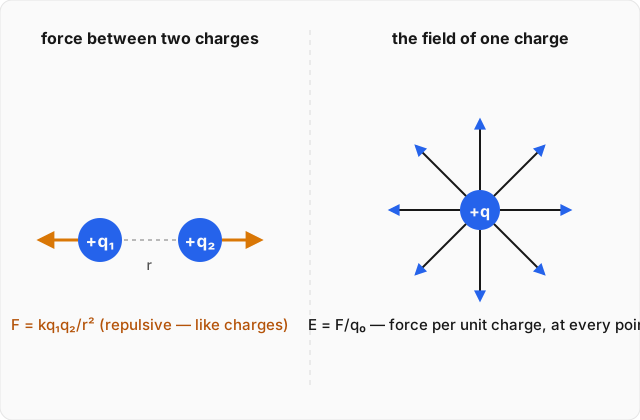
For two point charges and separated by a distance , the magnitude of the electric force each exerts on the other is:
Look at the shape of this equation before doing anything else with it. It is an inverse-square law — double the distance, and the force drops to a quarter — and if that structure looks familiar, it should: it's the same shape as the gravitational force between two masses. That resemblance is not decoration. Both forces emerge from a point source spreading its influence evenly over the surface of an ever-expanding sphere, and the surface area of a sphere grows as , which is exactly why both laws fall off as . The deep difference is that gravity only pulls — there's no such thing as negative mass — while Coulomb's law can push or pull depending on the signs of and . Multiply two like signs and the product is positive (repulsive); multiply opposite signs and it's negative (attractive).
Written as a full vector equation, with the unit vector pointing from one charge to the other,
a positive value of produces a force along — pushing the charges apart — and a negative value flips it, pulling them together. The sign convention does all the work; you never have to reason separately about "repel" versus "attract" once you trust the algebra.
When more than two charges are present, the total force on any one of them is simply the vector sum of the Coulomb forces from every other charge individually — a superposition principle, exactly like adding up several forces in a free-body diagram from Newton's laws. Nothing new has to be invented for many-charge systems; you just add more vectors.
The field: force without the other charge yet present
Here is a conceptual move worth taking seriously, because it will matter far beyond this page. Instead of asking "what force does charge exert on charge ," ask a more patient question: "what would charge do to any small positive test charge, placed at any point nearby?" Define the electric field at a point as the force per unit charge a tiny positive test charge would feel there:
For a single point charge , combining this definition with Coulomb's law gives the field it creates at distance :
The field exists whether or not a second charge is actually there to feel it — it's a property of the space around , not a statement about a specific pair of charges. This might look like a relabeling trick, and at this stage it mostly is one. But it's the same relabeling that, generalized and taken fully seriously, becomes the subject of classical field theory: a quantity assigned to every point of space, evolving according to its own equations, capable of carrying energy and momentum even through empty space where no charge sits at all. The electric field is the first real, physical field this track has met — not a toy chain of springs standing in for one, but the genuine article, and its full dynamical law (how the field is generated, and how it changes with time) is where this branch of the track is heading next.
Worked example
Two point charges, , sit at cm and cm. Find the electric field at the point cm. (click to reveal the solution)
Setting up: By symmetry, the point lies on the perpendicular bisector of the line joining the two charges, the same distance from each. Compute that distance using the Pythagorean theorem:
Magnitude of each charge's field, using :
Both charges are the same distance away and carry equal charge, so both produce a field of this same magnitude at the point — but pointing in different directions, and that's where the vector nature of the field matters.
Finding the directions: The 3–4–5 triangle formed by each charge and the field point gives the direction cosines directly, without needing trigonometric tables. The field from the charge at points away from that charge, toward — a direction with components . The field from the charge at points away from that charge instead, toward — components .
Adding the two field vectors as components:
The horizontal components are equal and opposite — they cancel exactly, which had to happen given the left-right symmetry of the charge arrangement.
The vertical components, by contrast, point the same way for both charges and add directly.
Result:
a field pointing straight up, away from the pair of positive charges, with no horizontal component at all. Notice that the symmetry argument told us before a single number was computed — a useful habit: let the geometry do as much of the work as possible before turning to arithmetic.
Where this leads
Coulomb's law and the field it defines are the electric analog of everything Newton's laws built for mechanical forces — a force law, a superposition principle, and now a field concept that mechanics never needed because gravity, for most everyday purposes, only ever involves one dominant source (the Earth) at a time. Electric charges rarely come one at a time, and the field concept introduced here — force reframed as a property of space itself — is about to become indispensable as this track builds toward the full theory of electricity, magnetism, and the electromagnetic field whose quantized excitation is the particle of light itself.