Push on the plunger of a bicycle pump with the outlet blocked, and you feel the air pushing back, harder and harder the more you compress it. Where is that push coming from? There's no spring inside the pump, no elastic material doing the resisting — just air, which is to say, practically nothing: molecules so small and so sparse that the pump feels empty to the eye. And yet something in there is shoving back on your hand with real, measurable force.
Here's the strange part: that force is completely steady. It doesn't flicker or pulse — it feels exactly like pushing against a spring. But a gas has no spring in it. What it has, instead, is an enormous number of molecules, each one utterly indifferent to your hand, doing nothing but flying in a straight line until it hits something. The steady push you feel is an illusion of scale: billions of individually violent, individually brief impacts per second, arriving so fast and so densely that they blur into what feels like one continuous force. This topic is about taking that picture completely literally, and following it all the way to a formula.
A gas as a swarm of elastic collisions
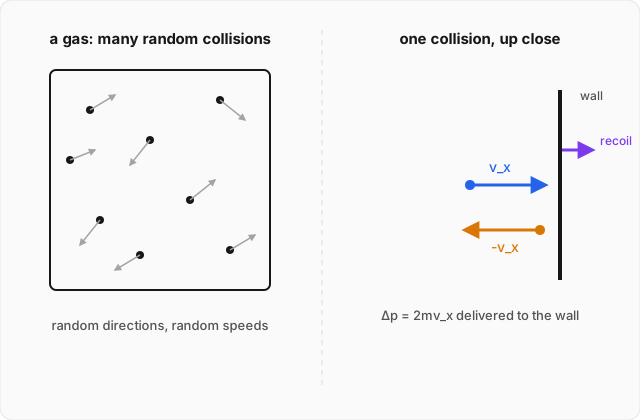
Model a gas the simplest way physically possible: a huge number of identical particles, each with mass , flying around inside a container in straight lines at various speeds and in various directions, only changing course when they collide — with each other, or with a wall.
Assume every one of these collisions is elastic, in the exact sense built in momentum and collisions: momentum is conserved, and so is kinetic energy — nothing is lost to heat, sound, or deformation. This isn't an approximation we're apologizing for; for point-like molecules bouncing off a rigid wall, it's an extremely good one. And it has a clean consequence for a particle hitting a flat, immovable wall: since the wall doesn't move (in the same way an object of much greater mass barely recoils in a collision), the only way for both momentum and kinetic energy to balance is for the particle to bounce straight back with its speed unchanged — the component of velocity perpendicular to the wall simply reverses sign, while the components parallel to the wall aren't touched at all, since the wall can't push sideways on something hitting it head-on.
That reversal is the entire engine of this topic. Every one of those collisions delivers a tiny kick of momentum to the wall. Pressure is nothing more than the accumulated effect of an astronomical number of those kicks per second, spread over the wall's area.
From one collision to a macroscopic pressure
To turn "lots of little kicks" into a number, we need to add up the momentum delivered by every particle, over some interval of time, and divide by the wall's area — because pressure is defined as force per unit area, and force is the rate at which momentum is delivered, , straight from Newton's second law in the form used to derive momentum conservation in the previous topic.
The full bookkeeping — tracking one particle's round trips across the box, then summing over all of them, then using the fact that a gas has no preferred direction to relate the sideways motion to the total speed — is carried out in complete detail below. It ends in one of the most useful equations in all of physics:
where is the average of the squared speed, averaged over all particles in the gas — not the square of the average speed, a distinction that will matter a great deal in the next topic.
Worked example
Derive from first principles, using only the wall-collision picture above. (click to reveal the solution)
Setting up: put identical particles of mass in a cubical box of side , so the volume is . Focus on the wall at , perpendicular to the -axis, with area . Track one particle with velocity components .
Momentum delivered in a single collision: the particle hits the wall at , and by the elastic-collision argument above, bounces straight back with its -velocity reversed: , while and are unaffected. The particle's own momentum change is . By Newton's third law, the wall receives the opposite: per collision.
Time between collisions with this wall: after bouncing off the wall at , the particle travels to the opposite wall at and back before it can strike the wall at again — a round trip of distance at speed (its -velocity doesn't change in magnitude between wall hits, since the only walls that touch at all are the two perpendicular to ). So the time between successive hits on this one wall is:
Average force from one particle: force is momentum delivered per unit time, so this single particle's average contribution to the force on the wall is:
Summing over all particles: every particle in the box makes the same kind of contribution, with its own value of . Adding them all up:
where is the average of the squared -velocity over all the particles.
Turning force into pressure: divide by the wall's area, :
Removing the special direction : nothing in this problem actually singles out the -axis — the gas doesn't know which wall we happened to analyze first, so by symmetry . Since for every particle, averaging both sides gives , so:
Substituting back:
Every step used only Newton's laws, the definition of an elastic wall collision, and a symmetry argument — no new physical assumption was smuggled in anywhere. A quantity that felt like it belonged to thermodynamics has been produced entirely out of mechanics.
Temperature unmasked
Here's where this pays off completely. You likely already know the ideal gas law from chemistry, , where is Boltzmann's constant and is the absolute temperature — an empirical relation, discovered from measurements on real gases long before anyone knew why it should be true. Compare it directly to what we just derived:
The cancels immediately, and a small rearrangement gives:
The left-hand side is exactly the average translational kinetic energy of one molecule. Temperature, in other words, is not some separate, mysterious quantity that happens to correlate with molecular motion — temperature is a direct measure of the average kinetic energy per molecule, up to the fixed conversion factor . Heat a gas, and you are, quite literally, making its molecules move faster on average. Cool it toward absolute zero, and you are asking — every molecule's random motion draining away, at least in this classical picture.
Notice what's still hiding inside that innocent-looking angle bracket, . It's an average over molecules that are, in general, moving at wildly different individual speeds — some fast, some slow, colliding and exchanging energy constantly. We derived a fact about the average without ever asking what the full spread of speeds around that average actually looks like. That question — how many molecules move at exactly , versus — turns out to have a precise mathematical answer, and it is the very next thing this track builds.
Where this leads
Nothing here required anything beyond Newton's laws and the elastic-collision reasoning from momentum and collisions — pressure and temperature, concepts that feel like they belong to an entirely different branch of physics, fell directly out of mechanics once we agreed to track an enormous number of particles at once instead of just one or two. That shift in perspective — from "solve for this one object's motion" to "reason statistically about billions of them" — is the entire method of statistical mechanics, and this was only its first payoff. The next topic confronts the loose end left dangling above: not every molecule moves at , so what fraction move at any given speed?