Picture two ice skaters gliding toward each other on a frictionless rink. They collide, arms flail, and then they move apart — perhaps one shoots backward while the other barely changes course. For the brief instant of contact, the forces are enormous and complicated. The skaters bend, their gloves compress, and the exact force changes from moment to moment.
Now ask the surprisingly clean question: is there anything about the motion before the collision that must still be true afterward?
There is. To find it, we need one more quantity. You already know force, which tells us how motion changes, and energy, which lets us compare a system before and after without following every instant in between. Why introduce yet another quantity when those two tools already seem to cover the territory?
Because collisions have a special feature: the forces may be complicated, but they come in equal-and-opposite pairs. Newton's third law is about to turn that paired pushing into a conservation law.
Momentum: mass with a direction
Define the linear momentum of an object as its mass multiplied by its velocity:
Momentum is a vector. A 2.0 kg cart moving east at 3.0 m/s has momentum east; the same cart moving west has momentum of the same size but the opposite direction. That sign is not decoration. In a collision, one object's momentum can cancel another's, and that cancellation is exactly what the conservation law keeps track of.
The units also tell you something useful:
Momentum is therefore a measure of how much "motion" an object carries in a particular direction. A loaded truck and a tennis ball can have the same momentum if the smaller object is moving much faster. They will not behave identically in every situation — the truck and ball can have very different energies — but in a collision, momentum is the quantity that adds cleanly.
Why momentum is not kinetic energy
It is reasonable to ask whether momentum is just kinetic energy wearing different notation. It is not. Kinetic energy is a scalar:
Momentum is a vector and depends linearly on speed:
Reverse an object's direction and its momentum changes sign, while its kinetic energy stays exactly the same because . Two equal carts moving toward one another can have total momentum zero, even though they have plenty of kinetic energy. The energy tells you how much capacity for change or deformation the motion contains; the momentum tells you the net direction and amount of motion that must be accounted for when objects push on each other.
That difference is why the two tools answer different questions. Energy is often the cleanest way to find a speed after a smooth change in height or position. Momentum is often the cleanest way to find what happens when several objects exert huge forces on one another for a very short time.
Newton's third law becomes conservation of momentum
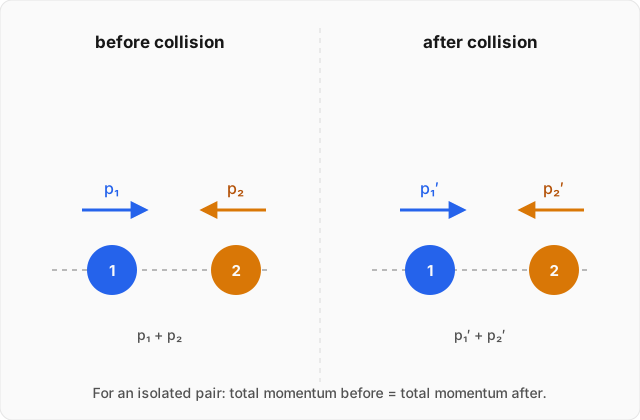
Let's derive the conservation law instead of treating it as a mysterious extra rule. Take two objects, 1 and 2, with no net external force on the pair. During their interaction, object 1 pushes on object 2 with force , while object 2 pushes back on object 1 with force . Newton's third law says:
For constant masses, Newton's second law can be written in momentum form. For object 1:
and for object 2:
Add those two equations. The third-law forces cancel because they are equal in magnitude and opposite in direction:
Combine the derivatives:
And a quantity whose time derivative is zero is constant. Therefore:
or, substituting :
This is conservation of momentum. It is not a fourth law sitting beside Newton's three. It is what the second and third laws say together when we look at the two interacting objects as one system. The internal forces cancel in the system total; only an external force could change the total momentum.
Elastic and inelastic collisions
Momentum conservation does not care whether the objects bounce, deform, make a sound, or stick together. If the pair is isolated, total momentum is conserved in all of those cases. What changes is the kinetic energy.
In an elastic collision, kinetic energy is conserved as well as momentum:
Ideal billiard-ball collisions are a useful approximation. In a real collision, some kinetic energy usually becomes sound, heat, or the energy of bending and denting. Those are inelastic collisions: momentum is still conserved, but kinetic energy is not.
The phrase "energy is not conserved" needs a careful translation. Total energy is never destroyed. In an inelastic collision, kinetic energy is not conserved because some of it has moved into other forms. A perfectly inelastic collision is the limiting case in which the objects stick together and leave with one common velocity. It loses as much kinetic energy as the laws of momentum allow, while still conserving momentum exactly.
Worked example
A 2.0 kg cart moving at 3.0 m/s strikes a stationary 4.0 kg cart, and the carts lock together. What is their common velocity after the collision, and how much kinetic energy is lost? (click to reveal the solution)
Setting up: The carts lock together, so this is a perfectly inelastic collision. Choose the moving cart's direction as positive. The first cart has and ; the second has and .
Conservation of momentum: After they lock together, both carts share one velocity :
Substitute the values:
The joined carts move at in the original direction of the first cart. Notice how the final speed is lower: the same total momentum is now being carried by twice as much mass.
Kinetic energy before:
Kinetic energy after:
So the kinetic energy lost is:
The minus sign means that of kinetic energy has left the organized motion of the carts and become deformation, sound, heat, and other internal energy. Nothing has violated energy conservation. Momentum and kinetic energy are simply tracking different aspects of the same event.
Where this leads
Momentum and work-energy are both direct children of Newton's laws, but they are siblings rather than steps in one narrow chain. They give you two independent tools for analyzing the same kinds of systems: momentum is especially powerful when objects interact briefly and force details are messy, while energy compares states without needing the full history. Together they prepare you for more advanced mechanics, where the same ideas reappear in Lagrangian mechanics, Hamiltonian mechanics, and eventually the quantum description of motion.