Here's a problem Newton's laws make surprisingly painful: a block is attached to a spring. You stretch the spring and let go. How fast is the block moving once the spring returns to its natural length?
You know the tool: . But a stretched spring doesn't push with a constant force — it pushes harder the more it's stretched, and less as it relaxes. So the acceleration is different at every single instant, which means the velocity you're solving for is tangled up in a moving target. You can grind through this with calculus, and physicists do. But it's worth asking whether there's a shortcut that avoids the grinding entirely. There is, and it's built around a single new idea: energy.
Work: what a force actually accomplishes
Define the work done by a force as the force times the distance over which it acts, in the direction of motion:
or, more generally, when the force is applied at an angle to the direction of travel:
That carries a genuinely counterintuitive consequence: a force applied perpendicular to motion does exactly zero work, no matter how hard you push. Carry a heavy bag of groceries at constant height across a flat parking lot, and your arm is doing real, tiring, physiological work — but in the physics sense, gravity is doing zero work on the bag, because gravity points straight down while the bag moves horizontally. Physics work and "feels like work" are not the same thing, and it's worth sitting with that mismatch for a second, because it's exactly the kind of thing that separates a formal definition from an intuition.
Kinetic energy: the energy of simply moving
Notice that , not . Double an object's speed and you don't double its kinetic energy — you quadruple it. This single exponent is the reason stopping distances grow so viciously with speed, and why a car crash at double the highway speed limit isn't twice as violent, but four times.
The payoff: the Work-Energy Theorem
Now for the result that makes this whole reformulation worth it. Start from , combine it with the kinematic relation from way back in the first topic, and the acceleration cancels out entirely, leaving:
The net work done on an object equals its change in kinetic energy. This is not new physics bolted onto Newton's laws — it's mathematically identical to them, just repackaged. But look at what that repackaging buys you: work is defined as force times distance, and for a varying force, "distance-times-force" is exactly the area under a force-vs-distance graph. Suddenly a problem that was a nightmare in the language of instant-by-instant acceleration becomes a straightforward geometry problem: just measure the area.
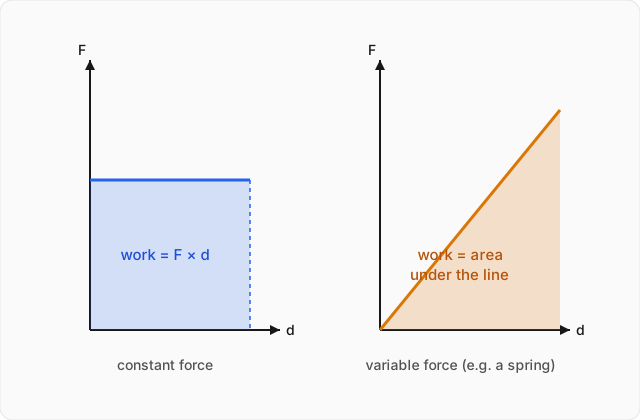
This is precisely how you'd finish the spring problem we opened with: instead of tracking acceleration instant-by-instant, compute the triangular area under the spring's force-vs-distance line to get the work done, set it equal to the block's final kinetic energy, and solve for . No calculus-of-a-changing-force required.
Potential energy and a very useful shortcut
Some forces are special: the work they do depends only on where you start and end, never on the path you took to get there. Gravity is one; an ideal spring is another. These are called conservative forces, and for each one we can define a potential energy — a kind of energy accounting trick — such that the work the force does equals the negative change in . Near Earth's surface, . For an ideal spring stretched or compressed a distance , .
The payoff is conservation of mechanical energy: if only conservative forces are doing work, then stays exactly constant throughout the motion, even as the two trade off against each other. A ball rolling downhill trades potential energy for kinetic energy at every instant, but their sum never budges. This lets you answer "how fast is it moving here?" questions by comparing only the start and the end — without ever computing a force, an acceleration, or a single moment in between.
Worked example
A 2.0 kg ball is released from rest at the top of a frictionless hill, 5.0 m above the ground. How fast is it moving when it reaches the bottom? (click to reveal the solution)
Setting up: No friction means the only force doing work is gravity — conservative, so mechanical energy is conserved. At the top, the ball has potential energy and no kinetic energy (it starts at rest). At the bottom, all of that has converted into kinetic energy, since height, and therefore , is now zero.
Conservation of energy:
Notice the mass appears on both sides and cancels — the ball's speed at the bottom doesn't depend on how heavy it is, only on how high it started. Solving for :
We found the ball's final speed without ever mentioning the shape of the hill, the normal force along the way, or a single instant of the trip in between — exactly the shortcut this whole topic was built to deliver.
Where this is heading
We now have two complete, fully equivalent descriptions of mechanics: Newton's force-and-acceleration picture, and this energy-based one. It's tempting to think that's the end of the reformulating — but it isn't. The move we just made, replacing "what pushes it" with "what energy-like quantity is conserved," turns out to be the seed of something much bigger. Once systems get complicated — multiple constrained parts, awkward coordinates, rotating frames — even the energy picture as we've built it here starts to strain. The full generalization of this idea is called Lagrangian mechanics, and it's where we go next.