Here's a fact that saved a lot of lives before anyone fully understood why: if lightning strikes a car, the people inside are safe, even though the car's metal body is now carrying a huge amount of charge. Michael Faraday demonstrated the same idea deliberately, building a room lined with metal foil, charging it with a powerful generator, and sitting inside it with an electroscope — an instrument sensitive enough to detect the faintest trace of an electric field — and watching it register nothing at all. The charge was undeniably there, on the metal. And yet, inside, the field was exactly zero. That's not a coincidence or a special property of cars and foil rooms; it's a direct, forced consequence of what a conductor is, and Gauss's law is the tool sharp enough to prove it outright rather than just observe it.
What makes a conductor a conductor
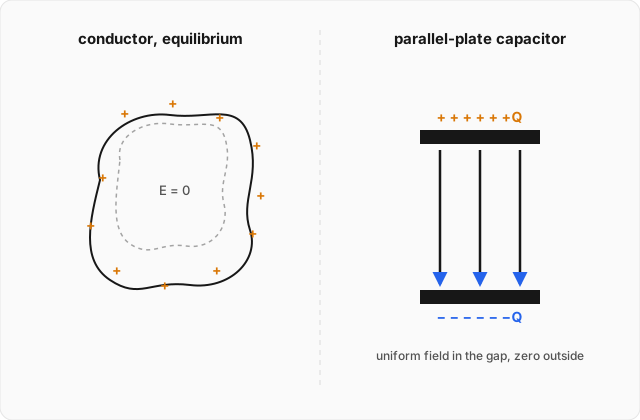
A conductor is a material with charges free to move through it — in a metal, these are electrons that aren't bound to any particular atom and can drift essentially freely in response to any force pushing on them. This one property has an immediate and inescapable consequence: in electrostatic equilibrium (everything has settled down, nothing is still moving), the electric field inside a conductor must be exactly zero. If it weren't, the free charges sitting in that nonzero field would feel a force and start moving — but "charges are still moving" is exactly what electrostatic equilibrium rules out by definition. The field inside a conductor at equilibrium isn't small, or negligible, or a good approximation; the argument is airtight, an internal field of any nonzero size would be self-undermining, so it has to be identically zero.
Where does the charge go? Gauss's law answers directly
Take any conductor carrying a net charge, and draw an imaginary Gaussian surface entirely inside the conducting material, hugging just beneath its actual surface. Every point on this imaginary surface sits inside the conductor, where the field is zero — so everywhere on it, and the flux through it is zero:
Gauss's law then says the enclosed charge must also be zero: . But this imaginary surface can be drawn as close to the conductor's actual outer boundary as you like, still entirely inside the material — so any charge the conductor carries cannot be sitting anywhere in its interior at all. It has nowhere left to go except the outermost surface. This is the second half of the picture Faraday's cage demonstrates: not only is the interior field-free, but every bit of the charge you put on a conductor migrates to its surface and stays there, however oddly shaped the conductor is.
A third fact falls out for free: just outside a conductor's surface, the field is always exactly perpendicular to that surface. If it had any component running parallel to the surface, that component would push the conductor's free surface charges sideways, along the surface, and they would keep redistributing until they didn't — which is exactly to say, in equilibrium, no such component can remain.
Capacitance: how much charge for how much potential
Take two conductors, carrying equal and opposite charges and , separated by empty space or an insulator. A potential difference exists between them (computable, in principle, from as in electric potential), and it turns out and are always directly proportional to each other for a fixed geometry — double the charge on each conductor and you exactly double the potential difference between them, because the field at every point doubles too, being sourced entirely by that charge. This constant ratio is called the capacitance:
Capacitance is purely a property of the geometry of the two conductors — their shapes, sizes, and separation — not of how much charge happens to be sitting on them at a given moment; put twice the charge on the same pair of conductors and doubles right along with it, so their ratio doesn't change. It's measured in coulombs per volt, a unit given its own name, the farad (F).
The parallel-plate capacitor
The cleanest example, and the one this section derives in full: two flat conducting plates, each of area , facing each other a small distance apart, carrying charges and . Because the plates attract each other's charge, essentially all of the charge sits on the two facing inner surfaces, each with a uniform surface charge density .
Finding the field between the plates, using a Gaussian pillbox that straddles the inner surface of the positive plate — one flat face of the pillbox buried inside the conducting plate itself, the other flat face poking out into the gap between the plates, with the pillbox's curved side irrelevant since the field runs perpendicular to it. The face inside the conductor contributes zero flux, since there. The face in the gap contributes , since the field is uniform and perpendicular to that face. Setting flux equal to enclosed charge over , and calling the pillbox's face area (a small patch, not the whole plate):
The patch area canceled, exactly as it should for a field that can't depend on the arbitrary size of the imaginary pillbox used to find it — and, outside the plates entirely, an identical pillbox argument (or direct superposition of the two plates' fields) shows the field is exactly zero, since the contributions from the two oppositely-charged plates cancel there instead of adding.
Finding the potential difference, using : since is uniform and points straight from the positive plate to the negative one over the gap of width , the potential drops linearly, and the total drop is simply field times distance:
Assembling the capacitance:
Notice the charge canceled completely — exactly as the general definition of capacitance promised it must, since is a statement about geometry alone. Bigger plates (larger ) store more charge per volt, matching the intuition that a bigger conductor has more room to spread charge out at lower mutual repulsion; a smaller gap () does too, because the two plates' opposite charges pull on each other's charge more strongly when they're closer, packing more charge on for the same potential difference.
Energy stored in a capacitor
Charging a capacitor means moving charge, bit by bit, from one plate to the other against an ever-growing potential difference — the first bit of charge moves almost for free, since starts at zero, but each subsequent bit faces a slightly larger than the last, since grows as charge accumulates. The work needed to move a small increment against the potential difference already present is , and summing (integrating) this from an empty capacitor () up to the final charge :
Using , this can equally be written or — three equivalent forms of the same energy, useful in different combinations depending on which of , , a given problem hands you. This energy is genuinely stored, recoverable in full (in the idealized case) by discharging the capacitor back through a circuit — exactly the electrical analog of the spring potential energy from work and energy, with charge playing the role displacement played there.
Worked example
A parallel-plate capacitor has plates of area separated by in vacuum. It is charged to a potential difference of . Find the capacitance, the charge stored, and the energy stored. (click to reveal the solution)
Setting up: we're given the geometry ( and ) and the operating voltage ; throughout.
Capacitance, from the geometric formula derived above:
Charge stored, using the definition directly:
A small amount of charge for a very ordinary-sized capacitor — a useful reminder of just how enormous the coulomb actually is as a practical unit of charge.
Energy stored, using , the most convenient of the three equivalent forms since and are already both in hand:
Checking with the alternate form, using as a consistency check:
matching exactly, as it must, since both formulas are algebraically the same statement written with different variables substituted in.
Interpreting the result: roughly nanojoules — a tiny amount of energy by everyday standards, consistent with the tiny amount of charge involved, but the same physics scales up directly: a real capacitor bank built for pulsed power applications uses the identical formula with in the range of farads rather than picofarads, storing energies large enough to weld metal or drive a defibrillator.
Where this leads
Everything in this topic has been electrostatics — charges sitting still, fields and potentials that don't change in time. The moment charge is allowed to move continuously, rather than just redistributing once and stopping, a whole new set of ideas opens up: current, resistance, and circuits, which is exactly where electric current and circuits picks up next. Further down this track, once charges are moving fast enough and in the right configurations, they generate an entirely new kind of field — magnetic — which is the subject of magnetic field and force.