In 1820, Hans Christian Oersted was setting up a lecture demonstration and noticed something that should not have been possible under the physics he'd been taught: every time he closed a switch and sent current through a nearby wire, a compass needle sitting on the table twitched and swung to point sideways, across the wire instead of north. Break the circuit, and the needle drifted back. Nothing about Coulomb's law, nothing about static charge, predicted this. A compass needle is a magnet, and here was an electric current — charges in motion, nothing more — pushing on it as though it were another magnet entirely. Electricity and magnetism, two subjects that had been developing on separate tracks for a century, turned out to be the same thing wearing two different masks. This page is about the mask called magnetism, and the strange rule that governs it.
The magnetic field and the Lorentz force
A magnetic field, written , is defined operationally, the same way the electric field was: put a charge in it and see what force it feels. But the rule turns out to be genuinely different in character from Coulomb's law. A charge sitting still in a magnetic field feels nothing at all. Only a moving charge feels a magnetic force, and the force depends on the direction of motion relative to the field, not just the field's strength. The full rule is the Lorentz force law:
Everything unusual about magnetism is packed into that cross product. Recall its meaning: has magnitude , where is the angle between and , and it points perpendicular to both and , in the direction your right hand's thumb points when your fingers curl from toward . A charge moving parallel to feels no force at all (); a charge moving perpendicular to feels the maximum possible force, aimed sideways to its own motion.
That last detail is worth sitting with, because it has a consequence unlike anything in Newton's laws so far: the magnetic force is always perpendicular to the velocity that produces it. It can never point even slightly forward or backward along the direction of travel.
A force that does no work
Work and energy defined work as , and singled out as the one angle where a force, however large, accomplishes nothing. The magnetic force lives permanently at that angle. Since is by construction perpendicular to at every instant, the power it delivers is
using the fact that is perpendicular to , so their dot product vanishes identically — not approximately, not for special cases, but always, for any and any . Zero power at every instant means zero work over any stretch of time. A magnetic field can never speed a charged particle up or slow it down. It can only steer it — bend its path, change its direction — while leaving its kinetic energy, and therefore its speed, completely untouched. This is the single fact that makes everything else about magnetic force fall into place, including the worked example below.
Force on a current-carrying wire
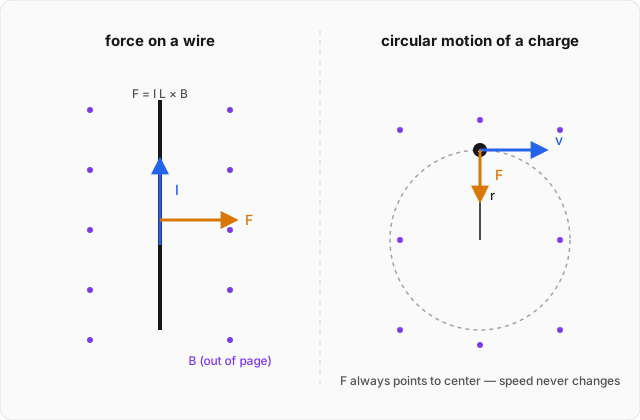
A current is nothing but a great many moving charges, so a wire carrying current in a magnetic field should feel a force too — this is exactly the force that swung Oersted's compass needle, seen from the other side. Consider a straight wire of length and cross-sectional area , carrying current , sitting in a field . Inside the wire, charge carriers of charge drift with velocity pointing along the wire, at number density per unit volume — exactly the microscopic picture behind the current density from circuits. The number of carriers inside the wire segment is , so the total force is the sum of the Lorentz force on every one of them:
Now use (current equals charge density times drift speed times area, the same relation underlying current density) to trade for . Writing and factoring:
Defining , a vector of length pointing along the current's direction, this is usually written
The drift speed — normally sluggishly slow, millimeters per second in a typical wire — cancelled out completely. It had to: the force on a wire can't depend on some invisible microscopic velocity, only on the current actually measured by an ammeter, and that's exactly what survived.
Worked example
A particle of charge and mass moves at speed perpendicular to a uniform magnetic field . Show that its path is a circle, and find the radius and period of that circle. (click to reveal the solution)
Setting up: the particle moves perpendicular to , so and the Lorentz force has constant magnitude , always perpendicular to . We already established that a magnetic force can never change a particle's speed — only its direction. A force of constant magnitude, always perpendicular to the velocity, always pointing the same way relative to the motion (say, always to the particle's left) is exactly the geometric definition of uniform circular motion: it's a centripetal force.
Applying Newton's second law in centripetal form, , and equating it to the magnetic force magnitude:
Solving for the radius, canceling one factor of from each side:
This is the cyclotron radius. Notice its shape: a faster particle, or a heavier one, needs a larger circle to turn on; a stronger field or a bigger charge tightens the circle. Every piece of that makes physical sense on its own — more inertia resists turning, more force enforces it.
Finding the period: the particle covers the full circumference once per orbit, at constant speed , so
The striking part of the result: the speed cancelled out completely. The orbital period doesn't depend on how fast the particle is moving at all — a slow particle traces a small circle, a fast particle traces a large circle, and both complete one lap in exactly the same time. This is not a coincidence of the algebra; it's the reason particle accelerators called cyclotrons work at all: a charged particle can be accelerated in tiny kicks once per orbit, using an alternating voltage at one fixed frequency , and the timing never needs to be adjusted as the particle speeds up and spirals outward to larger and larger radii.
Where this leads
The Lorentz force tells you what a magnetic field does to a charge, but it says nothing yet about where a magnetic field itself comes from. Oersted's compass needle is the clue: currents make magnetic fields, the same way charges make electric fields. Finding the precise law for that — how much field a given current produces, and how to compute it efficiently using the same integral machinery built in line and surface integrals — is the subject of the next topic.