Take a loop of wire, connect nothing to it — no battery, no power supply, nothing — and just push a bar magnet through the middle of it. An ammeter wired into the loop twitches. Current flows, briefly, while the magnet is moving. Hold the magnet still inside the loop, and the current vanishes, even though the magnetic field at that instant is just as strong as it was while the magnet was moving. Pull the magnet back out, and current flows again — in the opposite direction this time. Nothing about Ampère's law predicts any of this: that law tells you what field a current produces, not what a changing field might do to a loop of wire sitting there passively. Something new is going on, and Michael Faraday spent years in the 1830s tracking exactly what.
Magnetic flux: how much field passes through a loop
The relevant quantity turns out to be a familiar-looking one, the same flux integral built in line and surface integrals, now applied to instead of :
measures how much magnetic field threads through a surface bounded by the loop of wire. It grows if the field gets stronger, if the loop gets bigger, or if the loop tilts to face the field more directly — three completely different physical actions, all captured by the same one number.
Faraday's law
Faraday's experiments boil down to one precise statement: a changing magnetic flux through a loop induces an electromotive force (EMF, denoted ) around that loop, equal to the negative rate of change of the flux:
This is Faraday's law. Read the left side carefully: is a circulation of the electric field around the closed loop — and that's already strange, because the electric potential was built entirely on the premise that is conservative for static charges, meaning always. Faraday's law says that's only true when nothing is changing. The instant a magnetic flux starts varying in time, the electric field it induces has nonzero circulation — it is no longer a conservative field, no longer derivable from a potential alone, and it can genuinely drive charges around a closed loop the way a battery does, with no battery in sight.
Turning this into a local law works exactly the way it did for Ampère's law: apply Stokes' theorem to the left side,
and write the flux derivative as an integral of over the same fixed surface,
Since these two surface integrals must agree for every choice of loop and surface, the integrands must agree pointwise:
A changing magnetic field, at any single point in space, is a local source of circulating electric field right there — no wire, no loop, no charge required. The loop and the ammeter in Faraday's original experiment were never the fundamental physics; they were just a convenient way to detect an electric field that a changing creates in the empty space around it, whether or not a conductor happens to be sitting there to carry the resulting current.
Lenz's law: the direction, for free, from energy conservation
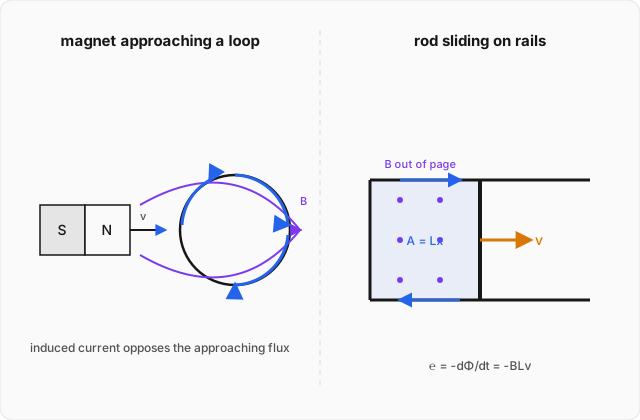
Faraday's law's minus sign is not decoration — it fixes the direction of the induced current, and that direction is not arbitrary. Lenz's law states it physically: the induced current always flows in the direction that opposes the change in flux that caused it. Push a magnet's north pole into a loop, and the induced current flows in the direction that makes the loop itself act like a north pole facing the incoming magnet, repelling it, resisting the increase in flux.
This isn't a separate law bolted onto Faraday's — it's a consequence of energy conservation, and it's worth seeing why the alternative is impossible. If the induced current instead reinforced the change in flux, pulling the magnet in faster, the magnet would accelerate on its own, gaining kinetic energy for free while also driving a current that dissipates energy as heat in the wire's resistance — energy manufactured from nothing, twice over. Nature doesn't allow it: the induced current must fight the motion that creates it, so that whatever mechanical work is done pushing the magnet in is exactly what pays for the electrical energy delivered to the loop.
Worked example
A conducting rod of length slides with speed along two parallel rails, closing a circuit of total resistance , inside a uniform magnetic field pointing perpendicular to the plane of the rails. Find the induced EMF, the induced current, and verify the same EMF by computing the force on the charge carriers directly. (click to reveal the solution)
Setting up: as the rod slides, it sweeps out area, enlarging the circuit loop and increasing the flux through it. Let be the distance from the rod to the closed end of the rails, so the enclosed area is , and the flux is
Applying Faraday's law: differentiate the flux with respect to time, using :
The magnitude of the induced EMF is ; the sign is Lenz's law's business, fixing the current's direction to oppose the increasing flux, which the geometry (not written out here) confirms flows in the sense that makes the loop's own field oppose inside it.
Finding the current, treating this induced EMF exactly like a battery driving current through resistance , by Ohm's law:
Cross-check — computing the same EMF from the Lorentz force directly: every charge inside the moving rod moves with the rod's velocity , and therefore feels a magnetic force , pushing it along the rod's length. This force does the job an electric field would do in an ordinary battery, so define an effective driving field along the rod, , with magnitude (velocity and field are perpendicular by setup). The EMF is this effective field integrated along the rod's length :
Comparing: both methods — Faraday's flux-rule bookkeeping, and a direct force calculation on individual charge carriers — give the identical magnitude . This had to happen: the "moving rod" picture and the "changing flux" picture are two descriptions of exactly the same physics, one from the reference frame of the charges being pushed, the other from the bookkeeping of the loop's changing area. Faraday's law is powerful precisely because it lets you skip the force-by-force argument and get the answer from geometry alone.
Where this leads
Between the previous topic and this one, electricity and magnetism have now closed a loop on each other: currents make magnetic fields (Ampère), and changing magnetic fields make electric fields (Faraday). That symmetry is suggestive, almost begging for one more piece to make it complete — and indeed there is one, a subtle correction to Ampère's law that James Clerk Maxwell spotted by demanding the equations stay logically consistent. Finding it, and assembling everything built across this entire branch of the track — Coulomb, Gauss, Ampère, and Faraday — into one unified set of four equations, is the next topic.