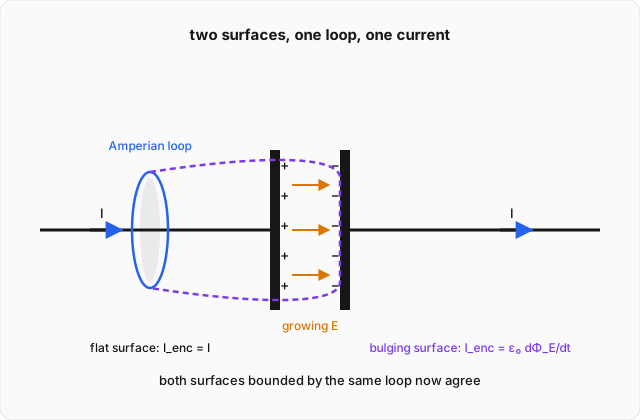
Imagine a capacitor being charged: current flows in through one wire, charge piles up on one plate, and current flows back out the other wire, with nothing but empty space — no wire, no charge carriers — sitting in the gap between the plates. Now try to apply Ampère's law to a loop that circles the wire feeding the capacitor. Ampère's law says , and it insists that is "the current through any surface bounded by the loop" — but it never specifies which surface, and Stokes' theorem's whole promise was that it wouldn't matter. Stretch a flat disk across the loop, punctured by the wire: it reports . Stretch a different surface across the same loop instead, one that bulges out and slips between the capacitor's plates without ever touching the wire: it reports , since no charge carrier ever crosses the gap. Same loop, same law, two different answers. Something in Ampère's law, as written so far, is broken.
Finding the crack: charge conservation
The break shows up cleanly if you take the divergence of Ampère's law in its differential form, . The divergence of any curl is identically zero — a general fact about vector fields, not specific to this one — so the left side vanishes no matter what is:
But that can't be a general law. Charge is locally conserved — it doesn't vanish or teleport — and the precise statement of that fact is the continuity equation: whatever current density flows outward from a point drains the charge density piled up there, at exactly the matching rate,
Inside the charging capacitor, charge is actively accumulating on the plate: , so there. Ampère's law, as Ampère left it, silently demanded everywhere, always — a statement that's only true for steady currents that never pile up charge anywhere. It's not that Ampère's law is wrong; it's incomplete, built for a special case (magnetostatics) that the charging-capacitor problem simply isn't.
Maxwell's fix: the displacement current
Maxwell's move was to add a term to Ampère's law chosen specifically to repair this — and Gauss's law hands you exactly the right one. Recall from Gauss's law. Add the term to the right side of Ampère's law:
The added piece, , is called the displacement current density — not an actual flow of charge, but a changing electric field that turns out to source a magnetic field exactly as if it were one. In the capacitor's gap, no charge crosses, but the electric field between the plates is growing every instant the capacitor charges, and that growing supplies precisely the missing piece: the bulging surface, which sees zero conduction current, sees a nonzero displacement current instead, and the two surfaces once again agree. The worked example below checks, in full, that this fix does exactly the job it was built for: restoring the continuity equation as an automatic consequence rather than a special-case accident.
The four equations
With this correction in hand, everything discovered across this entire branch of the track collapses into four equations, each a local, differential statement built from nothing but and — the divergence and curl introduced back at the start of the mathematical-methods track:
The second equation deserves a moment on its own, because unlike the other three it isn't the correction of some previously-broken law — it's a statement that's been true, silently, since the Biot-Savart law was first written down. Electric field lines start and end on charges, but magnetic field lines never do; the Biot-Savart law builds purely out of circulating contributions , which never produces a field with any net outward flow from a point. No isolated magnetic "charge" — a magnetic monopole, a lone north pole with no south — has ever been observed, and is the precise statement that there is nothing for magnetic field lines to start or stop on: they only ever form closed loops.
These four equations, together with the Lorentz force law that tells you what the fields do once you have them, are the complete classical theory of electricity and magnetism. Every static problem solved with Coulomb's law or Gauss's law, every circuit built from conductors and capacitance, every magnetic force from the Lorentz force law, every induced current from Faraday's law — all of it is contained in, and derivable from, these four lines. Nothing classical about electromagnetism lies outside them.
And they carry one more secret, planted the moment and entered the equations symmetrically on both sides: a changing makes a , a changing makes an , each feeding the other. Special relativity opened with a crisis — Maxwell's equations producing one definite speed for light, the same in every reference frame, with no medium and no privileged observer required to make sense of it. That number comes directly out of these four equations, with nothing else added. Finding it is the entire content of the next topic.
Worked example
Starting from the corrected Ampère-Maxwell law, take the divergence of both sides and show that the continuity equation follows automatically, using Gauss's law. (click to reveal the solution)
Setting up: start from the corrected law,
Take the divergence of both sides.
Left side: the divergence of a curl vanishes identically, for any vector field whatsoever:
Right side: apply the divergence to each term separately, since divergence distributes over addition:
Space and time derivatives commute — differentiating with respect to position and with respect to time can be done in either order — so
Substituting Gauss's law, , into this term:
Assembling the right side:
Equating both sides (left side was ):
Divide through by , which is a nonzero constant:
Interpreting the result: this is exactly the continuity equation, the local statement of charge conservation — and it emerged here as a derived consequence of two of Maxwell's equations together (Ampère-Maxwell and Gauss), not as an assumption fed in by hand. Without the displacement current term, the same calculation forced unconditionally, which is only correct for steady currents. With it, charge conservation holds automatically for any time-dependent charge and current distribution whatsoever — the exact generality the original, uncorrected Ampère's law was missing, and the precise reason Maxwell's single added term was enough to fix it.
Where this leads
Four equations, a handful of vector derivatives, and the entire classical theory of electricity and magnetism sits complete in front of you. What's left is to ask what these equations do when nothing else is around at all — no charge, no current, just the fields themselves, alone in empty space — and discover that they don't just sit there. They move. That's the next and final topic of this branch: the derivation of the electromagnetic wave, and the resolution, straight out of these four lines, of the mystery that opened special relativity.