Watch a figure skater spin with her arms stretched wide. Then watch her pull them close to her body: without any visible push from outside, she suddenly spins much faster. Or open a heavy door by pushing near its hinges, then try again at the handle. Same door, same force, radically different result.
These are not two unrelated tricks. They are the same physics in rotation, and there is a remarkably clean dictionary for translating what we already know:
This dictionary is not a clever analogy someone invented after the fact. It falls out of applying the same laws to objects that move around an axis instead of along a line. The question is whether we can build the translation carefully enough that it becomes a real calculation tool.
Torque: the force that actually turns something
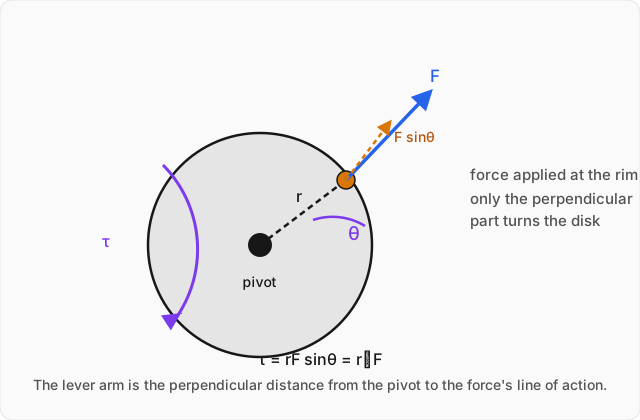
A force does not automatically cause rotation. Push directly toward the hinge of a door and the door barely notices; push perpendicular to the door at its handle and it swings open. What changed? Not the force. The lever arm — the part of the geometry that tells you how far the force acts from the pivot, and at what angle.
The vector definition of torque about a pivot is:
Here points from the pivot to the point where the force is applied. The cross product says that the torque points along the rotation axis, with a direction given by the right-hand rule. For an introductory calculation, we usually need only its magnitude:
where is the angle between and . The factor is the perpendicular lever arm, the shortest distance from the pivot to the line along which the force acts:
This makes the door example transparent. A force through the hinge has , so it produces no torque. A force applied at a right angle at the handle has , giving the largest possible torque for that force. The same push can be useless or effective depending entirely on where and how it is applied.
The direction matters too. We can call counterclockwise torque positive and clockwise torque negative. Then several torques can cancel, just as leftward and rightward forces can cancel in a linear free-body diagram.
Moment of inertia: rotational mass
Mass measures how stubborn an object is about changes in its linear velocity. Rotation needs its own version of stubbornness, because where the mass is located matters now. A kilogram concentrated near an axis is much easier to spin than a kilogram spread far away from it.
That rotational resistance is the moment of inertia, written . For a collection of point masses rotating about an axis:
The is the important part. Move a piece of mass twice as far from the axis and its contribution to becomes four times larger. For a continuous object, the sum becomes an integral, but the message stays the same: moment of inertia is not just "how much matter" there is; it is how that matter is arranged relative to the axis.
We will not need a catalog of formulas for disks, rods, and hoops yet. The definition is more valuable at this stage. It tells you what to expect before you calculate anything: pull mass inward and decreases; spread it outward and increases.
The rotational twin of Newton's second law
The promised dictionary should not stop at matching symbols. It should reproduce the actual law. Start with one small mass at distance from an axis. If the object has angular acceleration , the mass has tangential acceleration:
Newton's second law for the tangential component of the force says:
The torque from that tangential force is , so:
For a real rotating object, add the contributions from every small mass making it up:
If the object is rigid, every part shares the same angular acceleration . Pull it outside the sum:
So the rotational version of Newton's second law is:
This is not a new law with new physics hidden inside it. It is applied to the tangential motion of every piece of the rotating object, then gathered into one useful equation. Force measures the push that changes linear motion; torque measures the geometrically weighted push that changes rotation.
Angular momentum and its conservation
The rotational partner of linear momentum is angular momentum. For a rigid object rotating about a fixed axis:
There is a direct reason this is the right quantity. From and , assuming is constant:
This is the rotational form of the momentum relationship . Now the conservation law is almost unavoidable.
Take a system of rotating parts. Internal forces act in equal-and-opposite pairs, just as they did for the two carts in momentum and collisions. For the usual mechanical forces between parts, the two forces in each pair also have equal lever arms about the chosen axis and produce opposite internal torques. When we add all the torques over the whole system, those internal contributions cancel:
If no net external torque acts, then:
And therefore the total angular momentum cannot change:
For a single rigid skater changing her body configuration, this becomes:
Pulling her arms inward decreases . With no external torque to change , must increase to keep the product fixed. The faster spin is not mysterious and it is not free energy; it is the rotational version of a system rearranging itself while preserving its momentum.
Worked example
A spinning skater has an initial moment of inertia of and angular velocity . She pulls her arms in, reducing her moment of inertia to . What is her final angular velocity, and how does her rotational kinetic energy change? (click to reveal the solution)
Setting up: The skater is on nearly frictionless ice, so the external torque about her vertical axis is negligible. That means angular momentum is conserved. We are given:
Conservation of angular momentum:
Solve for the unknown final angular velocity:
Substitute the values:
Her angular velocity increases from to . Check the conserved quantity:
The angular momentum matches, as it must.
What happened to the kinetic energy? Rotational kinetic energy is:
Initially:
Finally:
The rotational kinetic energy increases by . That does not contradict angular-momentum conservation: the skater's muscles do positive work while pulling her arms inward. Angular momentum stays fixed because the external torque is negligible; kinetic energy increases because internal chemical energy is converted into motion.
Where this leads
Rotational motion is a sibling of momentum and collisions and work-energy, not a replacement for either one. All three descend directly from Newton's laws, but each emphasizes a different conserved or changing quantity: force and acceleration, linear momentum, or torque and angular momentum. Together they give you complementary ways to analyze motion — and they will all be waiting when mechanics becomes more general in the topics ahead.