There is something suspicious hiding in the Schrödinger equation.
Look at its shape:
Time appears with one derivative. Space appears with two. But special relativity does not permit space and time to have fundamentally different transformation laws. Lorentz transformations mix them, while preserving the spacetime interval
An observer moving past the laboratory divides spacetime into space and time differently from an observer at rest. If an equation changes its physical content under that change of viewpoint, it cannot be a fundamental relativistic law.
The mismatch was present from the beginning. The free-particle Schrödinger equation comes from the non-relativistic energy relation
followed by the operator replacements
The first power of becomes one time derivative; the second power of becomes two spatial derivatives. The equation faithfully remembers the non-relativistic mechanics from which it was built.
This is not a small correction waiting to be added. Quantum mechanics and special relativity are each extraordinarily successful, yet their basic structures collide here. The question is not whether the Schrödinger equation needs polishing. The question is what must replace it.
The obvious relativistic repair
For a free relativistic particle, energy and momentum satisfy
Now make the same quantum substitutions, but begin with the relativistic relation:
Acting on a wave function , the left-hand side becomes
The momentum term becomes
Substitution into the energy-momentum relation gives
Move every term to one side and divide by :
Defining the d'Alembertian
we obtain the Klein-Gordon equation:
Unlike the Schrödinger equation, the derivatives now assemble into the Lorentz-invariant operator . Space and time have entered the equation in the combination demanded by the spacetime interval.
Why the Klein-Gordon equation was not the end
The equation gets relativistic kinematics right, but two concrete problems appear if is interpreted as the wave function of one particle.
First, the equation is second order in time. Its plane-wave solutions therefore come in two frequency branches, corresponding to
and
Negative energy is not an occasional special case. It is built into the differential equation.
Second, the natural conserved density is not positive-definite. For a complex Klein-Gordon field, one may write the conserved current as
Its time component, apart from the conventional placement of factors of , is
For a definite-frequency state ,
so
The sign of follows the sign of . A negative-energy solution has negative density. That cannot represent a probability of finding a particle: probabilities may vanish, but they cannot be less than zero.
The two problems are therefore precise: the theory admits negative-energy solutions, and its conserved density cannot serve as a positive-definite single-particle probability density.
Dirac asks for a different square root
Paul Dirac wanted an equation first order in time, like Schrödinger's, while retaining the relativistic energy relation. Suppose the Hamiltonian is also first order in momentum:
Here and are coefficients still to be determined. If this equation is to reproduce relativistic kinematics, squaring the Hamiltonian must give
But direct expansion gives
To eliminate the mixed terms and leave exactly , the coefficients must obey
Ordinary numbers cannot satisfy these requirements. Numbers commute, so two nonzero numbers cannot anticommute. The coefficients must be matrices, and must therefore have several components on which those matrices act. The smallest matrices that work in three spatial dimensions are , so is a four-component spinor.
In the Dirac representation, one convenient choice is
where the are the Pauli matrices. The resulting Dirac equation is
Equivalently, using gamma matrices and ,
Now comes the astonishing part. Dirac did not append spin to a scalar wave function as an extra feature. The attempt to build a first-order Lorentz-covariant quantum equation forced the wave function to become a spinor, and the transformation properties of that spinor are those of spin . The electron's already known angular momentum and spin emerged from the architecture required to reconcile quantum mechanics with relativity. Spin was not put in by hand; it fell out of the demand for relativistic consistency.
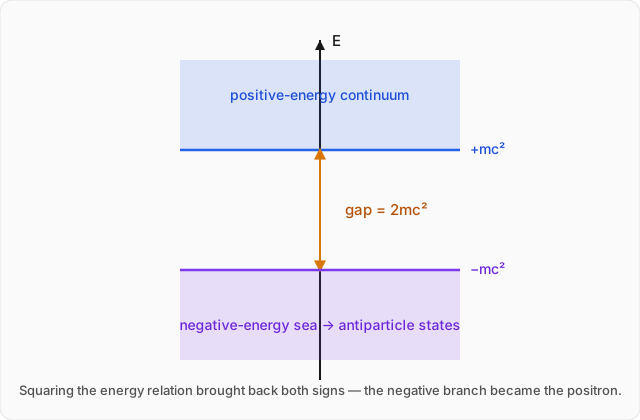
The negative branch returns
Squaring the Dirac Hamiltonian recovers the relativistic energy relation, so the allowed energies still include both signs:
Dirac eventually interpreted the negative-energy structure as evidence for a new kind of particle with the electron's mass and opposite electric charge. The positron was predicted before it was seen and was discovered experimentally a few years later.
Worked example
Show that a plane wave solves the Klein-Gordon equation only when its energy and momentum satisfy the relativistic dispersion relation. Why can the negative-energy branch not simply be erased? (click to reveal the solution)
Setting up: In one spatial dimension, the Klein-Gordon equation is
Take the plane-wave trial solution
where is a constant amplitude.
Taking the time derivatives: The first derivative is
Differentiating once more,
Taking the spatial derivatives: Similarly,
and therefore
Substituting into the equation: Insert both second derivatives:
Factor out :
A nonzero plane wave requires the quantity in parentheses to vanish:
Move the frequency term to the other side:
Multiply by :
Using the quantum identifications
we find
which is exactly the relativistic energy-momentum relation.
Solving for the frequency: The dispersion relation determines , not itself:
Taking the square root necessarily gives two possibilities:
or
Multiplying by and using gives
and
Thus the general mode with fixed contains both independent time dependences:
where
The Klein-Gordon equation is second order in time, so specifying a solution requires both and . The two frequency branches supply the two independent pieces needed to represent general initial data. Deleting the negative-frequency branch would make the solution set incomplete: arbitrary allowed initial conditions could no longer be reconstructed.
The equation therefore encodes relativistic kinematics correctly, but it brings both signs of energy with it. This unavoidable negative-energy branch is the crack through which antimatter entered physics.
Where this leads
Relativistic quantum mechanics cannot remain a theory of one particle moving forever through a fixed external world. The failure is physical, not merely mathematical. Relativity says that energy and mass are interchangeable:
Give an interaction enough energy and it can create particles that were not present initially. A particle and antiparticle may also annihilate into other excitations. The number of particles is not a permanent label carried through time.
But an ordinary single-particle wave function is built around a fixed question: where is this particle, and what is its momentum? Even a many-particle wave function with a fixed number of arguments assumes that the number of particles has already been decided. Such an object cannot describe a process in which the particle count changes.
The resolution is to reverse what we regard as fundamental. Particles are not the basic objects with fields attached to them. Fields are the basic quantum objects, present throughout spacetime, and particles are excitations of those fields. A framework that allows those excitations to be created and destroyed is quantum field theory.