Two promises have been made and not yet kept.
At the end of classical field theory: "a general field configuration can be decomposed into independent oscillation modes... the field is therefore an infinite collection of independent harmonic oscillators... quantizing a field means applying that construction to every mode at once."
At the end of relativistic quantum mechanics: "the resolution is to reverse what we regard as fundamental. Particles are not the basic objects with fields attached to them. Fields are the basic quantum objects... and particles are excitations of those fields."
Both statements were assertions, made in advance of the machinery needed to justify them. This topic pays that debt in full: we will take one specific field, carry out its quantization from the first line to the last, and watch the word "particle" fall out of the algebra as a precise, checkable consequence — not a name we attach afterward, but a label for something the mathematics forces on us.
A note on units, before the algebra gets heavy
Every equation from here on will be cluttered with factors of and unless we do something about it. Physicists handle this by choosing units in which
This is not a physical approximation — it is bookkeeping. Since has units of energytime and has units of length/time, setting both to means we're measuring time and length in units built from energy: a time literally is an inverse energy, a length literally is an inverse energy. Any equation written this way can be restored to ordinary SI units afterward by dimensional analysis — inserting exactly the combination of 's and 's that makes the units come out right, and there is only ever one such combination. We use natural units here purely so that the structure of the calculation is visible instead of buried under conversion factors.
The free scalar field
We already have every ingredient we need. Classical field theory gave us the machinery for a Lagrangian density and the field Euler-Lagrange equation. Relativistic quantum mechanics gave us the Klein-Gordon equation, , derived there as a (troubled) single-particle wave equation. Take that same equation, but now assert that is not a probability amplitude for one particle — it is a classical field in its own right, like the displacement field of the mass-spring chain, just relativistic. The Lagrangian density that produces the Klein-Gordon equation as its field equation is:
Applying the field Euler-Lagrange equation exactly as in the worked example of the previous topic — compute , , , and assemble them — reproduces
the Klein-Gordon equation, now understood as the equation of motion of a classical field rather than a single-particle wave function. This reinterpretation is the entire trick of this topic, and everything else is just following it through carefully.
The conjugate momentum density — the field analog of — is
and the Hamiltonian density, built the same way was built for a single coordinate, is
so that the total Hamiltonian is .
Normal modes: making the "infinitely many oscillators" claim precise
Confine the field to a large cubical box of volume with periodic boundary conditions (a standard trick: it discretizes the allowed momenta so we can index modes with a sum instead of an integral, and we take at the end). The allowed wavevectors are then a discrete set for integers . Expand the field in plane waves, one complex amplitude per mode:
with
Look closely at that dispersion relation: with restored to ordinary units it reads — exactly the relativistic energy-momentum relation from special relativity, with and . This is not a coincidence we are pointing out after the fact; it is forced on us the moment we demanded obey the relativistic Klein-Gordon equation. The two terms in the expansion are complex conjugates of each other specifically so that comes out real, as a physical field must.
Substitute this expansion into . Every term in is quadratic in or , so substituting produces a double sum over modes and , each term carrying a factor . The key fact that makes the whole calculation collapse is the orthogonality of plane waves on the box:
Every cross term with integrates to zero. Only terms survive, and after collecting the surviving terms (a short but genuinely mechanical exercise in substitution) the Hamiltonian reduces to
This is precisely a sum of independent harmonic-oscillator energies, one per mode , each with its own frequency — the field has become, in the most literal algebraic sense, an infinite collection of uncoupled oscillators. The claim from classical field theory is no longer an assertion; it is a computed fact.
Canonical quantization: promoting modes to operators
Everything up to this point was classical. Quantization proceeds exactly as it did for the single oscillator in the quantum harmonic oscillator: promote the classical amplitudes to operators,
and impose commutation relations — one copy of for every mode, with operators belonging to different modes commuting:
Substituting these into the mode-summed Hamiltonian and using where needed to keep the ordering honest gives
Compare this term by term with the single-oscillator result from the earlier topic: it is literally that formula, copied once for every allowed momentum , and added up. Nothing new had to be invented to quantize a field — the entire construction was already built when we quantized one spring.
One honest complication is worth naming rather than hiding: summing over every mode , out to arbitrarily large momentum, gives an infinite constant. This is the (in)famous vacuum energy of quantum field theory. For most purposes it is harmless — only energy differences are ever measured, so physicists define a normal-ordered Hamiltonian that simply drops this constant by convention, placing all operators to the left of all operators before evaluating. We will not need to resolve the deeper questions this raises (they connect to genuinely unresolved physics, including the cosmological constant problem) — only to note honestly that the infinity is there, and that ignoring it is a choice, not an accident.
The vacuum, and what climbing a ladder means
Define the vacuum state as the state annihilated by every mode's lowering operator simultaneously:
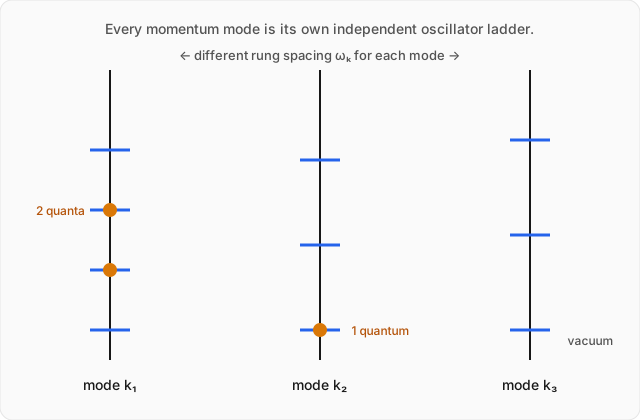
This is the field's ground state — no oscillator, in any mode, has any quanta of excitation. Now do the one new thing this whole topic has been building toward: act on the vacuum with a single raising operator.
is, by the same ladder logic as the single oscillator, a state with exactly one quantum of excitation in mode and none in any other mode. Its energy, reading directly off , is
and its momentum (which a fuller treatment shows is carried by an analogous momentum operator ) is exactly . Put the two together: this state has energy and momentum related by — precisely the relativistic dispersion relation for a particle of mass and momentum .
That is the entire content of the claim "a particle is a quantum of a field," stated with no more hand-waving left in it: is a one-particle state, of a specific mass and momentum, and it is nothing more or less than the first excited state of one particular oscillator mode. Applying again produces a two-particle state with both quanta in mode ; applying to the vacuum builds an arbitrary multi-particle state, with the total number of particles simply counted by the number operator . The space of all such states — vacuum, one particle, two particles, and so on without bound — is called Fock space.
One consequence falls out immediately and answers a question this whole track has been quietly building toward since angular momentum and spin promised that "spin determines whether a particle is a fermion or a boson." Because , the order in which creation operators are applied does not matter:
Swapping two particles leaves the state completely unchanged — not merely physically indistinguishable, but literally the identical vector. This is precisely the defining property of bosons. The scalar field we quantized carries no spin index at all (it is a single number at each point, not a multi-component spinor like the Dirac field), and a spin- field, quantized this way, automatically produces bosonic particles. Nothing was assumed about statistics anywhere in this derivation; the commutator algebra of the ladder operators produced it as a theorem.
Worked example
Starting from the mode expansion of and , derive the equal-time canonical commutation relation . (click to reveal the solution)
Setting up: work at a single fixed time, which we can take to be without loss of generality (the algebra is identical at any equal time). Then
and, differentiating the full time-dependent expansion with respect to and then setting ,
Setting up the commutator: write it as a double sum,
Expanding the inner commutator into its four pieces, and using to discard two of them immediately:
Using and , both surviving terms collapse onto :
Collapsing the double sum to a single sum via the Kronecker delta (), and multiplying through the prefactors:
which is independent of — a clean simplification that confirms the mode normalization chosen earlier was exactly the right one. So
Taking the continuum limit. As , the mode spacing shrinks to zero and the sum becomes an integral via the standard replacement :
The imaginary () part of integrates to zero by symmetry ( flips its sign while leaving the integration domain unchanged), so this integral equals the real part of the full complex exponential integral:
using the standard Fourier representation of the three-dimensional Dirac delta function. Therefore:
This is the field-theoretic generalization of from the introduction to quantum mechanics — restoring , it reads . Position and momentum failed to commute at a single point; here, the field's value at one point and its conjugate momentum at another point fail to commute only when the two points coincide. Everywhere else — for — the field operators commute exactly, which is exactly what "independent oscillator at every point" ought to mean.
Where this leads
We can now say precisely what this entire track has been walking toward. A physical field fills all of space. Decomposed into normal modes, it is an infinite family of independent oscillators. Quantized, each oscillator acquires a ladder of evenly spaced energy levels, exactly as the quantum harmonic oscillator first showed for a single spring. A particle is one rung climbed on one mode's ladder — nothing more exotic than that, and nothing less precise either. Its mass is fixed by the field's own parameter in the Lagrangian; its energy and momentum are forced by the relativistic dispersion relation to obey special relativity exactly; its statistics — boson or fermion — are forced by the algebra of the ladder operators, not chosen by hand.
This free-field theory is not yet capable of describing the physics that makes particles interesting: particles scattering off one another, decaying, or being created in collisions. All of that requires adding interaction terms to the Lagrangian density beyond the free used here, and computing their effects order by order using the diagrammatic bookkeeping system known as Feynman diagrams — a substantial subject in its own right, and the natural continuation of the road this track has followed from a falling ball's instantaneous velocity all the way to the question of what, fundamentally, a particle is.