In Newton's laws, velocities behaved exactly as experience seemed to demand. If a train moves at and you throw a ball forward at relative to the train, someone standing beside the track sees the ball move at . Run alongside a water wave and the wave slows relative to you. Chase anything fast enough, and you should reduce its speed relative to yourself.
Then Maxwell's equations produced a number:
This was not merely a prediction that light travels very fast. The equations singled out one definite speed for electromagnetic waves. But a speed relative to what?
Every velocity in Newtonian mechanics is measured relative to some frame. Sound has a speed relative to air; water waves have a speed relative to water. Physicists therefore imagined that light must travel through its own invisible medium, the luminiferous ether, and that was the speed of light relative to that ether. As Earth moved through space, its motion through the ether should create an "ether wind." Light sent along Earth's motion should then have a different measured speed from light sent across it, just as a swimmer's progress depends on whether the current is with them or across them.
The Michelson-Morley experiment looked for precisely this difference. It split a beam of light along perpendicular paths, recombined the beams, and searched for the interference shift that Earth's motion through the ether should produce. It found nothing. Turn the apparatus, wait for Earth to move to another part of its orbit, repeat the measurement: still nothing. Light's speed refused to reveal any preferred frame.
That left a genuine emergency. Either Maxwell's theory of electromagnetism was wrong, despite its spectacular successes, or something built deep into Newtonian mechanics was wrong. In particular, perhaps velocities do not add in the way we had silently assumed.
Einstein's two postulates
Einstein began by refusing to rescue the old picture with an undetectable ether. Instead, he took two statements seriously:
- The laws of physics are identical in all inertial frames. No experiment performed entirely inside a non-accelerating laboratory can reveal an absolute state of rest.
- The speed of light in vacuum is in every inertial frame, regardless of the motion of the source or the observer.
The first postulate extends the relativity already present in classical mechanics. The second is the radical one. If a lamp on a train sends a pulse forward, both a passenger and an observer beside the track measure that pulse moving at , even though they are moving relative to one another.
Everything that follows is a consequence of accepting those two postulates together. Time dilation, length contraction, the relativity of simultaneity, and mass-energy equivalence are not extra repairs added one by one. They are what space and time must do if no inertial frame is privileged and every inertial observer measures the same speed of light.
Time dilation: building a clock out of light
Imagine a clock consisting of two parallel mirrors separated by a distance . A light pulse bounces from the lower mirror to the upper mirror and back. Each round trip is one tick.
In the clock's rest frame, the light travels straight upward a distance and straight downward another distance . Because the light travels at speed , the duration of one tick is
The subscript marks the proper time: the time between two events measured in the frame where those events occur at the same place. Here, emission and return both occur at the lower mirror.
Now watch the same clock from a frame in which it moves sideways at speed . During half a tick, the clock slides horizontally. The light cannot travel straight up in this frame because the upper mirror is moving. It must follow a diagonal path to meet the mirror.
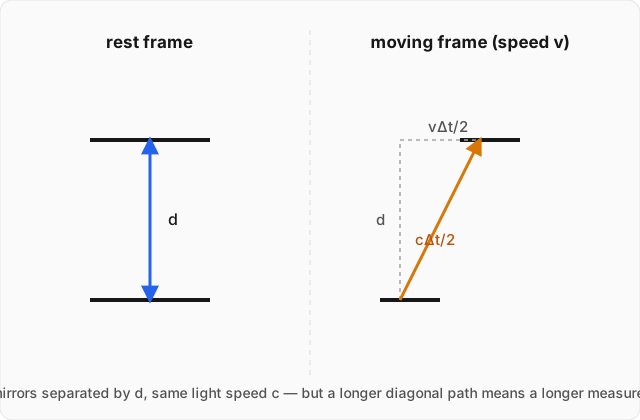
Let be the full round-trip time measured by the observer who sees the clock moving. During half the trip, the light travels for a time , so the diagonal path has length
In the same half-tick, the clock moves horizontally by
The vertical separation of the mirrors remains . The three distances form a right triangle, so the Pythagorean theorem gives
Multiply by :
Move the term containing to the left:
From the rest-frame result , we have
Substituting this into the triangle equation gives
Divide by :
Therefore,
Define the Lorentz factor
Then the time-dilation equation is
For every nonzero relative speed, . The moving clock takes more coordinate time between ticks. This is not a defect of light clocks. Any other clock must slow by the same factor; otherwise, comparing a light clock with another physical process would reveal an absolute state of motion and violate the first postulate.
Length contraction
The same postulates require a moving object's length along the direction of motion to be shorter than its rest length:
Here is the proper length, measured in the frame where the object is at rest. The contracted length is measured by an observer relative to whom the object moves at speed .
Measuring a moving length requires recording both endpoint positions at the same time in the observer's frame. That phrase matters: observers in relative motion do not generally agree about which separated events are simultaneous. Length contraction and time dilation are therefore not independent tricks. They are two aspects of the same reorganization of space and time.
The Lorentz transformations
Let frame move in the positive direction at speed relative to frame , with their origins coinciding at . The coordinates of the same event are related by the Lorentz transformations:
and
The second equation contains the break with Newtonian intuition. Time in one frame depends not only on time in another frame, but also on position. Two events that are simultaneous in have , yet if they occur at different positions then
which is generally not zero. Simultaneity itself depends on the observer's inertial frame.
But classical mechanics has not vanished. When ,
Also, the correction becomes negligible on ordinary mechanical scales. The Lorentz transformations then reduce to
which are exactly the Galilean transformations silently assumed throughout kinematic quantities and Newton's laws. Newtonian mechanics was never wrong. It is the low-speed limit of a larger theory, just as a nearly flat patch of Earth is the local limit of a curved surface.
The spacetime interval
Suppose two events are separated by a time difference and a spatial difference in one inertial frame. Define the spacetime interval
For motion in three spatial dimensions, this becomes
Apply a Lorentz transformation to the coordinate differences:
Now compute the interval in the primed frame:
Expanding both squares,
The cross terms cancel:
Factor out :
Because
we obtain
This is the deepest shift in the theory. Observers disagree about elapsed time. They disagree about distance. They may even disagree about whether separated events occurred simultaneously. Yet every inertial observer computes the same spacetime interval.
Space by itself is frame-dependent. Time by itself is frame-dependent. Spacetime is not.
The interval plays a role in relativity much like distance plays in Euclidean geometry. Rotating ordinary axes changes the separate and components of a displacement but preserves . A Lorentz transformation mixes space and time while preserving . What different observers call "space" and "time" are different decompositions of one invariant spacetime structure.
Energy, mass, and the cost of approaching light speed
For a particle of invariant mass moving at speed , the relativistic total energy is
As approaches , the denominator in approaches zero, so and the required energy grow without bound. A particle with nonzero rest mass can be accelerated arbitrarily close to the speed of light, but never all the way to it.
In the particle's rest frame, and . The total energy becomes
This is rest energy: a body possesses energy simply by having mass, even when its momentum is zero. The famous equation is therefore not primarily a statement about fast-moving objects. It is the rest-frame case of the full relativistic energy equation.
Worked example
Muons are created about above Earth's surface, have a mean lifetime of at rest, and travel toward the ground at roughly . How can any of them reach sea level? (click to reveal the solution)
Classical prediction: If time were absolute, a muon traveling at for would cover a mean distance
Using ,
so
That is nowhere near . Classically, atmospheric muons should decay long before reaching the ground.
Relativistic calculation in Earth's frame: First compute the Lorentz factor:
Since
we get
The muon's lifetime is the proper time because it is measured in the muon's rest frame. In Earth's frame, time dilation gives
Therefore,
During this dilated mean lifetime, the muon travels
Thus,
A mean travel distance of is still less than , but decay is probabilistic, not a sudden event that occurs for every muon at one lifetime. The survival fraction after traveling a distance is
For ,
So roughly survive the full descent in this idealized estimate, an easily detectable fraction. Without relativity, the predicted fraction would be
effectively none.
The same calculation in the muon's frame: The muon is now at rest, so its lifetime remains
But the atmosphere is moving toward it at , and the atmospheric thickness is length-contracted:
Therefore,
The time required for the contracted atmosphere to pass the muon is
Substituting,
The survival fraction in the muon's frame is therefore
Both frames predict the same survival fraction. Earth says the muon's clock runs slowly; the muon says the atmosphere is shorter. This agreement is not a coincidence. Different frames may assign different distances and times, but they must agree on observable events, including whether a particular muon reaches a detector.
And this is not merely a thought experiment. Cosmic-ray muons are routinely detected at sea level, including in undergraduate teaching laboratories. Their arrival is spacetime geometry clicking audibly inside a detector.
Where this leads
Special relativity opens a branch of physics separate from the quantum track, running parallel to it. Relativity rebuilds space, time, momentum, and energy around the invariant speed . Quantum mechanics rebuilds states, measurement, and dynamics around amplitudes and Planck's constant.
Neither branch can be ignored when particles move relativistically and quantum effects matter. Quantum field theory is where they finally converge: reconciling quantum mechanics with special relativity is precisely the problem QFT was invented to solve. There, particles become excitations of fields, creation and destruction become unavoidable, and the invariant structure of spacetime remains the stage on which quantum physics must operate.