Here are two of Newton's equations, side by side. The first says how hard gravity pulls on a body:
The second says how hard it is to accelerate a body:
I have deliberately written the two masses with different subscripts, because they are measuring genuinely different things. The quantity is a gravitational charge — the analogue, in Newton's gravity, of the electric charge in Coulomb's law. It says how strongly this body couples to the gravitational field. The quantity is inertia — how much this body resists a change in velocity, whatever the cause of that change. Push it with a spring, kick it, hit it with a photon: is what fights back.
There is no reason on earth these should be the same number. In electromagnetism they emphatically are not: a proton and an electron have electric charges of equal magnitude but inertias differing by a factor of . Charge is one property of a particle, inertia is another, and nothing in Newton's framework connects them.
And yet, set the two equations equal and solve for the acceleration of a falling body:
Every experiment ever performed says the ratio is exactly for every substance. That is why all objects fall at the same rate — the fact Galileo is supposed to have demonstrated from a tower, and which every dropped hammer and feather on the Apollo 15 lunar surface has confirmed since. It's worth pausing on how strange this is. The falling rate of an object is completely independent of what it's made of, how it's bound together, how much of its mass-energy is nuclear binding energy versus rest mass, whether it's a lump of aluminum or a block of platinum or a sealed flask of antimatter.
Newton knew this. He tested it with pendulums, and he wrote it down as an experimental fact. What he never did — what nobody did for two hundred and twenty years — was explain it. In Newton's theory the identity is a numerical coincidence of no structural significance whatsoever. You could rewrite all of Newtonian mechanics with for gold and for wood and nothing would break; the theory simply doesn't care.
Modern experiments have hunted for a violation with extraordinary care. Torsion-balance experiments compare the free-fall accelerations of two test bodies of different composition, and satellite experiments do the same in orbit for months at a time. The standard figure of merit is the Eötvös parameter
the fractional difference in acceleration between two materials. The best current bounds put below a few parts in . Fifteen decimal places of a coincidence that the theory calls meaningless.
When a coincidence is that good, it is not a coincidence. It is a law wearing a disguise.
Einstein's box
Einstein's move — he later called it the happiest thought of his life — was to ask what it would actually be like to be inside a freely falling elevator.
Here is the scenario. You wake up in a sealed windowless box. You have with you every instrument you like: springs, scales, lasers, gyroscopes, interferometers, a chemistry set. Your job is to determine, from inside, whether
- the box is sitting at rest on the surface of a planet whose surface gravity is , or
- the box is far from any mass whatsoever, being towed by a rocket with constant proper acceleration .
Try it. Drop a ball: in case 1 it accelerates downward at because the planet pulls it; in case 2 it hangs there in empty space and the floor rushes up to meet it at . Same observation. Drop two balls of different material: in case 1 they fall together — because , exactly the coincidence we just refused to accept as a coincidence. In case 2 they obviously fall together, because they aren't doing anything at all; the floor is doing the moving, and the floor doesn't know what the balls are made of. Same observation, and note precisely which fact was needed to make the two cases agree.
Stand on a scale: it reads in both cases. Fire a bullet horizontally: it drops by the same amount in both cases. Run any experiment you like, and you get the same answer.
The equivalence principle asserts that this is not a limitation of your equipment. It is a statement about the world:
No local experiment performed inside a freely falling frame can distinguish that frame from an inertial frame in the absence of gravity. Equivalently: no local experiment inside a uniformly accelerating frame can distinguish acceleration from a uniform gravitational field.
Two words in there are load-bearing, and glossing over either of them is how people end up talking nonsense about general relativity.
Local. Real gravitational fields are not uniform. Earth's field points toward Earth's center, so it converges; it also weakens with height. Give yourself a box a thousand kilometres across and you can tell the difference: two balls released far apart at the same height will drift toward each other in case 1, because both fall toward the same center, and will not in case 2. That residual, un-cancellable part of gravity — the part that survives no matter what frame you choose — is called the tidal field, and it is going to turn out to be the real, honest, coordinate-independent content of gravity. It is the subject of the next topic. But over a small enough region, for a short enough time, the tidal effects fall below any given measurement precision, and the two cases become genuinely indistinguishable.
Uniform. The acceleration must be constant, and the gravitational field it mimics is the uniform one.
There are stronger and weaker versions of the principle, and it is worth knowing which is which. The weak equivalence principle is just : all bodies fall alike. The Einstein equivalence principle is the sweeping statement above — that all of physics, not merely the mechanics of falling bodies, is unaffected. Optics, nuclear physics, thermodynamics, everything. It is the strong version we are going to use, and the version that immediately produces something outrageous.
The consequence nobody ordered: light must fall
Here is what you get for free the moment you accept the strong version.
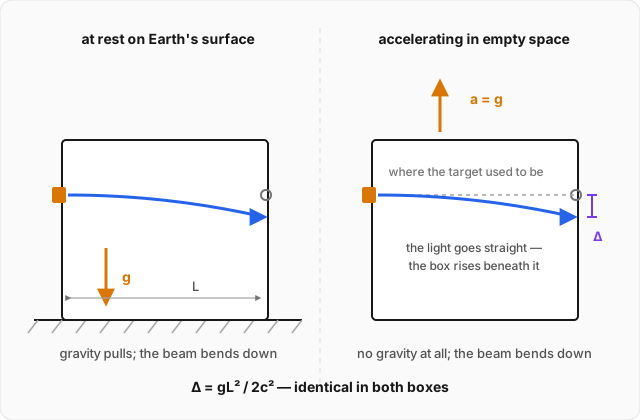
Put a laser on the left wall of the box, aimed horizontally at a target on the right wall, a distance away. Now consider case 2: the box in empty space, accelerating upward at .
In an inertial frame — one in which the box was momentarily at rest when the pulse was emitted — the light does nothing interesting. It goes in a perfectly straight line at speed , exactly as special relativity demands. It crosses the box in a time
But during that time the box has accelerated upward. Starting from rest, it has risen by
So the target on the right wall has moved up by while the pulse was in flight. The pulse therefore strikes the wall a distance below the target. To an observer inside the box, who considers the box to be perfectly stationary and the walls to be where they have always been, the light beam bent downward.
Nothing in that paragraph is controversial. It's kinematics, in flat spacetime, with a straight light ray. Any student of special relativity would accept it without complaint.
Now invoke the equivalence principle. Case 1 must give the same result. Which means:
A horizontal light beam, in a gravitational field of strength , deflects downward — falls — by over a horizontal run . Equivalently, it picks up a downward velocity , and so its direction turns through an angle
This is a genuinely new physical prediction, and notice where it came from: not from a new force law, not from assuming light has mass, not from any model of what light is. It came from one experimental coincidence, taken seriously.
A second consequence: gravity shifts frequencies
The same box gives another result in three lines, and we will need it much later, so let's collect it now.
Aim the laser from the floor of the accelerating box straight up at a detector on the ceiling, a height above. The pulse takes a time to arrive. During that time the detector — accelerating upward at — has gained a speed
relative to the frame in which the light was emitted. The detector is therefore receding from the emission event, and sees an ordinary first-order Doppler shift:
By the equivalence principle, the same must happen in a gravitational field: light climbing out of a gravitational field is redshifted. Turn it around and light falling in is blueshifted. Since a frequency is just a clock — count the crests — this is already telling us something disturbing about time, which is that clocks at different heights in a gravitational field cannot agree with one another. Hold onto that; it comes back in full force with black holes.
Pound and Rebka measured this in 1959, sending gamma rays up a tower at Harvard and looking for a fractional shift of
and found it. Two parts in a thousand trillion, extracted from a stairwell.
Worked example
A light pulse crosses a -wide elevator at rest on Earth's surface. By how much does it fall? Then use the same reasoning to estimate the deflection of starlight grazing the Sun, and compare with what was actually measured. (click to reveal the solution)
Setting up: the elevator is at rest in a field . By the equivalence principle we may compute in the accelerating-box picture instead, where the light travels dead straight and the box rises beneath it. The two ingredients are the crossing time and the box's rise during that time.
Crossing time:
Eight nanoseconds. This is the number that is going to make the answer small, and it is worth seeing why: gravity gets only eight nanoseconds to act on this pulse, whereas it gets a comfortable half-second to act on a dropped coin.
Deflection:
Is that a big number? Not remotely. A proton's charge radius is about , so
The beam falls by about four tenths of the radius of a proton. Nothing in a laboratory elevator will ever detect this. The corresponding bend angle is
which is about arcseconds — some ten billion times finer than the best astronomical angular measurements.
So how could anyone ever see it? Every factor in is working against us, so we need to attack all of them. Get a stronger field, and get a longer run through it. The Sun offers both.
Take a ray of starlight grazing the Sun's limb, at radius . The field strength there is
and the ray spends its time meaningfully deflected only while it is within a distance of order of closest approach — beyond that, falls off as and contributes little. So the effective run length is of order on each side, giving an effective interaction time and a transverse velocity
Putting in and :
Converting to arcseconds ():
Nine tenths of an arcsecond — small, but this is a completely different regime from the elevator. It is roughly times larger than the elevator's bend, and it is comfortably within reach of a photographic plate taken during a total eclipse.
And now the honest part. That crude estimate happens to land exactly on the answer a careful calculation gives using only the equivalence principle applied to a uniform field, patched together field-line by field-line: the result is precisely . It is also exactly half of the correct answer.
General relativity predicts
and is what Eddington's 1919 eclipse expedition measured, and what every subsequent measurement — including radio interferometry of quasars occulted by the Sun, which now confirms it to better than one part in — has confirmed.
So where did the missing factor of two go? Not into an arithmetic slip. It is missing because the equivalence principle, by construction, is a statement about small local patches, and a light ray skimming the Sun is not confined to a small local patch. Stitching together many small freely falling frames along the ray's path requires knowing how those frames are glued to each other — and that gluing is exactly the curvature of spacetime, which the equivalence principle alone does not determine. Half the bending comes from what we computed here, the "falling" of light in the local field, encoded in how gravity distorts time. The other half comes from the distortion of space itself, which the accelerating box cannot see, because the accelerating box lives in perfectly flat spacetime.
An honest summary: the equivalence principle told us light must bend, and got us to within a factor of two of how much, using nothing but . It cannot get the last factor of two, and it was never going to. Getting it requires the geometry.
Where this leads
The equivalence principle is a demolition tool. It says that gravity is the one "force" you can make vanish completely at any point you choose, simply by letting go — and that no local measurement can then find any trace of it. No other interaction behaves like this. You cannot make electromagnetism go away by picking a clever frame; the electron's charge-to-mass ratio differs from the proton's, so no single acceleration cancels the force on both.
A force that can be locally erased by a change of reference frame is behaving exactly like the centrifugal and Coriolis "forces" of a rotating frame — artifacts of a coordinate choice rather than features of the world. But gravity cannot be erased globally: two balls released a kilometre apart still drift toward each other, and no choice of frame prevents it. So gravity is not quite a coordinate artifact either. It is something with the local character of a fictitious force and the global character of a real, unremovable structure.
There is exactly one kind of object in mathematics with that signature: the geometry of a curved space, where you can always find coordinates making a small patch look flat, but never coordinates making the whole thing flat at once. Building that idea properly is the job of curved spacetime and the metric tensor, which takes the flat interval from special relativity and the index machinery from tensor calculus and generalizes both. From there, geodesics will explain what a freely falling body is actually doing when it "falls," and the Einstein field equations will finally say how much curvature a given lump of matter produces — at which point the missing factor of two in the light-bending calculation stops being a mystery and becomes a two-line consequence.