You have been handed conservation laws one at a time. Momentum is conserved in an isolated collision. Angular momentum is conserved when there is no external torque. Energy is conserved when only conservative forces act. Each law works, each has survived every experimental test in its domain, and each can be used to solve problems that would be miserable if attacked directly with Newton's laws.
But why should anything be conserved?
A puck slides across frictionless ice and keeps the same momentum. A planet sweeps around the Sun while preserving angular momentum. A pendulum trades kinetic energy for potential energy and back again while their sum stays fixed. Why does nature carry these quantities forward with perfect bookkeeping? And why do there happen to be three famous conserved quantities rather than two, or seventeen?
The mechanics developed so far does not answer that question. It tells us how to verify a conservation law from the equations of motion, and work and energy shows how forces transfer energy. But none of that reveals why conservation laws exist as a family, or why momentum, angular momentum, and energy are the members we keep meeting.
Emmy Noether found the missing principle:
Every continuous symmetry of the action corresponds to a conserved quantity.
That sentence is not a suggestive analogy. It is a theorem. Conservation of linear momentum, angular momentum, and energy are not three independent accidents. They are three applications of one mathematical fact.
What symmetry means here
In everyday language, symmetry often means that an object looks unchanged after being reflected or rotated. Noether's theorem uses a broader and more precise idea.
A symmetry is a transformation of the system that leaves the action unchanged, or changes the Lagrangian only by a total time derivative. If
then a symmetry is a transformation for which the physical content of does not change. A total derivative is allowed because
changes the action only by endpoint terms:
With fixed endpoints, those terms do not alter the Euler-Lagrange equations.
The word continuous matters. The transformation must be adjustable by an arbitrarily small parameter. A translation by a distance , a rotation through an angle , or a shift in time by can be made as small as we please. Noether's theorem studies what happens under that infinitesimal change.
Before proving anything, look at the three cases that carry the whole idea:
- If the Lagrangian does not depend on where the experiment is performed, the action has spatial-translation symmetry, and linear momentum is conserved.
- If the Lagrangian does not depend on which way the apparatus is facing, the action has rotational symmetry, and angular momentum is conserved.
- If the Lagrangian does not depend on when the experiment is performed, the action has time-translation symmetry, and energy is conserved.
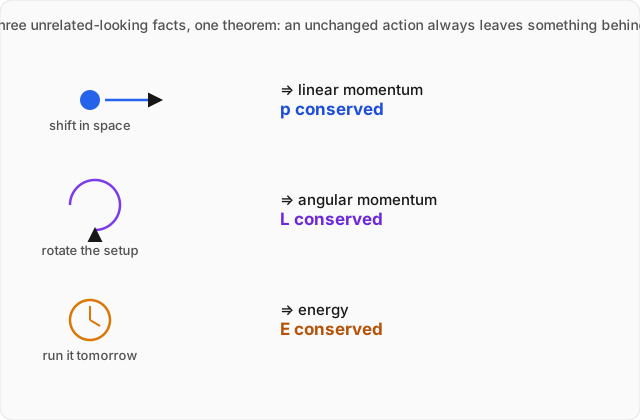
The third correspondence deserves a pause. Energy is conserved because the laws of physics do not change with time. Perform an isolated experiment on Tuesday or repeat it on Wednesday under identical conditions, and the same Lagrangian governs both. The universe has no preferred date hidden in its equations. Conservation of energy is the mathematical consequence of that absence.
The theorem in miniature: cyclic coordinates
The cleanest case is already sitting inside the Euler-Lagrange equation from Lagrangian mechanics:
Suppose the Lagrangian does not contain one coordinate explicitly. It may still depend on the corresponding velocity , but
Substitute this into the Euler-Lagrange equation:
Define the conjugate momentum
Then
so is constant.
That is Noether's theorem in miniature. If does not appear in the Lagrangian, shifting it by any constant,
leaves the Lagrangian unchanged. The coordinate labels a continuous symmetry, and its conjugate momentum is conserved. Such a coordinate is called cyclic or ignorable. The name does not mean the coordinate is physically unimportant. Quite the opposite: its absence from the Lagrangian exposes a conservation law immediately.
For a free particle in Cartesian coordinates,
none of the coordinates , , or appears explicitly. All three are cyclic, and therefore
are conserved. Spatial translation symmetry is conservation of linear momentum written in the language of the action.
The general theorem
Now let a continuous transformation be controlled by a small parameter . For fixed time, write the infinitesimal change of the generalized coordinates as
so that
Suppose the Lagrangian changes by at most a total derivative:
The variation of the Lagrangian is
Because , this becomes
where
Along a physical trajectory, the Euler-Lagrange equations give
Therefore,
The expression in parentheses is a product derivative:
But symmetry also requires
Equating the two results gives
Thus the Noether charge
is conserved:
The cyclic-coordinate result is contained inside this formula. For a shift of one coordinate , we have , all other , and . Therefore
When the transformation also shifts time,
the corresponding conserved charge can be written
For a pure time translation, take , , and . Then
where
is the Hamiltonian. The sign is conventional; if is conserved, so is . For ordinary mechanical systems with no explicit time dependence, the Hamiltonian is the total energy. Time-translation symmetry therefore gives energy conservation.
In field theory, the same logic is applied at every point in spacetime. The conserved quantity becomes a Noether current satisfying
and the associated charge is
Under suitable boundary conditions,
The notation becomes more elaborate, but the engine is unchanged: a continuous freedom to transform the description without changing the action produces a quantity that cannot change during the motion.
Worked example
Use Noether's theorem to find the conserved quantity for a particle moving in a central potential . (click to reveal the solution)
Setting up: A central potential depends only on the particle's distance from the origin, not on its direction. Because the force always points along the line joining the particle to the origin, polar coordinates are natural.
The squared speed in polar coordinates is
Therefore the kinetic energy is
and the Lagrangian is
Identifying the symmetry: The Lagrangian contains , , and , but it contains no explicit . Thus
The angle is a cyclic coordinate. Physically, the transformation
rotates the entire orbit by a fixed angle. Because depends only on , the rotated experiment has the same Lagrangian. There is no preferred direction in the plane.
Applying the Euler-Lagrange equation: For the coordinate ,
Since ,
The conjugate momentum is
Differentiate the Lagrangian with respect to :
Therefore,
This is the particle's angular momentum about the origin:
The result is the rotational counterpart of linear momentum conservation discussed in momentum and collisions. The Lagrangian does not care which direction is called , so the conjugate momentum associated with changing cannot change.
Connection to orbital geometry: During a short time , the radius vector sweeps out an approximately triangular area
Divide by :
Using ,
This is Kepler's second law: the line from the Sun to a planet sweeps out equal areas in equal times. The orbit also remains in a fixed plane because the full angular-momentum vector is conserved; both the magnitude and direction of remain fixed for a central force. The fixed orbital plane and the equal-area law are not separate celestial coincidences. They are angular momentum conservation, and angular momentum conservation is rotational symmetry, seen from two different angles.
Where this leads
Noether's theorem is not a curiosity tucked inside classical mechanics. It is one of the organizing principles of modern physics. Once the action is known, its continuous symmetries reveal the quantities the theory must conserve. Conversely, demanding a symmetry sharply restricts which Lagrangians and which interactions are possible.
In quantum field theory, the search for new particles and interactions is largely a search for symmetries. Continuous internal symmetries produce conserved currents and charges. Gauge symmetries constrain the fields and interactions so strongly that the associated gauge fields mediate forces. Electric charge, for example, is tied to the gauge symmetry of electromagnetism.
The reader will meet this idea again in a more powerful form. What begins here as a missing coordinate in a mechanical Lagrangian becomes a method for constructing the fundamental theories of matter: choose the symmetry, write the action it permits, and let the conservation laws emerge.