Noether's theorem closed with a promise it did not keep: "gauge symmetries constrain the fields and interactions so strongly that the associated gauge fields mediate forces. Electric charge, for example, is tied to the gauge symmetry of electromagnetism." Quantum electrodynamics then built the entire machinery of photons and their interaction with electrons, and, at its close, made an admission: the interaction term coupling the electron field to the photon field was not chosen freely, the way the toy coupling of interacting fields and perturbation theory was chosen freely — it was forced by a symmetry principle that topic declined to derive. Both loose ends are the same loose end. This is where it gets tied off, and where — because the ends of enough other loose threads tie off here too — this entire site's roadmap reaches the end of its road.
A symmetry so obvious it looks like nothing at all
Go back to the plainest quantum mechanics there is: a free particle described by a wave function , obeying the free Schrödinger equation from the introduction to quantum mechanics,
Everything physical about — every probability, every expectation value — comes from or from bilinear combinations like . Multiply everywhere, at every point of space and every moment of time, by one fixed, constant phase , and nothing physical changes at all: , exactly as before. This looks like the emptiest possible observation — of course an overall phase doesn't matter, it never showed up in a measurable prediction to begin with. But Noether's theorem takes even the emptiest-looking continuous symmetry seriously, and demands to know what conserved quantity it produces. Here, applied to the Schrödinger field, the answer is the probability current , satisfying the continuity equation with — the precise statement that probability is neither created nor destroyed, only moved around. Applied instead to a charged particle's field, this exact same symmetry is the reason electric charge is conserved. A transformation that looked like it changed nothing at all is quietly responsible for one of the best-tested conservation laws in physics.
What breaks when the phase is allowed to wander
Now ask a sharper question, the one this entire topic turns on. The transformation above used one fixed number , the same everywhere in space. What if the phase were allowed to be a different number at every point — , a genuine function of position, no longer a single global constant? Physically this still looks harmless: at any one point, multiplying by a phase still changes nothing measurable there. But the Schrödinger equation doesn't just evaluate at one point — it differentiates it, comparing 's value at neighboring points, and that is exactly where a position-dependent phase causes trouble. This is not a side issue; it is the entire content of the worked example below, carried out in full.
Worked example
Show that the free Schrödinger equation is invariant under a global phase change for constant , show explicitly what goes wrong when , and find the field that must be added to repair the symmetry. (click to reveal the solution)
Setting up — the global case. Start from the free Schrödinger equation, , and let be a constant. Under , every derivative simply pulls the constant phase straight through:
so substituting into the Schrödinger equation gives , which is just the original equation multiplied through by the constant — true whenever the original equation was true. The equation is unchanged: global phase really is a symmetry, exactly as claimed above.
Making the phase local. Now let vary with position, and repeat the calculation. The time derivative still pulls the phase through unchanged if doesn't depend on , but the spatial derivative no longer does, because itself depends on . By the product rule,
There is an extra term, , that was not there in the global case. It survives a second application of as well, leaving genuinely new terms involving and in the transformed Schrödinger equation — terms with no counterpart on the other side, so the equation obeyed by is no longer the same equation obeyed by . Local phase invariance fails, precisely because differentiation compares a field's value at neighboring points, and neighboring points are no longer being rotated by the same phase.
The fix: a covariant derivative. The extra term is a specific, calculable obstruction, which means it can be canceled by a specific, calculable fix. Define a new derivative operator, a covariant derivative, by combining with a new field and the particle's charge :
Demand that transform exactly the way itself transforms — — rather than picking up the extra term alone does. Write out using the transformed field and the result above for :
Require this to equal . Matching the bracketed terms:
Divide through by and solve for :
Interpreting the result. If, alongside letting , a new field is simultaneously shifted by , and every ordinary derivative in the Schrödinger equation is replaced by the covariant derivative , the whole equation becomes invariant again — locally, at every point, not merely globally. Two things about that result are worth sitting with. First, the transformation law just derived for , for some function , is exactly the gauge freedom of the electromagnetic vector potential: adding the gradient of any scalar function to leaves unchanged, a fact already latent in Maxwell's equations. Second, replacing with is precisely the standard "minimal coupling" recipe by which a charged particle's momentum operator is modified in the presence of an electromagnetic field. Demanding a purely internal, seemingly unphysical local symmetry — the freedom to relabel 's phase differently at every point — did not just permit an electromagnetic field to exist. It required one, and handed back its exact coupling to matter, derivative term by derivative term, with no additional physical input assumed anywhere in the calculation.
From one phase to the whole Standard Model
That worked example is QED's interaction term, stripped down to a single derivative and a non-relativistic wave function — the full relativistic version, applied to the electron field and its coupling to the photon field , is exactly the interaction quantum electrodynamics needed but declined to derive. The symmetry involved — multiplying a single complex number by a phase — is called, in the language of group theory, : the group of rotations of a circle, one real parameter, and its rotations all commute with each other (rotate by then , or then , and you land in the same place either way). Demanding local invariance is, precisely, demanding electromagnetism.
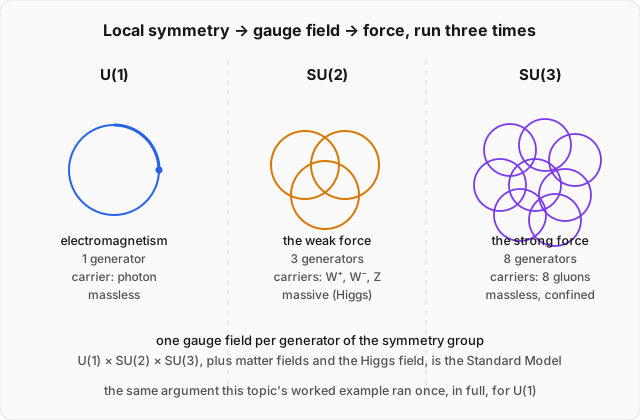
Here is the move that built the rest of particle physics across the second half of the twentieth century: nothing in the logic above was special to circles. A particle can carry an "internal" label with more structure than a single phase — not a point on a circle, but a point in a more elaborate internal space, rotated by a matrix rather than a single number, where the order of two rotations can matter. Demand that the physics be invariant under such a symmetry locally, point by point in spacetime, exactly as the worked example demanded for , and the identical mechanism forces a new field into existence — one new gauge field for every independent way the internal space can be rotated (technically, one gauge field per generator of the symmetry group).
Run that logic with the group — rotations of an internal two-component space, three independent generators, non-commuting ("non-abelian") — and three gauge fields are forced into existence, mediating the weak force: the , , and bosons, responsible for radioactive beta decay and for letting one type of quark or lepton transform into another. Run it with — rotations of an internal three-component "color" space, eight independent generators — and eight gauge fields appear, the gluons, mediating the strong force that binds quarks together into protons and neutrons and binds those, in turn, into atomic nuclei.
Two honest complications deserve to be named rather than smoothed over, exactly because this topic has tried to be honest about where its derivations stop. First: the photon and the gluons come out of this construction exactly massless, matching experiment beautifully — but the and bosons are observed to be very heavy, roughly 85 to 100 times the mass of a proton, and a naive mass term for a gauge field wrecks the very symmetry that produced it in the first place. Fixing this without breaking the symmetry requires an additional piece of machinery, the Higgs field, whose interaction with the weak gauge fields gives them mass through a mechanism called spontaneous symmetry breaking — confirmed experimentally in 2012 with the discovery of the Higgs boson, but a genuinely separate piece of construction, well beyond what this topic can derive. Second: 's coupling constant is not small at everyday energies the way QED's is, so the perturbative expansion built across interacting fields and perturbation theory and Feynman diagrams — the whole toolkit this quantum track spent its final stretch building — does not converge well for the strong force at low energy, which is precisely why individual quarks and gluons are never observed in isolation, only bound permanently inside particles like protons. That phenomenon, confinement, remains one of the genuinely hard unsolved problems in theoretical physics.
Put together — a gauge symmetry, matter fields for the quarks and leptons in three generations, and the Higgs field to give the weak bosons and the matter fields their masses — this is the Standard Model of particle physics: the most complete, most rigorously tested description of matter and its interactions that exists, built almost entirely from one repeated idea, applied three times, the idea this topic derived once in full above.
Where this leads
This is, deliberately, the last topic in the roadmap. It is worth actually stopping and looking back at the road, because it was one continuous road, not a pile of separate subjects that happen to share a website.
It began with a $327 million spacecraft lost over a units mismatch, in units and dimensional analysis, and with the deceptively simple question of how fast a falling ball is going right now, in kinematics — a question that, chased honestly, forced the invention of the derivative. Newton's laws, work and energy, momentum, and rotational motion built the mechanics of everyday objects; simple harmonic motion found the one oscillator that reappears, transformed but unmistakable, in nearly every topic after it; Lagrangian and Hamiltonian mechanics rebuilt the same physics from the principle of least action, and Noether's theorem — cashed out fully only here, at the very end — explained why conservation laws exist at all rather than merely cataloguing them. In parallel, vector calculus and the rest of the mathematical-methods track built the actual language — gradients, divergences, curls, Fourier and complex analysis, tensor calculus — without which none of what followed could even be written down. Coulomb's law through Maxwell's equations and electromagnetic waves built the classical theory of light and electricity from scratch and discovered, at the end of it, that light itself was hiding inside four equations that were never about light to begin with. A separate pillar, running from kinetic theory through quantum statistics, explained why heat flows one way, what temperature and entropy actually are, and how the statistics of enormous numbers of particles becomes as precise as any single-particle law. And the quantum track itself walked from the double-slit experiment's plain refusal to be classical, through the harmonic oscillator's ladder, through spin and special relativity's demands, to quantum field theory's full answer to "what is a particle," through interactions, Feynman diagrams, and QED's part-in-a-billion precision, arriving here, at a symmetry principle strong enough to generate three of nature's four fundamental forces from one repeated argument.
That leaves one force this road never touched: gravity. Special relativity and classical field theory, both built along the way, are exactly the tools needed to take the next step — and this site's companion track on general relativity, running from the equivalence principle through the curved-spacetime metric, geodesics, the Einstein field equations, Schwarzschild black holes, and gravitational waves, takes it: gravity, in that account, is not a force transmitted by a gauge field at all, but the geometry of spacetime itself.
And that is precisely where the honest part of this ending belongs. Quantum field theory, built and used across this entire track, and general relativity, built across its companion track, are both spectacularly successful — and nobody yet knows how to combine them into a single consistent theory of quantum gravity. Every method this track leaned on — perturbation theory in a small coupling, a well-defined vacuum state, Feynman diagrams order by order — breaks down when applied naively to gravity, and the smartest people working on the problem for the better part of a century have not settled it. Alongside that: this Standard Model, complete as its internal logic is, has no explanation for the roughly 85% of the universe's matter that appears, through its gravitational effects alone, to be dark matter unaccounted for by any of the fields discussed here; no explanation for the dark energy accelerating the universe's expansion; no built-in explanation for why neutrinos — treated as exactly massless in the Standard Model's original construction — turn out, experimentally, to have a tiny but nonzero mass; no explanation for why the universe contains so much more matter than antimatter when the two seem to have been produced in almost equal amounts; and it inherits, unresolved, the vacuum-energy puzzle quantum field theory flagged honestly at its own close and connected explicitly to the still-unsolved cosmological constant problem.
None of that is a failure of the road just walked. It is the actual, current, honest frontier — the real one, not a rhetorical flourish to end a webpage on. Every method on this site, from a secant line sliding into a tangent to a gauge field forced into existence by a wandering phase, is a genuine, working tool, still being used today, on exactly these open problems, by people who learned it starting in more or less the same order this site just walked it in. That is as good a place as any to stop, and as good a place as any to start.