We have solved this exact system three times before. Newton's second law gave . Lagrangian mechanics and the Hamiltonian formalism both reproduced the same equation from completely different starting assumptions, and along the way we found — total energy, a clean parabola in phase space. Three formalisms, one answer, no surprises.
Now let's ask what quantum mechanics says about the same spring. This is where something genuinely new happens: the energy stops being a continuous dial you can set to any value, and becomes a ladder with evenly spaced rungs — and the bottom rung isn't at zero.
Promoting the Hamiltonian
The recipe is exactly the one from the previous topic: take the classical Hamiltonian and reinterpret and as operators.
The time-independent Schrödinger equation, , can be attacked head-on as a differential equation, and if you do, you'll eventually meet a family of functions called Hermite polynomials. That route works, but it obscures the physics in a thicket of series solutions. There's a far more elegant path — algebraic, almost sneaky — that gets to the answer with nothing but the commutator we already derived.
Ladder operators: a change of variables that isn't obviously legal
Define two new operators, built by combining and in a specific complex combination:
There's no obvious motivation for this combination the first time you see it — it looks like an algebra trick pulled from nowhere. Trust it for a moment and watch what it buys you. First, their commutator, computed directly from :
(a clean, dimensionless number — worth pausing on, since every other commutator we've written so far had units). Second, and this is the payoff, invert the definitions to write and back in terms of and , substitute into , and after the algebra settles:
The messy quadratic Hamiltonian we started with has become almost embarrassingly simple — just a single operator combination, , dressed in constants.
The number operator and the ladder
Call the number operator. Since , finding the energy levels of the oscillator is now identical to finding the eigenvalues of . Using only the commutator , one can show that if is an eigenstate of with eigenvalue , then:
pushes the system one rung up the ladder; pushes it one rung down. That's the origin of their names: raising and lowering operators (or, in the language you'll meet again in quantum field theory, creation and annihilation operators). Since keeps lowering by one each time it acts, and probabilities can never go negative, this process has to stop somewhere — there must be a lowest rung , the ground state, defined by the condition that lowering it any further gives nothing:
Everything else follows from repeatedly applying to this one state. The full spectrum is:
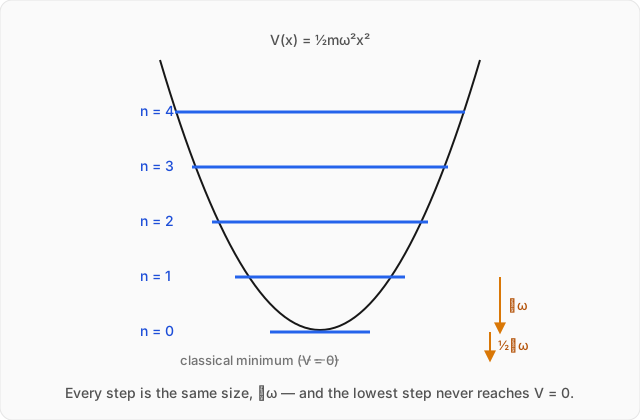
Two things about this result are worth sitting with. First, the levels are evenly spaced — the gap between and is identical to the gap between and , a distinctive fingerprint of this particular potential that most other quantum systems (including the infinite square well from the previous topic, where the spacing grows with ) don't share. Second, the ground-state energy is not zero. Classically, the lowest-energy state of a spring is simply not moving at all, sitting exactly at equilibrium. Quantum mechanically, that option isn't on the table — it would mean knowing and simultaneously, which the uncertainty principle from the previous topic forbids. This leftover minimum energy is called the zero-point energy, and it's real: it's measurable, and it's the reason a quantum oscillator can never be brought to perfect, motionless rest, no matter how much energy you remove.
Worked example
Find the ground-state wave function of the quantum harmonic oscillator. (click to reveal the solution)
Setting up: rather than solving the Schrödinger equation directly, use the defining property of the ground state: . In the position representation, with , this becomes a first-order differential equation for :
Simplifying: the overall constant out front doesn't affect where the equation is zero, so we can drop it:
Solving — this separates directly:
Normalizing: require . Using the standard Gaussian integral with :
So the ground state is a Gaussian:
Notice what we never had to do: solve a second-order differential equation, meet a Hermite polynomial, or grind through a power-series ansatz. The entire ground state fell out of one algebraic condition, . Every excited state can now be reached from here just by applying repeatedly — no new differential equation required at any step.
Where this leads
Notice the language this topic reached for without much comment: raising and lowering, creating and annihilating a quantum of energy . That's not a coincidence of naming, and it's not a metaphor either. When this same machinery is applied not to a single spring but to a field that fills all of space — the subject of classical and quantum field theory, further along this track — each independent oscillation mode of the field gets its own ladder exactly like this one, and climbing a rung is what it means to create a particle. The ladder operator you just used to find a ground-state wave function is, essentially unchanged, the mathematical object quantum field theory calls a particle.