Two Fridays ago, the owner of Harbor Falls Cinema — the town's only movie theater — charged $14 a ticket and sold 300 of them. Last Friday she tried something: she dropped the price to $13, and sold 350. Fifty more tickets. Naturally she expected fifty more tickets' worth of extra revenue, roughly dollars. She pulled the receipts. Revenue had gone from dollars to dollars — a rise of exactly $350, not $650.
Three hundred dollars had gone missing, and it is not hard to find where. The fifty new customers really did bring in dollars. But the other 300 people — the ones who would happily have paid $14 and did last week — also paid only $13 this week, because she cannot sell the seat next to theirs for a different price. That is dollars she gave up on customers she already had, just to attract fifty more. . The missing money was never missing; it went to her own regular customers, as a discount she didn't mean to give them.
Amara, the baker from the previous topic, never faced this problem. She and 499 other bakeries sold identical bread, so she could sell ten loaves or two hundred at the going price and never move it. Her marginal revenue was just the price, full stop — every extra loaf brought in exactly what the last one did, because the market was far bigger than she was. Harbor Falls Cinema is not in that position, because for movies within the town limits, the theater is the entire market. There is no wider sea of competitors to absorb the difference. That was the loose end the previous topic planted on its way out: what happens to a firm's decisions once it can no longer treat the price as a fact of nature and drop the term it had every right to drop? This topic answers it in full.
Why marginal revenue falls below the price
Go back to the general formula the previous topic wrote down and set aside. Revenue is price times quantity, but when a single seller's own output moves the market price, price is itself a function of quantity: . Differentiate with the product rule, honestly:
Read the two terms separately, because each one is a real economic effect and together they are exactly the $650-versus-$350 story above. The first term, , is the money the new unit itself brings in — the fifty tickets at $13. The second term, , is what happens to every other unit already being sold: the price on all of them moves too, by apiece, and there are of them to feel it. Since demand slopes down, , so this term is always negative, and
whenever the firm has any influence on price at all. A price taker is the special case — the demand curve facing an individual competitive firm is flat, so there is no "everyone else" to give a discount to, and exactly, as the previous topic showed. A monopolist has no such luxury: it faces the market demand curve itself, because it is the market.
Now specialize to a straight demand curve, since that is what makes the numbers in this topic checkable by hand. Write with . Two ways to get , and they had better agree. Directly: , so
Via the general formula: , so . Same answer, two routes. Same intercept as demand, twice the slope — and it is worth being honest that this exact statement is a property of linearity, not a law of economics. A curved demand curve still obeys everywhere, but will not in general be a straight line at double the slope; that clean doubling is special to the linear case, which is why every textbook example (including this one) uses it.
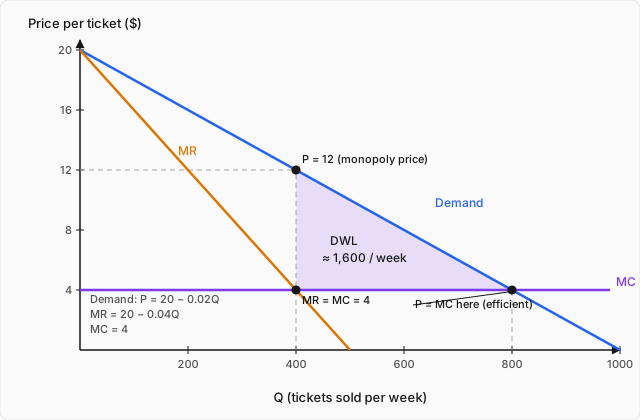
Harbor Falls Cinema's weekly demand for tickets, once the owner fits a line through several weeks of data, is
with in tickets sold per week and in dollars per ticket. So , , and
Check it against the receipts. Between 300 and 350 tickets, the average marginal revenue should be close to evaluated near the midpoint, : dollars. And directly from the receipts, dollars, exactly. The calculus and the cash register agree, to the dollar — no surprise, since for a linear demand curve the chord slope between two points equals the derivative at their midpoint precisely, not just approximately.
Produce until marginal revenue equals marginal cost — then read the price off demand
Profit is still revenue minus cost, and the logic of maximizing it has not changed at all:
This is the identical first-order condition as before — the previous topic proved it holds for any firm, competitive or not. What has changed is only what equals. For a price taker , so the rule collapsed to . For a monopolist , so the rule stays , and the price has to be found separately, by asking what buyers will pay for that quantity.
Suppose each ticket costs the theater about $4 in marginal expense — cleaning, concessions restocking, a few minutes of an usher's time — so , roughly constant across a normal night's attendance. Set :
Four hundred tickets a week is the profit-maximizing quantity. The price is not $4 — that is what the four-hundredth ticket costs to serve, not what it sells for. Read the price off the demand curve at :
Twelve dollars a ticket. Since here is strictly falling and is a flat $4, the crossing is unambiguously a maximum — profit rises for every below 400 and falls for every above it, with no U-shaped marginal cost curve to produce a second, false root the way the previous topic's pottery studio did. And notice the structural fact that survives from the derivation above: because always, the condition forces at the optimum. A monopolist's price sits strictly above its marginal cost — not by accident or by greed, but because the profit-maximizing rule is written in terms of a curve that already sits below price by construction.
The Lerner index: how far above marginal cost, exactly
"Above marginal cost" invites the next question: by how much, and does that number mean anything? It does, and deriving it is one line once is written the right way.
Go back to and factor out :
The elasticity of demand is defined as , and its reciprocal is exactly the piece sitting inside the parentheses: , since and are reciprocal slopes at the same point. So
Now impose and rearrange for the markup:
This is the Lerner index: the fraction of price that is pure markup over marginal cost, and it is pinned down by elasticity alone — no need to know the demand curve's intercept or slope separately, only how responsive buyers are right at that price.
Check it on the cinema. At , : since for this demand curve,
The Lerner index directly: . And from elasticity: . They agree, exactly, as they must. Two-thirds of every ticket's price is pure markup over marginal cost — not a number the theater chose freely, but one forced on it by how strongly moviegoers respond to price.
The corollary is sharper than it looks. A monopolist facing positive marginal cost can never choose to operate where demand is inelastic, . Here is why, straight from the boxed formula: , and since for a downward-sloping demand curve, requires , i.e. , i.e. (flipping the inequality because is negative) — which is exactly the elastic region, . If instead, : selling one more unit would make total revenue fall, and since , no positive marginal cost could ever equal a negative marginal revenue. A profit-maximizing monopolist, watching fall as it expands output, always stops while is still positive — which means always stopping on the elastic side of demand. Check it directly: at (halfway along this demand line, where it crosses $10), and the theater's actual quantity, 400, sits comfortably below that, on the elastic branch. It could never rationally push output past 500, no matter how cheap tickets became to produce, because every ticket past that point would lose money on the sale, not just on the margin above cost.
The deadweight loss of monopoly
Everything so far described what the monopolist does. Now ask what it costs everyone else, using the same benchmark the costs of production and firms in competitive markets topics built: what would this same demand and this same marginal cost produce if the market were competitive instead — many small sellers, each a price taker, each pushed by competition to ?
Eight hundred tickets a week, at $4, is the efficient quantity — every ticket up to 800 is worth more to some buyer than it costs to produce, so a competitive market would sell all of them. The monopolist sells only 400. The 400 tickets between them — numbered 401 through 800, so to speak — are exactly as worthwhile to produce as they were before. Nothing about buyers' willingness to pay or the theater's cost of showing the film changed. They simply stop being sold, because the monopolist's own optimum sits at a smaller quantity than the efficient one.
This is the same triangle from taxation and from externalities, arriving from a third direction. There, a wedge between buyer price and seller price killed trades; here, the wedge is the gap between price and marginal revenue built into , and it does exactly the same thing. One difference is worth naming precisely, though, because a reader who has just finished the taxation topic will reach for the wrong analogy otherwise. A tax's dead loss buys something: the government collects real revenue on the trades that still happen, money that can fund roads or schools. A monopoly's markup collects nothing of the kind — it is a private transfer from consumers to the monopolist's own profit, with no public revenue on the other side of the ledger to show for the trades that are destroyed. The loss is not offset by anyone's gain; it is simply gone.
Put dollars on it, two ways, and confirm they agree. Surplus accounting first. At the monopoly outcome (, ), consumer surplus is the triangle above the price and under demand:
The monopolist's profit (ignoring fixed cost for the moment — it plays no role in this quantity decision, exactly as fixed cost played no role in Amara's output choice) is the rectangle between price and marginal cost:
Total surplus under monopoly: dollars. Compare it to the efficient total, the triangle from 0 to 800 between demand and marginal cost:
The triangle formula, as a cross-check. The lost surplus is the gap between demand and marginal cost, integrated over exactly the trades that stopped happening — from to :
Because the integrand is a straight line falling from at (the gap between the monopoly price and marginal cost) to at (where demand meets marginal cost), this is just a triangle: dollars, the third route to the same number.
Price discrimination: shrinking or erasing the triangle
Every dollar of that $1,600 disappeared for one specific reason: the theater must charge the same price to everyone, so raising output means cutting the price on customers who would have paid more. What if it didn't have to?
First-degree: charging each buyer their own reservation price
Imagine, for a moment, the theater could read every customer's mind and charge each one exactly the most they would pay rather than walk away — the person who'd pay $19 pays $19, the person who'd pay $4.01 pays $4.01, nobody pays a cent less than their own maximum. This is perfect (first-degree) price discrimination, and real markets only approximate it (a doctor's sliding-scale fee, a university's need-based financial aid, an airline's dozens of fare classes) — but it is worth working out exactly, because the result is genuinely striking.
Under perfect discrimination, selling one more ticket no longer costs the theater anything on the tickets already sold, because each of those buyers is locked into their own personal price — nobody else's price moves. The troublesome term vanishes entirely, not because demand became flat, but because the firm no longer has to give every existing customer the same discount it gives the marginal one. The marginal revenue of the next ticket is simply that ticket's own price, read straight off the demand curve: . So the profit-maximizing rule becomes
the efficient quantity — identical to what a competitive market would produce. Every ticket worth more to a buyer than it costs the theater to show gets sold; deadweight loss is exactly zero. This is the striking part: a single, unconstrained, profit-hungry seller produces the economically efficient outcome. What is not efficient is the split of the pie. Total profit is now the entire area between demand and marginal cost, the same $6,400 that was total surplus above:
nearly double the $3,200 the theater earned under a single uniform price — and consumer surplus falls to exactly $0. Nobody captures a bargain anymore; every last dollar a buyer was willing to pay above cost ends up as profit instead of consumer surplus. The pie got bigger by $1,600 (the recovered deadweight loss) and every extra slice, plus all of the slices that used to be consumers', went to one party.
Third-degree: two markets, two prices
Perfect discrimination needs to read minds. A much more common, much more achievable version needs only to sort customers into groups with visibly different price sensitivity — which is exactly what a ticket window already does. Forget the pooled demand curve above for a moment, and suppose Harbor Falls Cinema studies its two kinds of showings separately.
Evening shows, for people with nowhere else to be that hour, have inverse demand . Matinee shows, for students, retirees, and anyone with a flexible schedule, have inverse demand . The theater's marginal cost of admitting one more patron is the same $4 either way. It can charge to evening buyers and to matinee buyers, provided the two crowds can't resell tickets to each other — which, for a same-day movie ticket, they effectively can't.
Total profit is , and because the two markets' revenues depend on different quantities while cost depends only on their sum, the two first-order conditions come apart cleanly:
There is also a one-line argument for this that needs no calculus at all: if and ever differed, the theater could move one ticket's worth of capacity from the lower- market to the higher- market, gain more revenue than it gives up, and pay exactly the same total cost either way. Profit can only stop rising once the two margins are equal.
Solve each market on its own, exactly as the single-market case above. Evening: , so gives and dollars. Matinee: , so gives and dollars.
Evening tickets cost more than twice as much as matinee tickets, for the identical film in the identical building. Check that this is not arbitrary but forced, via the Lerner index in each market separately. Evening: , so , and the Lerner index is ; check: . ✓ Matinee: , so , and the Lerner index is ; check: . ✓
The evening crowd, with the less elastic demand (), gets the higher markup (75%). The matinee crowd, with the more elastic demand (), gets the lower markup (43%). This is the Lerner index doing exactly what it did in the single-market case, applied separately inside each submarket: whichever group responds less to price gets charged more above cost, because raising their price loses fewer of them. It is the same logic behind student discounts, off-peak pricing, and every "why does the exact same seat cost different amounts depending on when you buy it" complaint anyone has ever had about an airline.
Where monopoly power comes from, and why it can be a trap
None of this works unless something stops rival sellers from undercutting the price down to marginal cost, the way 500 competing bakeries did to Amara. Three things typically supply that barrier: control of a genuinely scarce resource (the only spring feeding a mineral-water bottler), a legal grant like a patent or copyright (temporary and deliberate, a trade of monopoly profit for the incentive to invent in the first place), or economies of scale large enough that one seller can supply the whole market more cheaply than two ever could.
Harbor Falls Cinema is plausibly this last kind — a natural monopoly. A movie theater's costs are dominated by the fixed expense of the building, the projection equipment, and a baseline staff, all of which must be paid whether ten people or a thousand show up; the marginal cost of admitting one more patron is small. Splitting the town's moviegoers across two half-empty theaters would force each one to spread the same fixed cost over half the tickets — worse for everyone, including the buyers.
But this is exactly the situation that makes marginal-cost pricing — the rule that keeps a competitive market efficient — actively dangerous to impose on a natural monopoly. Suppose a town council, worried about the $1,600-a-week deadweight loss above, orders the theater to price at marginal cost: , the efficient . Total cost includes the fixed cost that the costs of production topic showed is invisible at the margin — it played no role in choosing — but it is emphatically not invisible in the final tally. With ,
The loss is exactly the fixed cost, whatever it happens to be — say $2,000 a week for the lease, the projector, and the base staff. Marginal-cost pricing, precisely because it forces price down to a level that recovers only the variable cost of the last unit, structurally cannot recover the fixed cost of a business whose fixed cost is the whole reason it is a natural monopoly in the first place. This is why real natural monopolies — water utilities, power grids — are almost never simply ordered to price at marginal cost; regulators instead cap price at average cost (enough to break even, if not to eliminate the markup entirely) or allow a modest, regulated markup, trading away a slice of efficiency for the more basic requirement that the business can afford to keep operating.
Worked example
Harbor Falls's only ferry to the mainland faces demand (passengers a day) and constant marginal cost of $6 a passenger. (a) Find marginal revenue and the profit-maximizing price and quantity. (b) Compute the Lerner index directly and cross-check it against the elasticity of demand at that point. (c) Find the deadweight loss of monopoly relative to the competitive benchmark, two ways. (d) Suppose the ferry could perfectly price-discriminate. Find its new profit and deadweight loss, and compare to (a). (click to reveal the solution)
Setting up (a) — invert demand and find . From , , so , , and by the doubling rule,
Set :
Read the price off demand, not off marginal cost: dollars. Three hundred passengers a day at $12 each.
Step (b) — Lerner index and elasticity. Directly: . From elasticity: , so , and . ✓ Half of every fare is markup over marginal cost. Since , the ferry is correctly operating on the elastic branch of demand, exactly as the general argument requires — check directly that at (halfway along the demand line), and 300 sits safely below that.
Step (c) — deadweight loss. The competitive benchmark sets : . Surplus accounting: consumer surplus at the monopoly outcome is dollars; monopoly profit (ignoring fixed cost) is dollars; total is $2,700. The efficient total is dollars. So dollars a day. Cross-check with the triangle formula directly: dollars. ✓ Both routes agree.
Step (d) — perfect price discrimination. Under perfect discrimination , so the rule becomes : , the efficient quantity, with zero deadweight loss. Profit is the entire area between demand and marginal cost from 0 to 600:
Compare to part (a): single-price profit was $1,800 a day; perfect discrimination exactly doubles it, to $3,600 — recovering the $900 deadweight loss and converting the $900 of consumer surplus that used to belong to passengers into additional profit as well ( ✓). The ferry now carries twice as many passengers and keeps every dollar any of them was willing to pay above the six-dollar cost of carrying them.
Where this leads
Start from one assumption — a single seller facing the whole downward-sloping market demand curve, rather than a flat one — and the rest is forced. Marginal revenue falls below price because raising output means discounting every unit already sold, not just the new one; still finds the profit-maximizing quantity, but the price it implies sits above marginal cost by an amount the Lerner index pins to elasticity exactly; the gap between that price and marginal cost destroys trades that a competitive market would have completed, the same triangle the tax and externality topics derived from entirely different causes; and a seller who can charge different buyers different prices can shrink that triangle, or with perfect information erase it completely, while capturing more of the total for itself rather than less.
Every calculation above assumed something that deserves to be noticed on the way out: exactly one seller, with no rival watching and reacting. Harbor Falls Cinema has no competitor because the town cannot support a second screen — but suppose it could. Add a second ferry company on the mainland run, or a second theater willing to open across town, and the entire framework here stops working, not because the mathematics gets harder in the usual sense, but because it becomes genuinely circular: the profit-maximizing price for one firm now depends on what the other firm charges, and the other firm's profit-maximizing price depends right back on this one's. Neither MR = MC nor anything derived from a single firm's own demand curve can resolve a problem where the "demand curve" itself depends on a rival's move. Untangling that circularity needs a different kind of mathematics than anything used so far — and it is exactly where Game Theory and Oligopoly begins.