Release two ball bearings side by side, a hundred metres apart, high above the ground, and watch them fall.
According to the equivalence principle, each one individually is doing nothing at all: ride along with either bearing and you are in a perfectly good inertial frame, with no gravity in it anywhere. Drop a third bearing next to the one you're riding and it just floats there beside you. Every local experiment says: no gravity here.
And yet the two bearings, a hundred metres apart, slowly drift toward each other. They must — both are falling toward the same center of the Earth, so their paths converge. Ride along with the left one and you will see the right one accelerate gently sideways toward you, for no reason you can locally account for. Ride the right one and you see the mirror image. Neither of you feels any force. Neither of you can find a frame in which nothing is happening between you.
That drift is the leftover. It is the part of gravity that no choice of reference frame removes, and it is therefore the only part with a right to be called real. Everything the equivalence principle let us delete — the weight, the , the whole apparent downward pull — was frame-dependent bookkeeping. What remains is a statement about relative motion of neighbouring free-fallers: initially parallel free-fall trajectories do not stay parallel.
Read that last sentence again, but pretend you have never heard of gravity. Initially parallel straight lines that fail to stay parallel. That is not a sentence about forces. That is the definition of a curved space.
Two ways of being fictitious, and the difference between them
Before committing to the geometric picture, it's worth being precise about what the equivalence principle did and did not establish, because there is a trap here that catches people.
The centrifugal force in a rotating frame is purely an artifact: transform to the non-rotating frame and it is gone, everywhere, permanently, in one step. Gravity is not like that. You can transform it away at a point (fall freely), but the transformation that kills it at your location does not kill it at your neighbour's. There is no single global coordinate change that removes gravity from all of space at once — because if there were, the two ball bearings would not converge.
So gravity sits in a strange middle ground: locally removable, globally not. And the trap is to conclude, from the local removability, that gravity is "just" a coordinate effect, or from the global irremovability, that it must "really" be a force after all. Both conclusions are wrong. The correct conclusion is the one that fits both facts, and to see what it is, look at what happened in tensor calculus when we merely switched to polar coordinates on an ordinary flat plane.
There, the line element came out as
so the metric components were
which is emphatically not the identity matrix, and which varies from point to point. A particle moving in a straight line at constant speed across that plane has, in these coordinates, non-constant and — it looks accelerated, and if you insisted on Newtonian language you would say a force was acting on it. That "force" is entirely an artifact of the coordinate grid: the plane is flat, the particle is going straight, and a single global change of coordinates back to Cartesian removes the whole apparent effect at every point simultaneously.
So a position-dependent metric does not by itself mean curvature. This is the single most common misunderstanding in the subject and it is worth nailing down: having non-constant components can mean nothing more than that you chose curvy coordinates on a flat space.
Curvature is the statement that no coordinate change works. It is the failure of the metric to be reducible to constant components over a finite region, no matter how cleverly you re-coordinate. On the flat plane in polar coordinates, the map exists and flattens everything. On a sphere, no such map exists — and the test that proves it needs nothing but a tape measure.
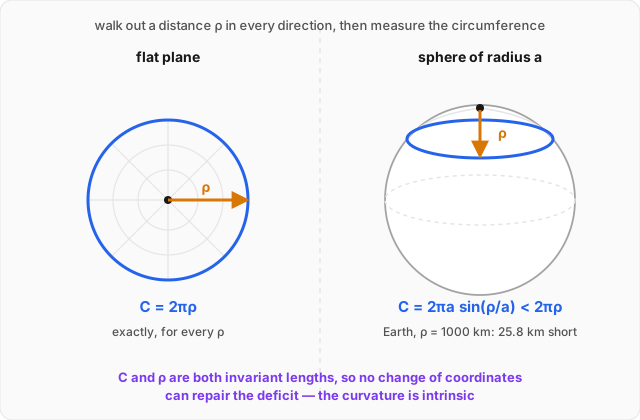
That is exactly the structure the two ball bearings demanded. Locally: choose freely falling coordinates and gravity vanishes (the metric becomes constant at your point). Globally: it cannot vanish everywhere (the metric cannot be made constant over a region). Gravity is curvature. Not "like" curvature, not "analogous to" curvature — the same thing.
From the flat interval to a general metric
Special relativity built one invariant out of space and time. Two events separated by and in some inertial frame have
and the whole point of that page's central derivation was that every inertial observer computes the same , even while disagreeing about all of the ingredients separately.
From here onward we write the same object infinitesimally, and with the overall sign flipped:
A word on that sign, because sloppiness about it causes real errors. The two expressions differ by an overall factor of ( for infinitesimal separations); which one you call "the interval" is pure convention, and no physical statement depends on the choice. What does depend on it is every explicit sign you will write for the rest of this track, so we fix it once: the signature used here is , timelike separations have , spacelike separations have . The reason for preferring it in general relativity is that the spatial part then reduces to the ordinary positive Euclidean , which is exactly the that tensor calculus built for spatial geometry. Purely spatial formulas carry over unchanged; only the time slot is unusual.
Now introduce the index notation from that same page. Label the four spacetime coordinates
with Greek indices running to (Latin indices, when they appear, run over the three spatial values only). Absorbing the into means every coordinate has units of length, which keeps the metric components dimensionless. Then flat spacetime has the line element
with the Einstein summation convention doing its usual work: the repeated upper-lower pairs on and are summed, sixteen terms in all, twelve of which vanish here. This particular metric is called the Minkowski metric, and it is the special-relativistic interval written as a tensor equation.
And now the generalization, which is a single act of erasure. Delete the requirement that the metric be . Allow it to be any symmetric, position-dependent tensor :
This is the central object of general relativity, and there is nothing in it that tensor calculus did not already supply. The metric tensor is a symmetric tensor, so it has independent components rather than ( because is symmetric, so any antisymmetric part would contribute nothing). It lowers indices, . Its matrix inverse , defined by , raises them. It converts a bare coordinate velocity into an invariant — exactly the job it did in producing from in that page's worked example.
What is genuinely new is not the mathematics. It is the physical claim attached to it:
is not a fixed background. It is a dynamical field, it is what we have been calling the gravitational field, and there is no such thing as "the" metric of spacetime independent of what matter is in it.
Ten functions of four variables, replacing Newton's single potential . That is a lot of new freedom, and finding the equation those ten functions obey is what the Einstein field equations are for.
Local flatness: the equivalence principle as a theorem about
The geometric picture has to reproduce the equivalence principle, and it does, exactly and provably.
Pick any point in any spacetime, however violently curved. Then there exists a coordinate system in which, at ,
These are called locally inertial (or Riemann normal) coordinates, and the counting works out neatly: a general coordinate change at a point involves a Jacobian with free entries, which is more than enough to bring the components of a symmetric to the standard form (the left over are exactly the Lorentz transformations, which preserve — the residual freedom of choosing your velocity and orientation in the falling frame). At the next order there are first derivatives and free second derivatives of the coordinate transformation, so all can be killed too.
That is the equivalence principle, translated: at any point you can find coordinates in which spacetime looks exactly like flat Minkowski spacetime with no gravitational field at all. Free fall.
Go one order further and it stops. There are independent second derivatives but only free third derivatives of the coordinate transformation available to cancel them. Twenty combinations survive, and no coordinate change on earth can remove them. Those leftover numbers are precisely the independent components of the Riemann curvature tensor at that point — the thing the two ball bearings were measuring.
I want to be clear that I have not derived that counting argument here beyond sketching it, and I have not constructed the Riemann tensor. What I have done is show you why there has to be one, and why it has to be built from second derivatives of the metric and not first. First derivatives of are frame-dependent — they are the "gravitational field" in the sense of the thing you can make vanish by falling. Second derivatives are not.
Worked example
Derive the metric of a sphere of radius in the coordinates , then prove the sphere is intrinsically curved — using only measurements made on the surface — by comparing the circumference of a circle to its radius. Extract the Gaussian curvature and evaluate the effect for a circle on Earth. (click to reveal the solution)
Setting up: this repeats, on a genuinely curved surface, exactly the calculation tensor calculus did for polar coordinates on the flat plane — embed, differentiate, substitute — and the comparison between the two results is the whole point.
A sphere of radius sits in three-dimensional Euclidean space as
with the polar angle from the north pole (the colatitude) and the azimuth. Here is a constant — we are restricting to the surface, which is exactly why the result will be a two-dimensional metric.
Differentiating:
Substituting into the flat 3D line element . Take the pieces one at a time. The coefficient from :
The coefficient from :
The cross terms in :
equal and opposite, cancelling exactly as they did in the polar-coordinate calculation. And finally . Adding everything:
Reading off the components with :
A warning, and the real question. Compare this with the flat plane in polar coordinates, . Both are diagonal. Both have one constant entry and one position-dependent entry. Written down side by side they look like the same kind of object — and one describes a flat space while the other does not. So looking at the metric components settles nothing. We need a test.
The test: measure a circle. Stand at the north pole and walk a fixed distance outward in every direction, always along the surface. The set of points you reach is a circle. Now compare its circumference to its radius — and crucially, define "radius" as the distance you actually walked, not as the distance to some center buried in a third dimension we are pretending not to know about.
The walked-out radius, going from the pole () to colatitude along a line of constant (so ):
The circumference, going once around at fixed (so ):
Now eliminate using :
Why this settles it. Since for all , we have , and therefore
for every circle of nonzero radius. On the flat plane, by contrast, the identical calculation with gives and , so exactly, for every circle.
Both and are lengths of specific curves, computed by integrating — which is an invariant. Their ratio is therefore a number that every coordinate system must agree on. So is not something a change of coordinates could ever repair, and no map from the sphere to the flat plane can preserve all distances. The sphere is intrinsically curved, and we established it without ever leaving the surface. A two-dimensional surveyor with a tape measure and no concept of a third dimension could discover it.
Extracting the curvature. Expand the boxed result for small , using :
There is a standard result of surface geometry (quoted here, not derived — its proof belongs to differential geometry rather than this track) that for any smooth surface the circumference of a small geodesic circle obeys
where is the Gaussian curvature at the center. Matching term by term against what we just derived:
A big sphere is gently curved, a small sphere is sharply curved, and has units of — which is what curvature always has, and which will matter a great deal when we come to dimensional analysis of the field equations.
Numbers. Take Earth as a sphere of radius and walk out from the pole. Then , and
A flat-earth surveyor would have predicted
so the measured circumference falls short by
a fractional deficit of . Check it against the small- formula:
agreeing to three digits, as it should for .
Interpretation. Twenty-six kilometres of missing circumference, out of six thousand — measurable with nineteenth-century surveying equipment, and detectable in principle by anyone with a long enough tape measure and no telescope. That is the model for everything general relativity does. Curvature is not a metaphysical claim about a fourth dimension for space to bend into; it is a discrepancy between measured lengths and the lengths Euclid predicts, and it is measured with rulers and clocks on the inside.
Worth noticing before we move on
The angular part of the sphere metric,
is going to reappear verbatim, embedded inside the metric of a black hole, where is replaced by the radial coordinate . That is not a coincidence: any spherically symmetric spacetime contains nested two-spheres, and this is their geometry.
And one loose end, planted deliberately. In the worked example I said "walk outward from the pole along a line of constant " and computed the radius as — quietly assuming that a line of constant is the shortest route, the analogue of a straight line. It is, but nothing above proved it, and on a curved surface "which curve is straight?" is a real question with a nontrivial answer. That question is the next topic, and its answer turns out to be the entire law of motion for gravity.
Where this leads
We have replaced Newton's gravitational potential with a metric tensor , and replaced the notion of a gravitational force with the geometry of spacetime. That leaves two enormous holes, one on each side of the theory.
The first: given a metric, how does a particle move? Newton had fed into . The geometric picture must answer instead with "the straightest available path," which means defining straightness in a curved space and then finding the equation such paths obey. Geodesics does exactly that, and it does it by taking the metric and feeding it into the principle of least action from Lagrangian mechanics — the geodesic equation turns out to be nothing but the Euler-Lagrange equation with as the thing being extremized.
The second: given matter, what metric does it produce? Newton had . Its replacement must relate the curvature built from second derivatives of — the irreducible components identified above — to the energy and momentum of whatever matter is present. That is the Einstein field equations, and between the two of them the theory is complete: matter curves spacetime, and curved spacetime steers matter.