Throw a ball across a room. It traces a parabola — a specific parabola, not some other one, and if you throw it again the same way you get the same curve to within your ability to repeat the throw.
Now try to say that in the language curved spacetime just built. There is no force on the ball. Nothing is pushing it. It is in free fall, so by the equivalence principle it is doing nothing at all, and an observer falling alongside it sees it simply floating there. So what on earth is selecting the parabola?
The answer has to be "it's going straight, and spacetime's geometry makes straight look like that." Which sounds like an evasion until you actually look at the ball's path in spacetime rather than in space.
Here is the calculation that made this click for me. Suppose the ball is in the air for seconds and reaches a peak height of . Draw its worldline: height on the vertical axis, and — because this is spacetime, and because a spacetime diagram must use the same units on both axes — the quantity on the horizontal axis. Two seconds of flight is
of horizontal extent. So the ball's worldline is an arc that rises metres and falls back over a baseline of six hundred million metres. The radius of curvature of a shallow arc of sagitta over a base is , which here gives
or just under one light-year. The ball's worldline is an arc of a circle a light-year in radius. It is about as straight as anything gets. The parabola we think we see is a projection artifact: we throw away the time axis, which is where nearly all of the worldline lives, and the residual squiggle in the leftover spatial directions looks dramatic only because we have compressed the interesting axis by a factor of .
That is the whole picture. The ball goes straight. Spacetime is slightly curved. "Straight in a slightly curved spacetime, projected onto space, over two seconds" is a parabola. What remains is to make "straight" into an equation.
What "straight" can possibly mean
In flat space you have several equivalent definitions of a straight line, and the trick is to pick the one that survives being moved to a curved space.
"Zero curvature" won't do — it presupposes an ambient flat space to measure against, and we established last topic that we are working from the inside with rulers and clocks. "Constant direction" won't do either, at least not yet, because comparing directions at two different points of a curved space is precisely the thing that requires extra structure.
But shortest works. A straight line between two points in flat space is the path of least length, and length is something the metric computes locally, integrating along the curve, with no ambient space required. So define:
A geodesic is a curve that extremizes between its endpoints.
For spacetime there is a wrinkle worth being careful about. In signature , the worldline of a massive particle is timelike, meaning along it. So is imaginary and "shortest" is the wrong word. The right quantity is the proper time, defined by
which is positive for a timelike worldline. And is not an abstraction: it is exactly the proper time from special relativity — the time read by a clock carried along the worldline. Check it in flat spacetime with the particle at rest: , so , the clock's own time. Check it for a particle moving at speed : , so
which is time dilation, recovered from the metric in one line.
So the principle is:
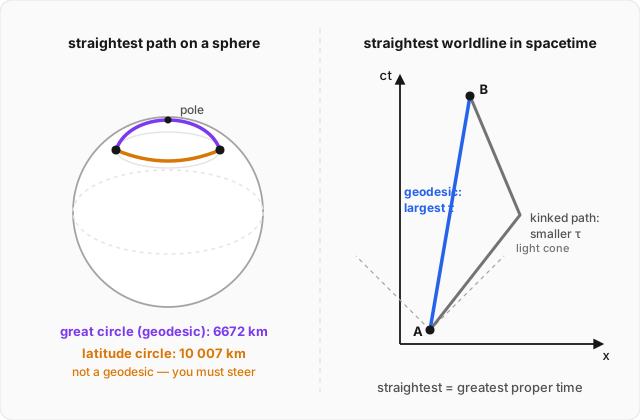
A free particle moves along the timelike worldline that extremizes proper time between two events. In a small enough region it is a maximum — the free-falling clock reads more elapsed time than any other clock that leaves the same event and returns to the same event.
That last sentence is the twin paradox restated, and it is worth savouring the reversal. In Euclidean geometry the straight path is the shortest. In spacetime the straight path is the longest — in proper time. It's the minus sign in the metric doing it, the same minus sign that made the interval invariant in the first place.
The principle of least action, in disguise
Now, Lagrangian mechanics built its entire structure around extremizing an action, and here we are extremizing something. This is not a resemblance. It is the same statement, and showing that resolves a question that page deliberately left hanging.
Recall that when it introduced , it flatly admitted the definition looked arbitrary — "kinetic minus potential, rather than their sum" — and told the reader to hold their suspicion, because the resolution would be more interesting than any hand-wave. Here is the resolution.
Take as the action for a free particle of mass the only quantity available to it: its own elapsed proper time, times whatever constants are needed to make the units work.
Nothing has been assumed about forces or potentials. This is a statement about geometry alone, and about the one clock the particle carries. (The minus sign is there so that maximizing corresponds to minimizing , matching the sign conventions of the earlier page; makes an action.)
Now evaluate it in a weak, static gravitational field. Take the metric to be nearly Minkowski, differing only in its time component:
where is a function of position with . I am positing this form here, not deriving it; the justification is that it will turn out to reproduce Newtonian gravity with the Newtonian potential, and later that the exact solution for a spherical mass has precisely this . Then
Divide through by and write :
Both correction terms are small, so expand the square root with :
Substitute into the action:
The first term, , is : a constant, fixed by the endpoints, identical for every candidate path. It cannot affect which path extremizes , so drop it. What is left is
There it is. Kinetic energy minus potential energy — the definition that looked like it had been reverse-engineered to make the Euler-Lagrange equation come out right — is the first-order Taylor expansion of proper time along a worldline. The minus sign between and is the minus sign in the spacetime metric. Nature is not comparing an infinity of trajectories and computing along each; it is going straight, and is what "straight" looks like when you expand it to first order in and throw away the time axis.
Everything Lagrangian mechanics derived — the pendulum, the constraint forces that never appear, the whole apparatus — is a low-speed, weak-field shadow of a geometrical statement.
The geodesic equation
Now do the variation properly and in full generality. Parametrize the worldline by proper time , write , and take as the Lagrangian
One honest remark about that choice. The quantity we actually want to extremize is , which has an awkward square root in it. Using the quadratic instead gives the same extremal curves, and the reason is visible from the structure of the problem: has no explicit -dependence, so the associated conserved "energy" is constant along any solution. With constant, extremizing and extremizing single out the same curves, differing at most in how they are parametrized. The quadratic version automatically delivers the curve in the parametrization we want, with fixed by the normalization .
Apply the Euler-Lagrange equation from Lagrangian mechanics, one copy for each coordinate :
The velocity derivative. The index can match either or in , giving two equal contributions because is symmetric:
Its -derivative. The metric depends on only through the position, so the chain rule gives (writing ):
The position derivative. Only depends on position:
Assembling:
Here is the one step that requires a moment's thought. The factor is symmetric under exchanging , so when it multiplies something, only the symmetric part of that something survives. We may therefore replace by its symmetrization without changing anything:
Divide by and contract with the inverse metric , using from tensor calculus to free the acceleration:
where
This is the geodesic equation, and the 's are the Christoffel symbols (or the connection). Look at what it is: four coupled second-order ordinary differential equations for the four functions , with coefficients built entirely out of the metric and its first derivatives. Give me , an initial position, and an initial four-velocity, and this determines the entire future worldline. It is 's replacement, and it contains no force and no mass — a fact worth pausing on, because it is exactly the statement that all bodies fall alike. The trajectory has no memory of what is travelling along it. is not an input to this equation; there is nowhere for it to enter.
The Christoffel symbols are built from first derivatives of the metric, which — by the local-flatness argument from the previous topic — can all be set to zero at any single point by choosing locally inertial coordinates. So can always be made to vanish at a point, whereupon the geodesic equation there reads : straight lines, no gravity. That is the equivalence principle, appearing as a property of the connection. It also means is not a tensor — a tensor that vanishes in one coordinate system vanishes in all of them, and this thing plainly doesn't. The Christoffel symbols are "the gravitational field" in exactly the frame-dependent sense that a weight reading on a bathroom scale is.
Gravity is not a force: the Newtonian limit
The geodesic equation had better reduce to Newton's law of gravity in the appropriate limit, and it does, in about six lines. This is the same result the action calculation above already gave, arrived at by a completely different route — a useful consistency check on both.
Take the weak static metric , , , and a slowly moving particle, with . In the double sum the dominant term is by far , so keep only it. For a spatial component :
Evaluate from the definition with :
The field is static, so every vanishes. To leading order and , leaving
For slow motion , so . Substituting:
Newton's law of gravitation, recovered exactly, with identified as the Newtonian gravitational potential. And notice what the derivation reveals about where Newtonian gravity actually lives inside the geometry: the entire effect came from , the time-time component. Newtonian gravity is a distortion of time, not of space. The spatial part of the metric was flat throughout that calculation and contributed nothing. (Which, incidentally, is exactly why the equivalence principle got only half the light deflection: a light ray moves too fast for alone to be the whole story, and the spatial curvature we just neglected supplies the other half.)
Worked example
Using the sphere metric , derive the geodesic equations from the variational principle, read off the Christoffel symbols, and determine which circles on a sphere are geodesics. Then compare the great-circle and constant-latitude routes between two points at N on opposite sides of the Earth. (click to reveal the solution)
Setting up: take the metric derived in curved spacetime and the metric tensor, with coordinates and constant. Parametrize curves by arc length and write . The Lagrangian is
This is a purely spatial problem, so the signature subtleties don't arise and we are minimizing length in the ordinary sense.
The equation. Notice first that does not appear in — only does. By exactly the mechanism Noether's theorem describes, this cyclic coordinate hands us a conserved quantity for free:
so the Euler-Lagrange equation reads
This is the sphere's angular momentum, and it is the reason a geodesic sweeping toward the pole (small ) must swing round in faster.
Expanding the derivative gives the equation in geodesic form:
The equation.
The Euler-Lagrange equation is therefore
Reading off the Christoffel symbols. Compare the two results with the general form , remembering that the double sum expands mixed terms twice (once as and once as ):
with all other components zero. (You can confirm these directly from using and ; for instance , which agrees.)
Test 1: is the equator a geodesic? The equator is for all , so . Substitute into the equation:
Satisfied. And the equation with becomes , so is constant: traverse the equator at a uniform rate and every geodesic equation holds. The equator is a geodesic.
Test 2: is any other circle of latitude a geodesic? Try , a constant with , again giving . The equation demands
We need (otherwise the curve is a single point), and (otherwise we are sitting on the pole). So the equation requires , that is, . No circle of latitude other than the equator is a geodesic.
Why the equator isn't special. A sphere has no preferred axis, so which circle we call "the equator" is a matter of where we chose to put the pole. Any great circle is the equator for a suitable choice of axis, and the geodesic equations are built from the metric alone — which is unchanged by that rotation. So the geodesics of a sphere are exactly its great circles. That also retroactively justifies the loose end left in the previous topic: the "walk outward from the pole at constant " path used to define the circle's radius is a meridian, which is a great circle, hence genuinely the shortest route.
What it costs to ignore this. Take two points at latitude N — colatitude — on opposite sides of the Earth, apart in longitude, with .
Route along the line of latitude (half of that circle):
Route along the great circle, which for these two points runs straight over the north pole — down one meridian from the first point to the pole and up the other:
The geodesic is shorter by , a saving of one third. This is not a subtlety; it is why long-haul flights between northern cities go over the Arctic, and why the route looks absurdly bent on a Mercator projection while being the straight one.
Interpretation. A pilot flying "due east" along the N line, holding a constant compass heading, feels like they are going straight and is not. They are steering — continuously turning left, toward the pole — and is the precise measure of how hard. That is the two-dimensional rehearsal for the whole idea: a person standing on the ground, held there by the floor, is not going straight through spacetime either. They are being steered, continuously, by the floor, away from the geodesic their body would otherwise follow. What they feel as their weight is the steering. What the falling apple does is stop steering.
Where this leads
Two of the three pieces are now in place. Curved spacetime and the metric tensor gave us the arena, ; this topic gave us the law of motion, the geodesic equation, and showed it contains Newton's law of gravitation and the principle of least action from Lagrangian mechanics as special cases.
The piece still missing is the one that makes the theory predictive rather than descriptive. So far has been an input: I wrote down by hand and said "posit this," which is exactly the sort of thing this track does not permit itself to leave standing. Nothing yet tells us what metric a given lump of matter actually produces, and until something does, general relativity can tell you how a planet moves in a given geometry but not what geometry the Sun makes.
That equation is the subject of the Einstein field equations, where the curvature built from second derivatives of gets tied to the energy and momentum of matter. And once it exists, the Schwarzschild solution solves it for a spherical mass — at which point the posited above stops being a posit and becomes the weak-field limit of an exact result, and the geodesics of that solution turn out to include Mercury's orbit, the bending of starlight past the Sun with the missing factor of two restored, and the impossibility of ever climbing back out of a black hole.