Take a sealed steel box of hydrogen gas, put it on a scale, and record the reading. Now heat the gas. No atoms have been added; nothing has entered or left the box. The scale reading goes up.
It has to. The molecules are moving faster, so the box's total energy has increased, and by from special relativity that energy has inertia — and, since to fifteen decimal places, it must gravitate too. Heat the gas by and the box gains gravitational mass . The effect is absurdly small — heating a kilogram of hydrogen gas by takes about , which buys of extra weight — but it is not zero, and it is not optional.
So the source of gravity is not mass. It is energy.
That single correction wrecks any attempt to write Newton's field equation
relativistically. Because energy is not an invariant. Watch the same box from a passing rocket: it now has kinetic energy, so its energy density is larger — and its volume is length-contracted, making the density larger again. Different observers assign completely different values to . Meanwhile, whatever is supposed to be, involves only spatial derivatives, so the equation as written also implies that changing the mass here changes the potential everywhere instantaneously — which is exactly the kind of thing relativity forbids.
The problem is worse still. Energy is one component of the four-vector , and a Lorentz transformation mixes energy into momentum. If gravity couples to energy, it must couple to momentum as well, or the coupling would be frame-dependent — and a frame-dependent law of gravity is no law at all. And momentum flux is stress: pressure, tension, shear. All of it has to be in there.
So the right-hand side of the equation we are looking for cannot be a single number per point. It has to be an object with enough slots to hold energy density, the three components of momentum density, and the nine components of stress. And the left-hand side, whatever it is, must be an object of exactly the same type, built out of the curvature of .
The right-hand side: the stress-energy tensor
The object that holds all of that is the stress-energy tensor , a symmetric rank-2 tensor of the kind tensor calculus constructed. Its physical reading, with as always:
or written out component by component:
- is the energy density , in . For slow-moving matter of mass density , .
- is the energy flux in direction , divided by ; is times the momentum density. Symmetry of forces these to be equal, which is a real physical statement rather than bookkeeping: energy flux momentum density, so energy flow is momentum.
- is the stress tensor: the flux of -momentum across a surface of constant . Its diagonal is pressure; its off-diagonal part is shear.
Every component has the units of energy density. That uniformity is what makes the dimensional analysis in the worked example clean.
The standard example, and the one that covers stars, dust clouds, and the universe as a whole, is a perfect fluid — a material with a density and an isotropic pressure and no viscosity or shear:
where is the fluid's four-velocity. In the fluid's own rest frame this collapses to the diagonal matrix — energy density in the time slot, pressure in the three space slots — which is as transparent as it gets.
The crucial structural property of is that it is locally conserved. In flat spacetime that reads , four equations expressing conservation of energy () and of the three components of momentum (). In curved spacetime the ordinary derivative is replaced by its covariant version:
Remember this. It is about to dictate the entire form of the left-hand side.
The left-hand side: curvature
We need a symmetric rank-2 tensor built from . It cannot involve only first derivatives of the metric, because geodesics showed those are exactly the Christoffel symbols, which can be made to vanish at any point — so an equation built from them would say "no gravity here" in every freely falling frame, which is wrong. It has to be second derivatives.
The object that packages the second derivatives covariantly is the Riemann curvature tensor:
I am writing this down, not deriving it, and I want to be explicit about that. Constructing the Riemann tensor properly — from the failure of two covariant derivatives to commute, or equivalently from the failure of a vector to return to itself when parallel-transported around a closed loop — is a substantial piece of differential geometry that this track does not develop. What you should take from the formula is its anatomy: two derivatives of , hence two derivatives of the metric, arranged antisymmetrically in so that the frame-dependent pieces cancel and what survives is a genuine tensor. In four dimensions it has independent components after all its symmetries are imposed — exactly the irreducible second derivatives that curved spacetime and the metric tensor counted as un-removable by any coordinate change.
Its physical meaning is the thing we started this whole story with. The Riemann tensor governs geodesic deviation: for two nearby geodesics separated by ,
which is the equation for the two falling ball bearings drifting toward each other. Riemann is the tidal field, made into a tensor.
Riemann has four indices, and we need two. Contract:
The first is the Ricci tensor — symmetric, independent components, exactly the shape we need. The second is the Ricci scalar, a single number at each point, the most compressed measure of curvature there is.
Now, which combination goes on the left? The naive guess is , which is what Einstein tried, and it fails — because is not zero in general, so it cannot equal something that is. The unique fix comes from an identity of Riemannian geometry called the contracted Bianchi identity (again quoted, not derived):
That particular combination is divergence-free automatically, as a matter of geometry, with no equations of motion assumed. So define the Einstein tensor
and you have a symmetric rank-2 tensor, built from second derivatives of the metric, that is identically conserved — matching, slot for slot and property for property, the tensor on the other side.
The equations
Ten coupled, nonlinear, second-order partial differential equations for the ten components of . Written out, each one is a page of Christoffel symbols. And every symbol in it has now been given a meaning:
- : the Einstein tensor, pure geometry. Second derivatives of the metric. Units of .
- : the stress-energy tensor, pure matter. Energy density, momentum density, pressure, stress. Units of energy density.
- : the coupling. A conversion factor from energy density to curvature, and — as the worked example computes — an unbelievably small one.
- (no indices): Newton's gravitational constant, . It is unfortunate that the same letter serves as the Einstein tensor; the index structure always tells you which is meant.
In vacuum, , and taking the trace of the equations then forces , so they collapse to the compact
This is emphatically not the statement that spacetime is flat. Flat means , all components; kills only the contracted ones and leaves the other free to do whatever they like. Those surviving components are what light bending, orbital precession, black holes, and gravitational waves are all made of — every one of them happening in empty space where .
Einstein also noted that one more term is permitted without spoiling any of the requirements above, since itself is symmetric and covariantly constant:
The cosmological constant acts like a uniform energy density of empty space. Observation says it is not zero. It is the subject of cosmology rather than this track, and we set from here on, which is an excellent approximation for anything smaller than a galaxy cluster.
What has, and has not, been done here
This is the point in the track where I have to be blunt about what kind of statement has just been made, because it is different in kind from everything else on this site.
The field equations are not derived. They are postulated. There is no argument that starts from something more elementary and ends at . What there is, is a list of requirements — the left side must be a symmetric rank-2 tensor, built from the metric, containing at most second derivatives, identically divergence-free, reducing to in the weak-field limit — and the observation that is essentially the only object meeting all of them. That is a uniqueness argument, not a derivation, and it is a genuinely strong one (it can be made into a theorem, Lovelock's theorem, in four dimensions). But it is not the same thing.
There is also a beautiful reformulation, the Einstein-Hilbert action,
from which the field equations follow by varying with respect to , exactly the way Lagrangian mechanics and classical field theory extract equations of motion from an action. This is the closest thing to a derivation there is, and it is genuinely illuminating — the simplest scalar you can build from curvature, integrated over spacetime, and the field equations drop out. But carrying out that variation requires the machinery of covariant derivatives, the variation of the metric determinant, and a good deal of tensor identity work, all of which is beyond what this track has built. I am not going to pretend otherwise by gesturing at it and moving on.
Three specific things above are quoted, not proved: the formula for the Riemann tensor, the geodesic deviation equation, and the contracted Bianchi identity. Each is a real theorem with a real proof; none of those proofs is here.
And the is fixed by hand, from the Newtonian limit. Here is how, since the argument is short enough to give honestly. Rearranging the field equations into "trace-reversed" form gives the equivalent statement
For static dust, and , so with to leading order,
It is a standard weak-field computation — which I am quoting — that for the metric used in geodesics. Then the equation reads
which is Newton's field equation exactly. Had the coupling been or , we would have got the wrong gravitational constant in the solar system. So the is not aesthetic; it is calibration against a falling apple.
One last honest caveat: sign conventions for the Riemann and Ricci tensors differ between textbooks, and with the opposite convention the field equations carry an overall minus sign. The signature and the sign conventions above are the ones in Misner-Thorne-Wheeler and Wald, and they are what this track uses throughout. Nothing physical depends on the choice; every published disagreement about the sign of the field equations is a disagreement about bookkeeping.
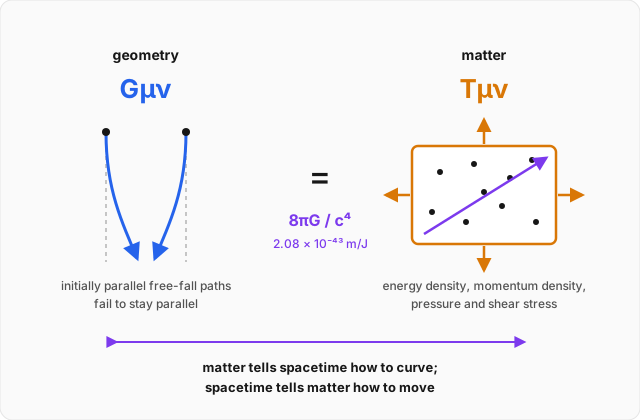
Spacetime tells matter how to move; matter tells spacetime how to curve
Wheeler's summary is the best one-sentence account of the theory, and now that both halves exist it can be stated precisely.
"Spacetime tells matter how to move" is the geodesic equation from the previous topic: given , the worldline of a free particle is fixed.
"Matter tells spacetime how to curve" is the field equations on this page: given , the metric is fixed (up to coordinate freedom and boundary conditions).
And the two statements are not independent, which is the part that makes general relativity hard in a way that no earlier theory on this site is hard. The field equations are nonlinear: curvature appears on the left in products, because and Riemann contains . So gravitational fields gravitate. You cannot add two solutions to get a third, the way you can superpose two solutions of Maxwell's equations. Worse, — the conservation law for matter — involves Christoffel symbols, hence the metric. So the source depends on the field it is sourcing. There is no "put in the matter, turn the crank, get the geometry" procedure in general; the matter distribution and the geometry have to be solved for together, self-consistently.
Which is why the exact solutions are so few, so precious, and so famous. Getting even one closed-form solution out of these equations was expected to take years. It took two months.
Worked example
Show by dimensional analysis that converts energy density into curvature, i.e. into , and evaluate it. Then estimate the spacetime curvature produced by the Sun's own energy density, and express the answer as a radius of curvature. (click to reveal the solution)
Setting up: the field equations assert . If that is to be an equation rather than a category error, the units on both sides must match. So the claim to be checked is
Why is the right target. Curvature always has these units, and the sphere from curved spacetime and the metric tensor shows why concretely: its Gaussian curvature came out as , with a length. Equivalently, the Riemann tensor is two derivatives of a dimensionless metric with respect to coordinates carrying units of length, so , and contracting with the dimensionless changes nothing. So .
Dimensions of the coupling. Newton's constant:
which you can read straight off : . And
Therefore
Dimensions of energy density. Energy is , so
Multiplying:
Every kilogram and every second cancels, and what is left is one over a length squared. The equation is dimensionally consistent, and the coupling constant is exactly a device for turning "joules per cubic metre" into "inverse metres squared" — energy content into shape. Equivalently, : metres of curvature per joule.
Its numerical value:
Read that number. Pour one joule of energy into one cubic metre of space and you buy of curvature — a radius of curvature of , about light-years, or twice the width of the Milky Way. This is why gravity is the weakest interaction by an absurd margin, and why it took until 1915 to notice spacetime was bent at all: the exchange rate between energy and geometry is .
Now the Sun. Its mean energy density is its total rest energy divided by its volume:
With and :
A hundred billion billion joules per cubic metre — an enormous energy density by any human standard. Feed it through the coupling:
A cross-check worth doing algebraically first. Substituting into the coupling gives
so the curvature scale is set by the ratio of a length (which the next topic will name the Schwarzschild radius) to the cube of the object's size. For the Sun , giving
identical to the direct computation, as it must be.
Turning curvature into a length. A curvature of corresponds to a radius of curvature
Interpretation. Spacetime inside the Sun is curved on a length scale of . Compare that to the Sun itself:
and to the solar system:
So the Sun — a body of generating by fusing hydrogen — bends spacetime on a scale comparable to the radius of Earth's orbit, some times its own size. Over any region small compared with , spacetime near the Sun is flat to within a part in tens of thousands. That is the quantitative content of "gravity is weak," and it is why every calculation in the solar system works beautifully in the weak-field limit, and why Newton's theory survived for years without anyone noticing that its central equation was wrong.
It also tells you what it would take to make curvature obvious: not more mass, but the same mass in a much smaller , since the curvature scales as . Squeeze the Sun's mass from down toward itself and the curvature radius comes down to the size of the object. That is a black hole, and it is the next topic.
Where this leads
The theory is now complete: geodesics say how matter moves in a given geometry, and the equations on this page say what geometry a given distribution of matter makes. Everything else in general relativity is consequences.
Getting those consequences is hard, because ten coupled nonlinear PDEs are hard, and the honest state of affairs is that exact solutions are rare. But the most important one arrived almost immediately. Impose spherical symmetry and vacuum ( outside the mass) and the equations become tractable — Karl Schwarzschild found the solution in December 1915, while serving on the Russian front, weeks after Einstein published. The Schwarzschild solution and black holes is that metric: it contains the correct light bending with the factor of two the equivalence principle could not supply, the precession of Mercury's perihelion, gravitational time dilation, and — lurking at a radius nobody initially believed was physical — an event horizon.
The other great consequence comes from going in the opposite direction: instead of looking for exact solutions, linearize. Write with small, keep only first-order terms, and the nonlinear monster becomes a wave equation of exactly the type classical field theory solved. That is gravitational waves, and the fact that the linearized equations look so much like the ones behind electromagnetic waves is not an accident — it is what a massless field with a conserved tensor source is bound to look like.