Take Maxwell's four equations and switch off the universe: no charges anywhere, ; no currents anywhere, . In empty space, with nothing left to source anything, it would be reasonable to expect the equations to just say and and stop talking. That is one solution. It is very much not the only one — and finding out what else is hiding in these four equations, with absolutely nothing put in by hand to make it happen, is one of the great moments in the history of physics.
Maxwell's equations with nothing left to source them
Set and in Maxwell's equations:
Look at what's left: no sources, but the two curl equations still couple and tightly together, each one's time derivative feeding directly into the other's circulation. A changing still generates a circulating (the displacement-current term, alone now that is gone); a changing still generates a circulating , exactly as Faraday found. Picture it as a hand-off: a bit of changing creates a ; that new , if it's changing too, creates a new next door; that creates the next bit of , and so on. Nothing here has to decay — this can, in principle, sustain itself indefinitely, propagating from each point in space to its neighbor, needing no charge and no current to keep it going once it's started. That self-sustaining hand-off is worth making completely precise, and it's exactly the kind of thing the wave equation from classical field theory was built to recognize.
Where this is heading
Special relativity opened with an emergency: Maxwell's equations produced one definite number, , as the speed of electromagnetic waves — not a speed measured relative to some medium, the way sound moves relative to air, but a number that came out of the field equations themselves, with no medium mentioned anywhere in their derivation. That mystery — a speed relative to what? — is precisely what forced Einstein to rebuild space and time from the ground up. The derivation below is the other half of that story: showing exactly how, and exactly where, that number actually comes from. It's sitting inside and the entire time — two constants originally measured in completely unrelated experiments, one from the force between current-carrying wires, the other from the force between static charges — and Maxwell's equations lock them together into a speed.
Worked example
Starting from Maxwell's equations in vacuum, derive the wave equation for by direct substitution, showing every step, and identify the wave's speed. (click to reveal the solution)
Setting up: start from Faraday's law in vacuum,
and take the curl of both sides:
The left side, using the standard vector identity for a double curl, , applied to :
In vacuum, Gauss's law gives , so the first term vanishes entirely, leaving
The right side: space and time derivatives commute, so the curl can be pulled inside the time derivative:
Now substitute the vacuum Ampère-Maxwell law, :
Equating the two sides:
Multiply both sides by :
Recognizing the result: this is exactly the wave equation, in the same form derived for a scalar field, , generalized from one spatial dimension to three (where is replaced by the full Laplacian ) and matched term by term with . Reading off the wave speed:
(An identical calculation, starting instead from the curl of the Ampère-Maxwell law and substituting Faraday's law, gives — the same equation, same speed, for .)
Checking the number: using and ,
Verifying with a plane-wave solution: try , propagating along . Substituting into the boxed wave equation exactly as the same check was carried out for the scalar field — two time derivatives bring down , two spatial derivatives bring down — gives
so : the wave's frequency and wavenumber are locked together by exactly the speed just derived, for every wavelength, from radio waves to gamma rays.
The number that started this whole crisis — no medium required to define it, no preferred frame anywhere in this derivation — is not an extra fact bolted onto electromagnetism. It is , sitting inside Maxwell's equations from the moment the displacement current was added, waiting to be read off. This is the same that walks into special relativity and refuses to add like an ordinary velocity — because it was never an ordinary velocity to begin with. It is a structural constant of the field equations themselves, the same in every inertial frame for the same reason and don't care which frame measured them.
Light is this
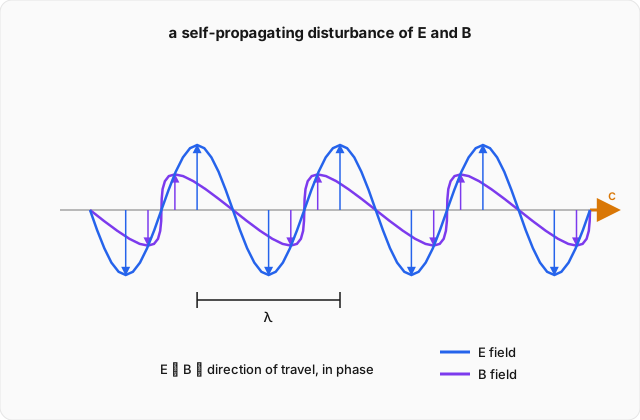
Once you accept that and satisfy a wave equation, the further properties of the wave follow from the same equations, not from any new assumption. Requiring for a plane wave forces to be perpendicular to the direction of travel — the wave is transverse, never longitudinal. Faraday's law then locks 's direction and phase to 's: the two fields oscillate together, in step, each perpendicular to the direction of propagation and perpendicular to each other, exactly as drawn above. And the speed of this disturbance, , matches — not approximately, not suggestively, but to every digit anyone has ever measured — the speed of light.
This is not a coincidence physics stumbled onto. It is the discovery that light is an electromagnetic wave: not a separate phenomenon that happens to travel at a suspicious speed, but literally a self-propagating disturbance of the same and fields that push on charges and deflect compass needles, oscillating too fast for the eye to see anything but a steady glow. Visible light, radio waves, X-rays, and gamma rays are all solutions of the same equation derived above, differing only in and — the same relation, all the way across the electromagnetic spectrum.
Where this leads
This branch of the track began with a spark jumping from a doorknob and ends with a derivation of light itself, both from the same four-letter alphabet: , , , . Classical field theory showed that a field's wave modes are, mathematically, an infinite collection of independent harmonic oscillators — and that quantizing even one such oscillator turns its energy ladder into a countable stack of identical quanta. Apply that same construction to the electromagnetic field derived here, and each rung of each mode's ladder is a photon — not a separate particle bolted onto the theory, but a single quantum of exactly the wave found above, described in full by quantum field theory. And because that same field equation carries the invariant speed discovered here into every inertial frame without alteration, it is also exactly the fact special relativity needed to get started. Two enormous branches of twentieth-century physics, both standing on the four equations assembled on this track — which is as good a place as any to stop and notice how much came from so little.