Two entirely separate stretches of this site's roadmap have been walking toward the same intersection without saying so. One stretch derived, from Maxwell's four equations and nothing else, that empty space can carry a self-sustaining wave of and fields, moving at speed — and identified that wave as light itself, in electromagnetic waves. The other stretch took an abstract scalar field, decomposed it into independent oscillator modes, and showed that quantizing one such oscillator turns a smooth classical wave into a countable stack of discrete quanta, in quantum field theory. Put those two results next to each other and the next move stops being a choice — it's almost forced. Take the electromagnetic field, whose wave equation is already sitting there proven, and run it through the exact quantization machine already built and checked. What comes out the other side is quantum electrodynamics (QED): the quantum theory of light and its interaction with charged matter, and the single most stringently tested physical theory human beings have ever produced.
The photon is not a new assumption
Here is the entire logical chain, and every link in it was already forged earlier in this track.
Electromagnetic waves showed that in vacuum, each Cartesian component of (and of ) satisfies
with the further constraint that a plane-wave solution must be transverse — perpendicular to the direction of travel — a direct consequence of in vacuum. Compare this to the free scalar field's equation of motion from quantum field theory, the Klein-Gordon equation . Set the mass to zero and rearrange: — with in the natural units used throughout that topic, this is exactly the same equation the electric field satisfies. Every Cartesian component of the electromagnetic field, in vacuum, obeys the massless wave equation — the special case of the very equation that topic quantized in full.
That is the whole trick, stated honestly rather than dressed up: quantizing the electromagnetic field means running the identical construction — expand in normal modes, promote the mode amplitudes to operators, impose — a second time, on a field that already satisfies the equation that machine was built for. Two real complications appear along the way that a full course works through carefully and that are worth naming honestly rather than skating past: the field being quantized is really the four-component vector potential , not directly, and Maxwell's equations have a built-in redundancy (gauge freedom) that has to be fixed by a choice of gauge before the mode expansion is unambiguous; and only two of the naively available polarization directions turn out to be physical, matching the transverse-only result already derived in electromagnetic waves. Carrying that gauge-fixing through rigorously is a genuine topic of its own, beyond what belongs here — but the endpoint is clean enough to state precisely. The quantized Hamiltonian comes out looking exactly like the scalar field's, with a sum over two transverse polarization states added on top of the sum over momentum modes:
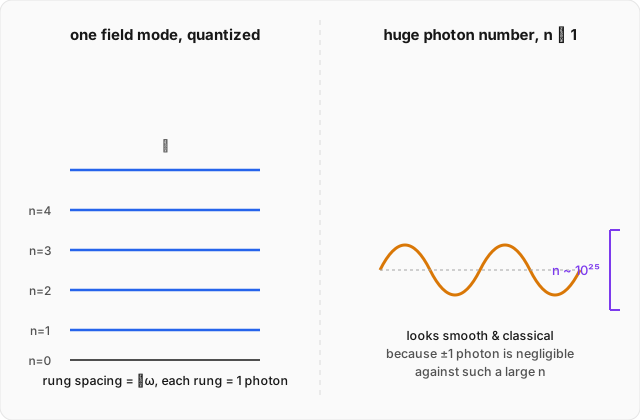
Compare this term by term with the single-oscillator result from the quantum harmonic oscillator, and with the scalar field's from quantum field theory: it is the identical structure, one oscillator ladder per mode, now with a mode meaning "this wavevector , in this one of two transverse polarization directions." Acting with on the vacuum builds a one-quantum state of the electromagnetic field — a state with energy and momentum , satisfying , the special case of . That state is the photon. It is not an extra particle bolted onto Maxwell's equations after the fact; it is one rung climbed on one polarization's oscillator ladder, in exactly the sense quantum field theory already made precise for the scalar field, and in exactly the sense the ladder operator of the quantum harmonic oscillator first made precise for a single spring.
Where the electron comes in — and where this is heading
QED is not only a theory of free photons; free photons alone would be exactly as inert as the free scalar field of interacting fields and perturbation theory — no scattering, no absorption, no emission. The rest of QED adds a second field, describing the electron, and a specific interaction term coupling the two fields together — drawn, in the language of Feynman diagrams, as a vertex where one electron line, one outgoing (or incoming) electron line, and one photon line all meet at a point. What makes QED remarkable is that this interaction term is not chosen freely, the way the toy coupling was chosen freely in the last two topics. It is forced, uniquely, by a symmetry principle — and uncovering that principle, and watching it generate the interaction rather than assuming it, is the entire subject of the next and final topic of this track.
What can be said honestly here, without yet deriving that interaction term, is what it buys once it's in hand: a complete, calculable, diagrammatic theory of how light and charged matter push on each other — light scattering off electrons, atoms absorbing and emitting photons, electrons repelling each other by trading virtual photons back and forth. And when that machinery is pushed to high enough order in the Feynman-diagram expansion built in the previous topic, QED becomes the most accurately verified theory in the history of physics. Its most famous triumph is the electron's magnetic moment: a quantum electron behaves, in a magnetic field, like a tiny bar magnet with strength proportional to a number called its -factor, and simple theory predicts exactly. QED's correction — computed as a perturbative series in the electron's coupling to the photon field, order by order, exactly as interacting fields and perturbation theory built the machinery to do — pushes that number very slightly above , and the correction has been calculated out to several loops of Feynman diagrams and measured in the laboratory. Theory and experiment agree to about one part in a billion: a level of precision often compared to measuring the distance between New York and Los Angeles accurate to the width of a human hair. Very few quantitative predictions in the physical sciences have ever been checked this precisely. That agreement is not a decoration on top of the formalism built across this entire quantum track — it is the payoff of it, the concrete, numerical proof that treating a particle as a quantum of a field, and computing its properties order by order in a perturbative expansion built from Feynman diagrams, describes nature exactly.
Worked example
A green laser pointer emits light of wavelength at a power of . Find the energy of a single photon, the number of photons emitted per second, and use that number to explain why the beam looks like a smooth, continuous classical wave to the eye. (click to reveal the solution)
Setting up: each photon of this light carries energy , where . So
Computing the single-photon energy. Using , , and :
Converting to electron-volts (dividing by ) as a sanity check against familiar atomic-physics numbers:
a thoroughly ordinary number for visible light — right in the range of a typical atomic transition energy, exactly as it should be.
Counting photons per second. A power of delivered in packets of each means a photon emission rate of
Interpreting the scale of that number. Even the fastest photodiodes used in laboratories resolve time to roughly a nanosecond (). In that single nanosecond, this "weak," pocket-sized, one-milliwatt laser still emits
two and a half million individual quanta arriving within a single tick of the fastest clock a benchtop instrument can resolve. No detector, and certainly no human eye (whose response time is measured in tens of milliseconds, ten million times slower still), has any chance of resolving the discreteness of individual photon arrivals at this rate; the individual clicks blur into what looks, for every practical purpose, like a perfectly smooth, continuous flow of energy — the classical electromagnetic wave electromagnetic waves derived directly from Maxwell's equations, with no photon anywhere in that derivation.
The resolution of an apparent contradiction. This is exactly the same relationship as the right-hand panel of the figure above: a "classical-looking" field is not a different kind of object from a photon field — it is a photon-field state sitting on an almost unimaginably high rung of the oscillator ladder, with such an enormous number of indistinguishable quanta present that the -photon graininess of any single emission or absorption event is a vanishingly small fractional fluctuation, invisible against the overwhelming average. Turn the power down far enough — to single photons arriving one at a time, seconds apart, as in the opening thought experiment of the introduction to quantum mechanics — and the graininess is exactly what shows up as individual clicks on a detector. Nothing about light changed between the two descriptions. Only the photon number did.
Where this leads
Quantum electrodynamics is not the end of this quantum track — it is the proof that everything built along it actually works, checked against nature to more decimal places than any other theory in physics has ever been checked. What remains is the deepest question of all: why does the interaction between the electron field and the photon field take exactly the form that makes all of this true, rather than some other form? Gauge symmetry and the Standard Model answers that question — and, in doing so, closes the entire roadmap this site has been building since a single falling ball.