Coulomb's law handed us something new: a field, , a vector attached to every point in space. An ordinary derivative answers "how fast is this changing, along this one path through time?" But a field doesn't live on a single path — it's spread through three dimensions at once, and "how is it changing?" stops being one question and splits into several genuinely different ones. Is it getting bigger in some direction? Is it flowing outward from this point, like water from a spring? Is it circulating around this point, like water in a whirlpool? These are three different physical questions, and it would be a strange coincidence if one number could answer all three. It can't — and building the right tool for each is the entire content of this topic.
The del operator
Collect the three partial derivatives into a single symbol, written ("del" or "nabla"):
Treat this as a strange kind of vector — not a vector of numbers, but a vector of instructions, each one waiting for something to differentiate. What makes worth naming is that there are exactly three sensible ways to combine it with a field, and each one turns out to be exactly the tool needed for one of the three questions above.
Gradient: which way is "more," and by how much
Apply to a scalar field — a single number at every point, like temperature or altitude — by ordinary-looking multiplication:
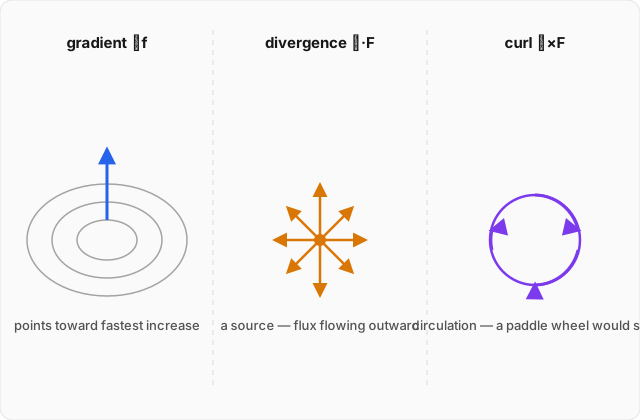
This is the gradient, and unlike itself, it's a vector: at every point it points in the direction increases fastest, and its magnitude is the rate of that increase. Standing on a hillside described by a height function , points directly uphill, steepest-path-first — which is also exactly the direction water would not flow, since water always moves toward .
The gradient also unifies something you might not have noticed was fragmented: the rate of change of in any direction (not just along the coordinate axes) is simply
Every partial derivative you've ever taken, , , and so on, is just this formula applied to , — a special case of a single, more general statement.
Divergence: is this point a source or a sink?
Apply to a vector field using the dot product:
This is the divergence, and it turns a vector field back into a scalar — one number per point, answering: is this point a net source of the field, a net sink, or neither? Picture as the velocity field of a fluid. A positive divergence at a point means more fluid is flowing out of a tiny volume around that point than flowing in — as if fluid were being created there, a literal source. A negative divergence means fluid is disappearing, a sink. Zero divergence everywhere means the fluid is incompressible: whatever flows into any small region flows back out again, with nothing left over.
Curl: is this point circulating?
Apply to a vector field using the cross product:
This is the curl, and it turns a vector field into another vector field, measuring circulation. Drop an imaginary tiny paddle wheel into the fluid at a point: if the surrounding flow makes it spin, the curl is nonzero there, pointing along the wheel's spin axis (by the right-hand rule), with magnitude proportional to how fast it spins. A field with zero curl everywhere has no local "swirl" anywhere, even if the field itself is large or complicated.
The connection you already half-know: conservative forces
Here is a fact that reaches back and makes something from work and energy precise. That topic defined a conservative force as one whose work depends only on start and end points, never on the path — and showed that such forces can always be written as for a potential energy function . Vector calculus now lets us state exactly which vector fields have this property:
A curl-free field is exactly a field that can be written as the gradient of some scalar potential (in any region without holes in it — a technicality worth knowing exists, not worth dwelling on here). "Path-independent work" and "zero circulation everywhere" turn out to be the same statement, seen from two different angles. This is exactly the property Coulomb's law's electric field will turn out to have for static charges — which is precisely why an electric potential can be defined for it, the same way gravitational and spring potential energy were defined earlier in this track.
Worked example
A rotating disk has velocity field . Find its divergence and its curl, and interpret both physically. (click to reveal the solution)
Setting up: identify the components: , , .
Divergence:
The divergence is zero everywhere. Physically: rigid rotation doesn't create or destroy fluid anywhere — every bit of fluid just moves along a circle, so nothing accumulates or vanishes at any point. This is exactly the kind of incompressible flow divergence is built to detect.
Curl, computing each component of :
Interpreting the result: the curl is nonzero, constant, and points along the -axis — exactly the rotation axis of the disk. Check that really is a rotation: at the point , , pointing in — consistent with clockwise motion when viewed from the axis looking down, which is rotation with angular velocity (using the standard convention that positive means counterclockwise viewed from ). For any rigid rotation with angular velocity , a general result (not derived here) states — and indeed, , exactly matching what the direct computation gave. The paddle wheel would spin at exactly twice the disk's own angular velocity, an artifact of how curl is normalized, and its axis would point straight down the direction — precisely because the disk itself rotates that way.
Where this leads
Gradient, divergence, and curl are not three unrelated tricks — they are the complete vocabulary needed to write down a field theory. Classical field theory already needed spatial derivatives of a field to write the field Euler-Lagrange equation; from here on, gradient, divergence, and curl are how those derivatives get organized into the actual laws governing real physical fields. The next topic in this track builds the remaining tools — line, surface, and volume integrals, and the theorems (Stokes', divergence) that connect them to what's been built here — and together they are precisely the mathematical language in which the laws of electricity and magnetism are written.