In 1783 the English clergyman John Michell did a calculation that had no business working.
He took Newton's escape velocity, the speed a projectile needs to leave a body of mass and radius and never come back,
and asked what happens if you shrink . The escape velocity grows without bound. So there must be a radius at which it reaches the speed of light. Setting and solving,
Michell reasoned — on the corpuscular theory of light then in fashion — that light leaving such a body would be dragged back down, and the object would be invisible. He called them dark stars. Laplace repeated the argument in 1796, and then the whole idea was quietly dropped when light turned out to be a wave, because you cannot sensibly ask about the "escape velocity" of a wave.
Every step of that reasoning is wrong. Light is not a Newtonian corpuscle; it does not decelerate as it climbs; the energy relation makes no sense for something with no rest mass; and gravity is not a force. And yet the number
is exactly, to the last digit, the radius at which general relativity says something extraordinary happens. Not approximately. Exactly. This is one of the strangest coincidences in physics, and before this page is over it will be clear why the two calculations agree numerically while sharing no physical content whatsoever — the ratio and the ratio turn out to be the same quantity, and that is not an accident of the algebra.
The metric
Karl Schwarzschild was , a professional astronomer, and serving in the German army on the Russian front computing artillery trajectories when Einstein's field equations were published in November 1915. He read them, solved them, and posted the solution to Einstein in December. Einstein, who had expected exact solutions to be years away, presented it to the Prussian Academy in January. Schwarzschild died of an autoimmune disease contracted at the front in May 1916.
The problem he solved: find the metric outside a static, spherically symmetric mass , in vacuum. Outside the mass , so the field equations reduce to . The answer, in coordinates :
with .
On the honesty of that boxed line: I have written it down, not derived it. The derivation is not conceptually beyond this track — you posit the most general static spherically symmetric form , grind out all the Christoffel symbols, assemble , set it to zero, and find that the equations force and then , with the constant fixed by matching Newtonian gravity far away. But "grind out all the Christoffel symbols and assemble " is several pages of error-prone tensor algebra using a Riemann tensor this track has only quoted. Rather than fake it, I will state the result and then verify it against everything we have already established independently — which is a real test, and it will pass.
There is also a remarkable theorem here, Birkhoff's theorem (quoted, not proved): this is the unique spherically symmetric vacuum solution, and it is automatically static even if the source is not. A radially pulsating star produces exactly this metric outside itself, unchanged, with no time dependence at all. There is no spherically symmetric gravitational radiation — a fact that will matter enormously for gravitational waves. Note also that enters only through : the exterior geometry does not care whether the mass is a diffuse cloud, a dense star, or a black hole.
Four checks on the answer
Check 1: does it reduce to flat spacetime far away? As , and the metric becomes
which is Minkowski spacetime in spherical polar coordinates — the flat interval from special relativity with the spatial part written in polars exactly the way tensor calculus did it for the plane. ✓
Check 2: is the angular part the sphere we already built? Look at the last bracket:
That is verbatim the metric of a sphere of radius derived in curved spacetime and the metric tensor, with . Which is what spherical symmetry has to mean: the spacetime is a nested stack of two-spheres, and the geometry on each one is the ordinary round geometry. ✓
This also fixes the meaning of , and it is not what you would guess. is not the distance to the center. It is defined by the area of the sphere at that location: a sphere labelled has area , exactly as in flat space, because the angular part of the metric is exactly the flat one. Radial distances are a different matter — the proper distance between two nearby shells is
so measured radial distance always exceeds the difference in labels. Space is stretched radially. That stretching is precisely the spatial curvature that the equivalence principle's accelerating box could not see, and it is where the missing factor of two in the light deflection lives.
Check 3: does the weak field reproduce Newton? Expand for :
with , the Newtonian potential of a point mass. This is exactly the metric that geodesics had to posit by hand, and from which the geodesic equation was shown to yield . That posit is now discharged: it was the weak-field limit of an exact solution all along. ✓
Check 4: what is , physically? Compute the Newtonian escape velocity at radius and square it:
The dimensionless number governing the Schwarzschild metric is precisely the squared escape velocity in units of . That is why Michell's calculation landed on the right radius: he was computing the right dimensionless combination for entirely wrong reasons. ✓
Clocks: the gravitational analogue of time dilation
Now for the physics, and the cleanest place to see it is a clock.
Take an observer holding station at fixed — hovering, engines burning, not falling. Along their worldline , so the interval is entirely temporal:
Using from geodesics,
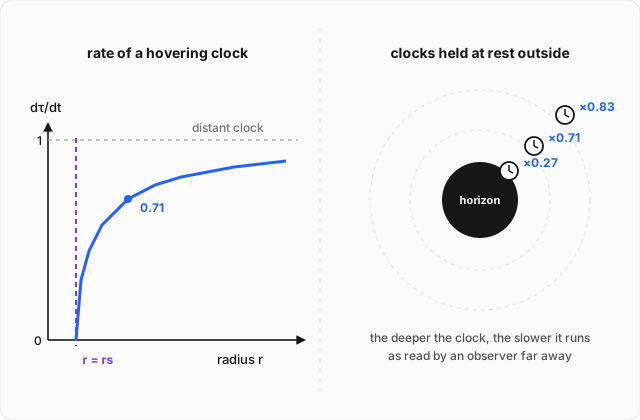
Here is the time the hovering observer's own clock reads, and is the coordinate time — which, because at infinity, is exactly the proper time of an observer infinitely far away. So this equation compares a local clock to a distant one, and the conclusion is that the local clock runs slow, by the factor , and slower the deeper it sits.
Set this beside the velocity time dilation from special relativity, which found , or equivalently
The two formulas are the same formula. Using Check 4,
A clock sitting still at radius in a gravitational field ticks slow by exactly the factor a clock moving at the local escape velocity would. This is a genuine structural identity, not a mnemonic, and it puts the two kinds of time dilation into one frame: in the velocity case the metric is flat and your worldline is tilted; in the gravitational case your worldline is as vertical as it can be and the metric itself has changed. Both are the same statement — that proper time is a length in spacetime, and lengths depend on the geometry and the path.
The frequency version recovers the equivalence principle result. A photon emitted at with frequency and received at arrives with
redshifted, since counting wave crests is timing a clock. In the weak field, expanding both roots to first order in :
which is the Pound-Rebka shift derived from the accelerating box in the first topic of this track, now falling out of an exact solution of the field equations. ✓
This is not an exotic effect. Every satellite navigation system corrects for it continuously. A GPS satellite orbits at ; relative to a clock on Earth's surface at , the gravitational term gives a fractional rate difference
so the satellite clock runs fast by per day. Its orbital speed of gives a velocity time dilation of per day, so the net is per day. Uncorrected, that error accumulates into a position error of per day. The satellites' onboard oscillators are deliberately offset before launch to compensate. General relativity is load-bearing infrastructure.
The horizon
Now look at what happens as . The factor goes to zero, and the metric does two alarming things at once:
Clocks stop and radial distances blow up. For decades this was read as a physical singularity, a place where the theory broke down and matter could not go — Einstein himself did not believe the region inside was physical.
It isn't a physical singularity. It is a coordinate singularity, the same species of pathology as the north pole in latitude-longitude coordinates, where all lines of longitude collide and becomes meaningless while the sphere itself is perfectly smooth. The way to tell the difference is to compute a scalar built from the curvature, since a scalar is coordinate-independent by construction. The standard one is the Kretschmann scalar, and for Schwarzschild it is (quoting the result)
At this is — a perfectly finite number, and a small one for a large black hole. Nothing physical goes wrong at the horizon; tidal forces there are gentle for a supermassive black hole. Coordinates that cross the horizon smoothly do exist (Eddington-Finkelstein, Kruskal-Szekeres), and in them the metric is unremarkable at .
At , on the other hand, the scalar diverges. That is a real singularity, where curvature genuinely becomes infinite and general relativity stops being able to say anything.
So what is the surface ? It is an event horizon: a one-way surface. Nothing that crosses inward can ever return, not because the "pull" is too strong to fight, but because inside every future-directed timelike path leads to smaller . There are no outward-pointing futures. Going back out would require moving in a direction that is not in your future light cone, which is the same kind of impossible as travelling faster than light.
That statement I can motivate but not properly demonstrate here, and I want to flag the gap. In Schwarzschild coordinates you can see the warning: for the sign of flips, so becomes positive and becomes negative, meaning has become a spacelike coordinate and a timelike one. Advancing in inside the horizon is as unavoidable as advancing in outside it. But because these coordinates break down exactly at the surface in question, an argument conducted in them is not airtight; establishing the one-way property rigorously requires horizon-crossing coordinates, and that is beyond this page.
One more consequence worth stating precisely, because it is usually stated wrongly. As an object falls toward the horizon, a distant observer sees its light arrive ever more redshifted and its apparent clock ever slower, asymptotically freezing at the horizon and fading to invisibility — the light does not stop arriving at some final moment, it just red-shifts and dims exponentially. But the infalling observer experiences nothing of the kind. Their own proper time to reach the horizon and then the singularity is finite and short. There is no moment at which they notice a horizon going by. "Time stops at the horizon" is a statement about a distant observer's coordinates, not about anybody's clock.
Worked example
Compute the Schwarzschild radius of the Sun, of the Earth, and of a person, and find the density each would need to be squeezed to. Then evaluate the gravitational time dilation at Earth's surface in milliseconds per year, and at outside a black hole. (click to reveal the solution)
Setting up: everything comes from , so start by evaluating the constant prefactor once:
That number is the whole story of why black holes are hard to make: one and a half billionths of a billionth of a billionth of a metre per kilogram.
The Sun ():
Three kilometres. The Sun's actual radius is , so — the horizon radius is smaller than the star by a factor of . To make the Sun a black hole you would need to compress it to a density
Compare with nuclear matter, : about times the density of an atomic nucleus. (This is why the Sun will never become a black hole — it is far too light. Nature makes stellar black holes only from stars above roughly solar masses, where nothing can hold the core up.)
The Earth ():
The entire Earth's event horizon would be a sphere the size of a large marble. Every mountain, ocean, and continent, inside .
A person ():
Ten orders of magnitude smaller than a proton — though still times larger than the Planck length , so this is not a quantum-gravity question, just an absurdly impractical one.
Time dilation at Earth's surface. Using and :
Sanity check against Check 4 above: Earth's escape velocity is , and . ✓ Identical, as the identity demands.
Since , expand:
Over one year (), a clock on Earth's surface falls behind a clock at infinity by
Twenty-two milliseconds per year. Everyone reading this is ageing about a fiftieth of a second per year more slowly than someone in deep space. Modern optical clocks have fractional stabilities near , nine orders of magnitude better than the effect computed here — which is why gravitational time dilation is now measurable over a height difference of a few centimetres on a laboratory bench.
Hovering just outside a black hole. Take :
Your clock runs at of the distant rate: spend one year hovering there and ten years pass far away. At the factor is , and at it is — already within of normal, which shows how quickly the effect dies off. Black holes are not cosmic time machines at a distance; they are extreme only within a few horizon radii.
Interpretation. Two things are worth taking away. First, the numbers are small everywhere in ordinary life — at Earth's surface — which is exactly why Newtonian gravity worked so well for so long, and is the same conclusion the curvature estimate for the Sun reached from the other direction. Second, nothing in says a black hole must be massive or exotic; it says a black hole is what you get when mass is confined inside its own . The barrier is never mass, it is compactness. The Sun's horizon radius is smaller than a small city; the Earth's is a marble. The universe manages this only where gravity has nothing left to fight it — the collapsing core of a dying massive star, or the centre of a galaxy given billions of years to accumulate.
Where this leads
The Schwarzschild solution is where general relativity stopped being philosophy and started making numbers. Its geodesics — which is to say, its answer to "how does matter move here?" via the geodesic equation — give the perihelion precession of Mercury at arcseconds per century, which had been an unexplained anomaly for years and which Einstein computed in a week; the deflection of starlight at , the value Eddington measured in 1919 and exactly twice what the equivalence principle alone could account for, with the missing half supplied by the radial stretching identified above; the Shapiro delay of radar signals grazing the Sun; and the innermost stable circular orbit at , inside which no orbit exists at all.
Black holes themselves are now routine astronomy rather than speculation: stellar-mass ones inferred from X-ray binaries, a one at the centre of the Milky Way tracked by watching stars orbit it for three decades, and direct images of the horizon-scale shadows of the black holes in M87 and Sagittarius A*.
One thing the Schwarzschild solution deliberately cannot describe is anything that changes. It is static by construction, and by Birkhoff's theorem it is static necessarily, so long as spherical symmetry holds. Break the symmetry — two black holes orbiting each other, a star collapsing asymmetrically, any mass distribution whose shape genuinely changes in time — and the geometry must be dynamical. Ripples in itself must propagate outward, and since the field equations linearize into a wave equation of exactly the kind classical field theory solved, they must propagate at . That is gravitational waves, and the loudest source in the sky turns out to be two of the objects introduced on this page, spiralling into each other.